Ireland Graduate Jobs on LinkedIn: How to Search Beyond Dublin
A practical LinkedIn search guide for Irish students and graduates targeting Cork, Galway, Limerick, Dublin and regional graduate roles.
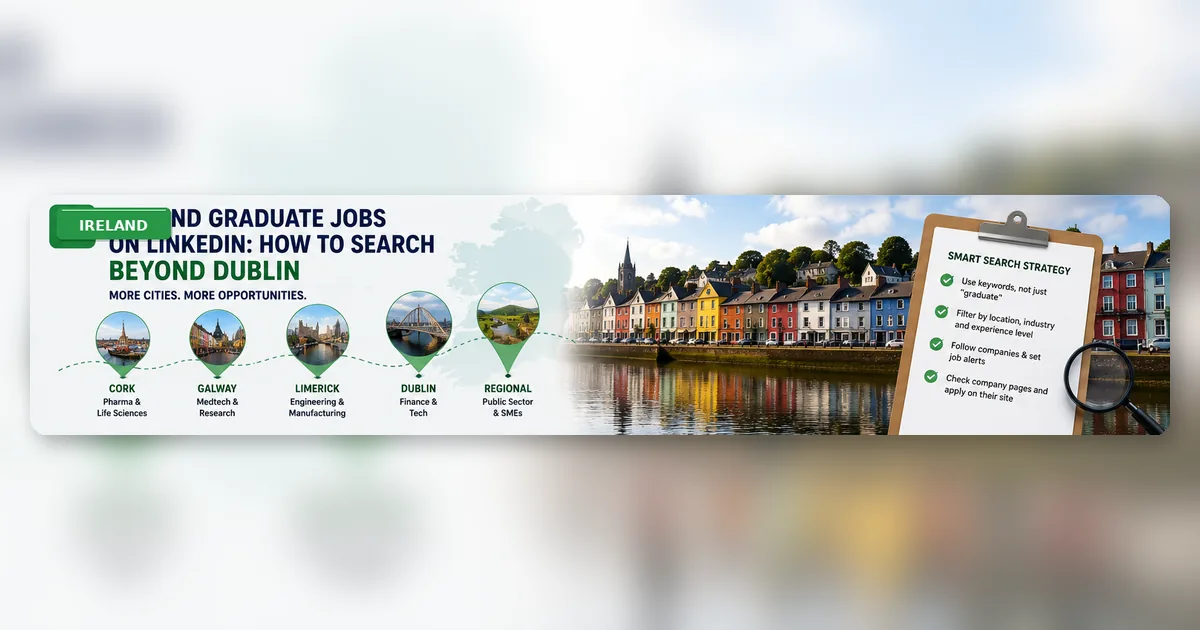
If your Ireland graduate job search is only “Dublin + graduate”, you are probably missing useful roles.
Dublin matters. It has finance, technology, consulting, public bodies, professional services and headquarters roles. But Ireland’s graduate market is not only Dublin. Cork, Galway, Limerick, Waterford, Athlone, Sligo and other regional centres can all matter depending on your field.
LinkedIn can help you find those roles, but only if you search by region, sector and role language rather than relying on one broad keyword.
Build a regional search, not a Dublin-only search
Use LinkedIn to discover employers and role language, not just vacancies.
A useful Ireland search combines four things:
- location or region;
- sector cluster;
- role family;
- graduate-friendly title pattern.
For example, “graduate Cork” is too broad. A stronger search might be:
quality engineer graduate Corkprocess engineer entry level CorkQC analyst graduate Corkmanufacturing science technology graduate Corkregulatory affairs associate Cork
For the wider market picture, read GradSharp’s guide to the 2026 Irish graduate market. If your search is sector-led, also compare the pharma graduate jobs guide and the Trinity vs UCD employer signal guide.
Why Dublin-only searching narrows your options
Dublin searches are crowded. They also push every field into the same visible graduate-scheme funnel.
That can hide useful routes:
- Cork pharma, biopharma and engineering roles;
- Galway medtech and device roles;
- Limerick and Mid-West manufacturing, engineering and operations roles;
- regional public-sector, education, local authority and SME roles;
- hybrid roles attached to offices outside Dublin.
The HEA Graduate Outcomes Survey for the Class of 2024 reported that most surveyed graduates were working or due to start work nine months after graduation. That does not mean every region is easy. It means you should search more intelligently before assuming all good options are in one city.
The Ireland LinkedIn search framework
Step 1: pick a region
Do not start with the whole country. Pick one region and learn its employer map.
Examples:
- Cork and wider Munster;
- Galway and the West;
- Limerick and the Mid-West;
- Dublin and commuter counties;
- Waterford and the South East;
- Athlone and the Midlands.
Step 2: add a sector cluster
A city name alone is weak. Add sector language.
| Region | Sector words to test |
|---|---|
| Cork | pharma, biopharma, manufacturing, process, quality, supply chain |
| Galway | medtech, device, quality, regulatory, R&D, software |
| Limerick | engineering, manufacturing, automation, operations, supply chain |
| Dublin | finance, consulting, technology, public policy, analytics, audit |
| Regional / SME | project officer, administrator, coordinator, assistant, analyst |
These are not the only sectors. They are starting points.
Step 3: add role-family language
“Graduate” is only one label. Employers may use:
- assistant;
- associate;
- junior;
- trainee;
- analyst;
- coordinator;
- technician;
- engineer I;
- administrator;
- officer.
A student who searches only “graduate programme” may miss a practical first job.
Step 4: search people
People search often teaches you more than job search. Look for recent graduates working in your target region and sector.
Check:
- their degree background;
- first job title;
- employer names;
- whether they moved cities;
- internships or part-time work they had;
- skills they list repeatedly.
Do not copy one person’s path. Look for patterns.
Step 5: move to employer careers pages
Once you find employers, do not stop on LinkedIn. Go to the careers page. Check whether the role is live, whether the location is correct, and whether the deadline or requirements differ from the LinkedIn advert.
Search strings to copy and adapt
Cork
graduate quality engineer CorkQC analyst graduate Corkprocess engineer entry level Corkbiopharma graduate Corkvalidation engineer junior Corksupply chain graduate Cork
Galway
graduate medtech Galwayquality engineer Galway entry levelregulatory affairs associate GalwayR&D engineer graduate Galwaysoftware graduate Galwaymanufacturing engineer Galway
Limerick and Mid-West
automation engineer graduate Limerickprocess engineer Limerick graduateoperations analyst Limerickmanufacturing graduate Limericksupply chain coordinator Limerick
Dublin
finance graduate Dublin analystaudit graduate Dublintechnology analyst graduate Dublinpolicy analyst junior Dublinmarketing coordinator graduate Dublin
Regional public-sector and SMEs
project officer graduate Irelandassistant analyst regional Irelandjunior administrator Cork Galway Limerickgraduate trainee SME Irelandprogramme officer Ireland graduate
How to filter without missing good roles
LinkedIn filters are useful, but over-filtering is risky. If you select only “entry level”, only “graduate”, only “remote” and one city, you may remove jobs that are relevant but labelled differently.
A better approach:
- search broadly;
- save role titles;
- search again using those titles;
- filter later;
- verify on employer pages.
Employer maps and sector clusters create leverage
Employer maps matter. Knowing twenty employers in Cork or Galway is more useful than refreshing the same three graduate boards.
Role language matters. “Associate” or “technician” may be the entry point.
Commute and location matter. A role that looks hybrid may still require office presence.
Sector clusters matter. Regional job search works best when you know why employers are there.
Prestige labels and Dublin-only thinking add less
A perfect “graduate scheme” label matters less than a genuine first professional role. A famous employer matters less than a role that builds relevant evidence. A Dublin address matters less than a realistic route into the sector you actually want.
Weekly regional routine
One hour per week is enough if you do it properly.
| Time | Task |
|---|---|
| 15 minutes | Search one region and one sector. |
| 15 minutes | Save five employers and role titles. |
| 15 minutes | Check people profiles for recent hires. |
| 15 minutes | Move to employer careers pages and record next actions. |
Keep a spreadsheet. Otherwise the same employers will feel new every week.
Run a regional search experiment
Hour one: choose two regions. One can be Dublin, but the second should be outside Dublin.
Hour two: build a role-title list for each region.
Hour three: search people and recent hires.
Hour four: check employer sites.
Day two: apply to one role, save five employers and write down three search strings that worked better than “graduate jobs”.
FAQ
Are most Irish graduate jobs in Dublin?
Dublin has a large share of visible graduate opportunities, but it is not the only market. Regional roles can be easier to find when you search by sector and role family.
Is LinkedIn good for finding graduate jobs in Ireland?
Yes, if you use it for employer discovery and role language. It should not replace employer sites.
What should I search for if “graduate” gives weak results?
Try assistant, associate, junior, trainee, analyst, coordinator, technician, engineer I and administrator.
How do I find SME opportunities?
Search by role function and region, not only by graduate schemes. SMEs may not label roles as graduate programmes.
Should I message alumni in regional roles?
Yes, if your question is specific and respectful. Ask about role titles, sector entry points or how they found the first role.
Source-checked notes
Checked on 15 June 2026 against HEA Graduate Outcomes, CSO labour-market context, IDA Ireland regional and sector material, Ireland for Finance regional notes and LinkedIn Help. Search strings are editorial examples, not live job counts.