GOIPG Funding Applications Explained: What International Students Get Wrong in Ethics and Data Management Sections
GOIPG applications do not only fail on the research idea. Learn how to write stronger ethics, data management and compliance sections.
Most GOIPG applicants spend their energy on the obvious parts of the application.
The research question. The literature gap. The methodology. The supervisor match. The university.
Those sections matter. But they are not the only places where the application is being judged.
The quieter risk is in the sections many applicants treat as admin: ethics, data management, sex/gender dimension, research governance and compliance. These sections look secondary because they are shorter. In practice, they tell reviewers whether your project can actually be carried out inside an Irish research institution.
That is the real point.
A Government of Ireland Postgraduate Scholarship application is not only asking whether your idea is interesting. It is asking whether your research can be funded, supervised, governed, stored, reviewed, shared where appropriate and completed without creating avoidable legal or institutional risk.
The mistake international applicants often make is writing these sections as promises:
Ethical approval will be sought if required. Data will be anonymised. Data will be stored securely. FAIR principles will be followed.
That sounds safe. It is usually weak.
A stronger application shows that you already understand the research reality: who or what is being studied, what data will exist, what risk it creates, who will see it, where it will be stored, whether it can be shared, and what will happen if it cannot be shared.
This article explains how to approach the GOIPG ethics and data management sections as part of the proposal, not as a box-ticking exercise.
For the broader scholarship overview, read GradSharp’s main guide to the Government of Ireland Postgraduate Scholarship. This article is narrower: it focuses on the ethics, data management, sex/gender dimension and compliance sections that applicants often underwrite.
The compliance problem in one view
The ethics and data management sections are not filler.
They are where reviewers see whether your project is operationally credible.
Research Ireland’s 2026 GOIPG Call Document says that, after submission, proposals are checked for compliance with mandatory criteria, including whether all sections are complete, uploads are appropriate and endorsements are complete. Applications identified as ineligible at that stage are withdrawn without review. It also says Research Ireland policies relevant to applicants include research integrity, data protection, open research and data management. Research Ireland 2026 GOIPG Call Document
The 2026 indicative applicant form asks applicants to provide an ethical statement explaining the careful consideration given to ethical implications and how those issues will be addressed over the award. It also asks for a data management plan covering how data will be shared or made accessible for verification and reuse, how it will be curated and preserved, how it will be made FAIR where applicable, and why data cannot be made available if sharing is not possible. Research Ireland 2026 indicative applicant form
So the aim is not to sound compliant. The aim is to show that your project already has a workable compliance logic.
A good ethics section answers: what could go wrong, who could be affected, and what controls are in place?
A good data management section answers: what data will exist, who controls it, how it is protected, what can be shared, and what cannot?
Where GOIPG compliance fits in the application
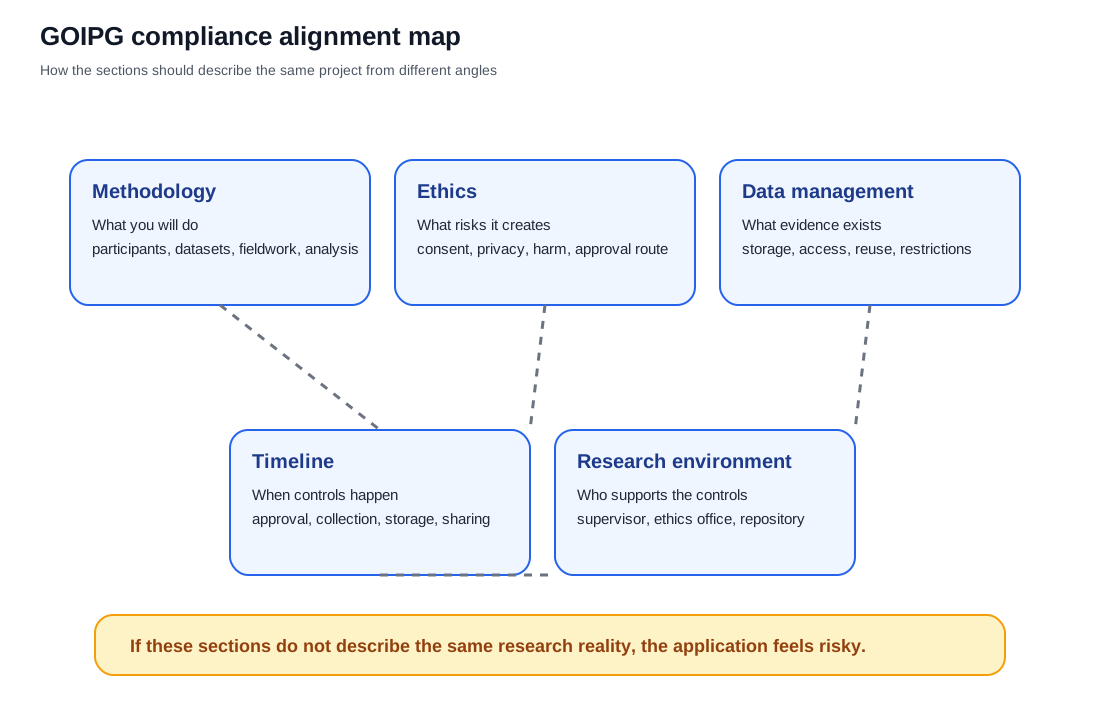
Chart source status: Illustrative synthesis based on Research Ireland 2026 GOIPG call and application-form requirements.
The most useful way to think about these sections is as an alignment system.
Your methodology says what you will do. Your ethics section says what risks that creates and how you will handle them. Your data management plan says what data will be created and how it will be stored, protected, shared or restricted. Your timeline says when the work can realistically happen. Your supervisor and research environment section says who can support the process.
If those sections do not describe the same project, reviewers notice.
For example, a proposal might say it will conduct 40 interviews with migrant workers. The ethics section then says only that “ethical approval will be sought if required.” The data management section says “all data will be shared openly.” The timeline has fieldwork starting immediately in month one.
That is not just weak writing. It is a project-risk signal.
The methodology implies human participants and potentially sensitive personal data. The ethics section does not show consent, recruitment or risk planning. The data statement may be inappropriate if interview transcripts could identify participants. The timeline may not allow time for institutional ethics approval.
A reviewer does not need to dislike the topic to downgrade confidence. The sections themselves create doubt.
What the ethics section is actually testing
Many applicants read the ethics section as a moral declaration: “My project will be ethical.”
That is too vague.
The ethics section is really asking whether you understand the harms, permissions and safeguards attached to your method.
If your project involves interviews, surveys, focus groups, observation, participatory research, social media data, clinical material, vulnerable groups, children, animals, human biological samples, politically sensitive topics or identifiable personal data, you need more than a generic assurance.
The GOIPG form is not asking you to prove that approval has already been granted. In many cases, formal approval comes after registration. But it is asking you to show that you know what approval route, consent process and risk controls are likely to be needed.
A weak answer says:
Ethical approval will be sought from the university if required. Participants will be anonymised and data will be stored securely.
A stronger answer says:
The project involves semi-structured interviews with adult participants. Participants will receive an information sheet and consent form before interview. Consent will cover recording, transcription, withdrawal and use of anonymised quotations. Audio files will be stored on the university’s approved secure storage and accessible only to the researcher and supervisor. Identifying details will be removed during transcription, and any quotations used in outputs will be checked to reduce re-identification risk. Institutional ethics approval will be sought before recruitment begins.
That second version is not longer because it is decorative. It is stronger because it shows a chain of control.
The international-student trap: copying ethics language without local fit
International applicants often borrow ethics language from successful proposals, university templates or examples from another country.
That can help with vocabulary. It can also create problems.
Irish institutions will normally expect research involving human participants, personal data, animals or other regulated areas to follow the relevant university approval processes. Research Ireland’s call material directs applicants to read the call documentation and work through their proposed research body, and it recommends contacting the research office well before submission for clarification where needed. Research Ireland 2026 GOIPG Call Document
That means your ethics answer should fit the institution where you are applying, not only the discipline.
For an international applicant, the practical question is:
Have I discussed this section with the proposed supervisor and checked whether the research office or ethics office expects anything specific?
This matters especially if your project involves fieldwork outside Ireland, cross-border data transfer, work with vulnerable groups, conflict settings, health information, children, politically exposed participants or industry partners.
Do not write as if “ethics approval” is a single universal switch. It is a process inside a specific research environment.
What data management is actually testing
Data management is where feasibility becomes visible.
The GOIPG data management question asks how data will be made accessible for verification and reuse, how it will be curated and preserved, how it will be made FAIR where applicable, and why data cannot be made available if sharing is not possible. Research Ireland 2026 indicative applicant form
That is a compact question, but it covers a lot.
It asks what data you will produce. It asks whether the data can be checked. It asks whether other researchers can reuse it. It asks where the data will live after the project. It asks what restrictions apply.
For qualitative researchers, this might include interview recordings, transcripts, coding files, consent forms, fieldnotes, anonymised extracts and analysis memos.
For computational researchers, it might include datasets, code, scripts, model outputs, documentation, software environments and metadata.
For archival researchers, it might include archive references, digitised notes, permissions, images, catalogues and constraints imposed by the archive.
For lab researchers, it might include raw measurements, protocols, lab notebooks, instrument outputs, images, samples, codebooks and analysis files.
The Digital Repository of Ireland describes FAIR as principles that make data and research outputs findable, accessible, interoperable and reusable. Digital Repository of Ireland
But FAIR does not automatically mean “put everything online.”
Some data cannot be openly shared. Personal data, commercially sensitive data, controlled datasets, confidential interviews, copyrighted materials or data governed by archive permissions may need to be restricted, anonymised, mediated through a repository, shared only as metadata, or not shared at all.
A strong GOIPG answer explains that decision.
What a stronger GOIPG data management answer covers
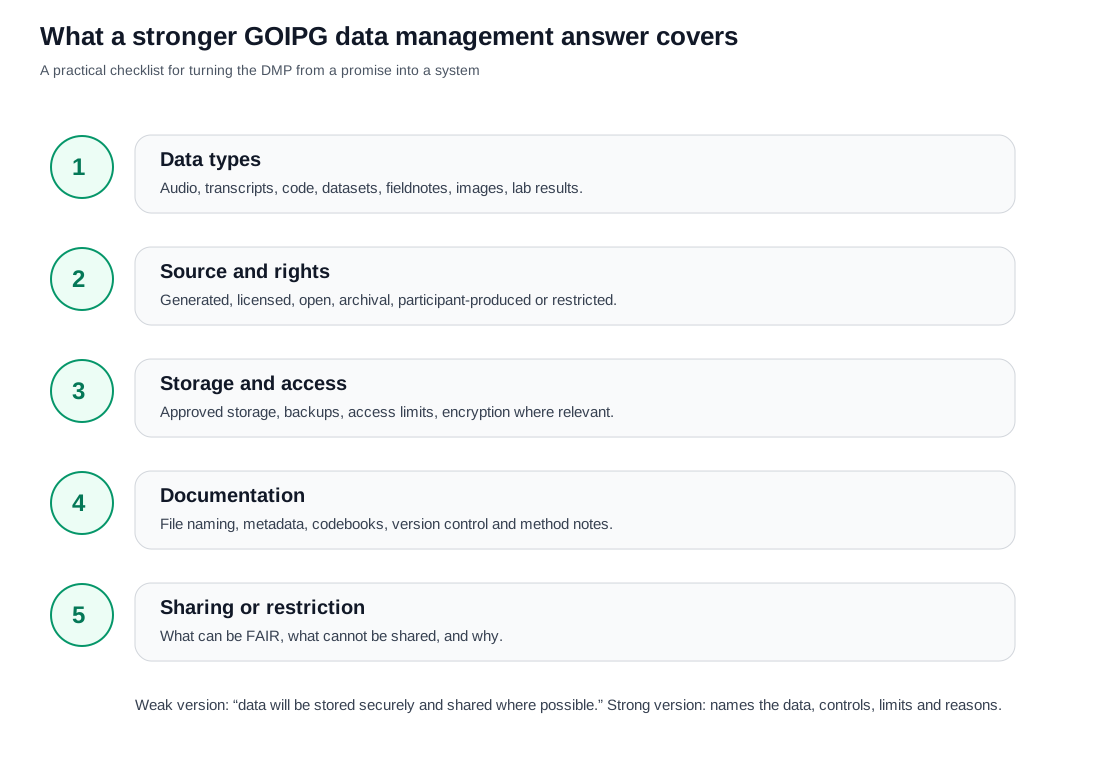
Chart source status: Editorial checklist based on GOIPG application prompts, Research Ireland policy references and FAIR data guidance.
A useful data management answer normally covers five practical questions.
First, what data exists? Name the data types. Do not write “data will be collected” as if the reader knows what that means.
Second, where does it come from? Explain whether data is generated by you, collected from participants, licensed from a provider, downloaded from an open repository, created through experiments, or accessed from an archive.
Third, how is it protected? Explain storage, backup, access, encryption where relevant, anonymisation or pseudonymisation, and separation of consent forms from research data where relevant.
Fourth, what can be shared? Describe whether raw data, cleaned data, metadata, code, anonymised transcripts, documentation or only summary outputs can be made available.
Fifth, what cannot be shared and why? This is not a failure. It is often a sign of maturity. If the data cannot be made openly available, say whether the restriction is due to consent, identifiability, copyright, licensing, commercial sensitivity, archive rules, safety or legal obligations.
The weak answer is “data will be stored securely and shared where possible.”
The stronger answer is a short system.
GDPR and special category data: the part applicants underplay
If your research involves living people, do not treat GDPR as a footnote.
The Data Protection Commission in Ireland lists special category data as including personal data revealing racial or ethnic origin, political opinions, religious or philosophical beliefs, trade union membership, genetic data, biometric data used for identification, health data, and data concerning a person’s sex life or sexual orientation. It also notes that processing these categories is prohibited except in limited circumstances set out in Article 9 of the GDPR. Data Protection Commission
This matters for GOIPG because many strong research projects in the humanities, social sciences, health, education, migration, politics, law and public policy involve exactly the kinds of data students casually describe as “interview data.”
An interview about migration status, disability, religion, sexuality, political activism, trauma, health, poverty, conflict, family life or workplace discrimination is not just “qualitative data.” It may involve sensitive information and re-identification risk.
You do not need to turn the ethics section into a legal essay. But you do need to show that you understand the risk class.
A stronger answer might say:
Because interviews may involve sensitive personal experiences, the project will minimise collection of unnecessary identifying details, use participant codes, store consent forms separately from transcripts, remove direct identifiers during transcription, and restrict access to raw files to the researcher and supervisor. Public outputs will use anonymised excerpts only where re-identification risk is low.
That is not legal advice. It is good research planning.
Compliance risks applicants often miss
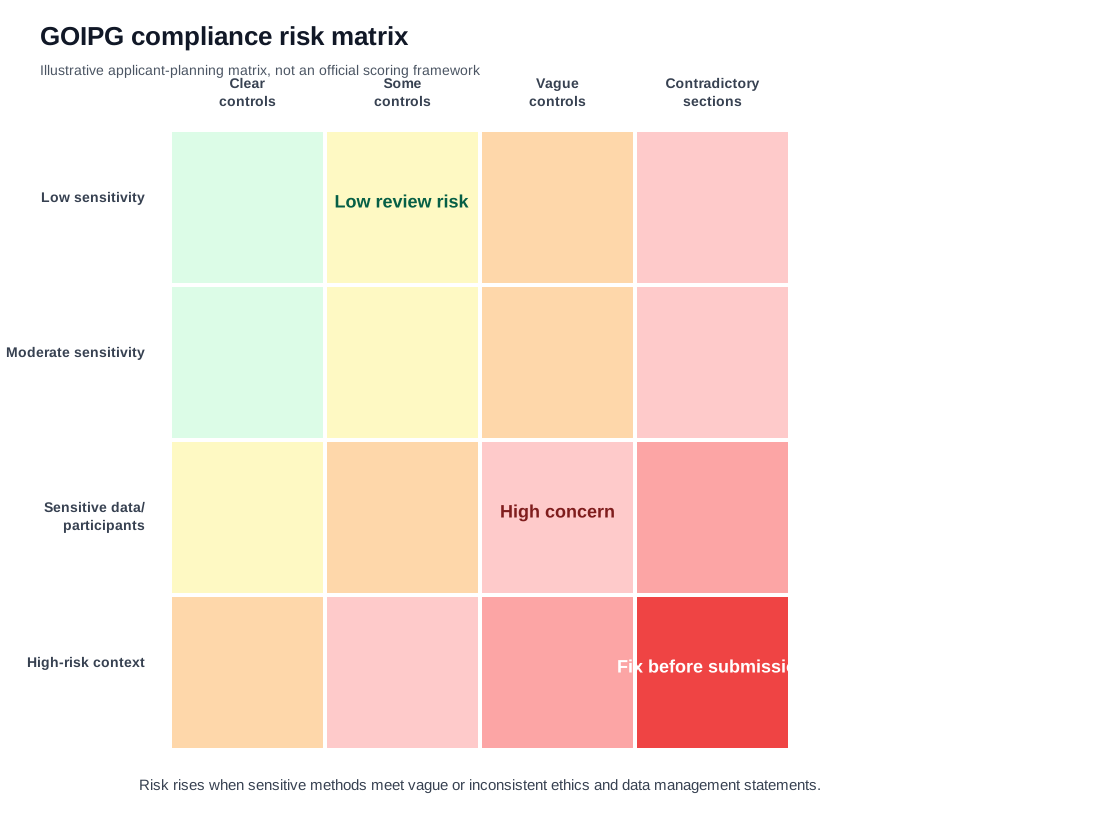
Chart source status: Illustrative synthesis for applicant planning. Not a Research Ireland scoring framework.
This risk matrix is not an official GOIPG marking scheme. It is a practical way to spot weak points before submission.
The highest-risk applications are not always the most controversial topics. They are the applications where the method, ethics statement and data plan do not agree with each other.
A project can be low risk in topic but still weak if the data plan is vague. A project can be sensitive but credible if the applicant shows a careful approval pathway, consent process, secure storage plan and realistic data-sharing limits.
Reviewers are not expecting a PhD applicant to sound like a data protection officer. They are expecting the applicant to know when specialist advice is needed and where the institution’s systems will come in.
What to write if your project has no obvious ethical risk
Some applicants genuinely have low-risk projects: desk-based legal analysis, literary analysis, secondary source historical work, theoretical modelling, public dataset analysis or archive-based research with no identifiable living individuals.
That does not mean the ethics section should be lazy.
A stronger low-risk answer might say:
The project is desk-based and uses publicly available policy documents, legislation and published secondary literature. It does not involve human participants, interviews, surveys, personal data collection or animal research. No participant recruitment or consent process is expected. If the scope changes to include interviews or non-public material, the appropriate institutional ethics approval will be sought before data collection begins.
This shows that you know why the project is low risk. It also shows what would trigger a change.
What to write if your data cannot be open
Do not promise open data if it is not realistic.
A strong data management plan can say that some data cannot be shared openly, as long as it explains why.
For example:
Raw interview transcripts will not be made publicly available because participants may be identifiable from contextual details. Public outputs may include short anonymised quotations where re-identification risk is low. The project will preserve anonymised coding summaries, documentation and metadata where appropriate, while raw audio files and consent forms will remain restricted according to institutional retention rules.
This is much stronger than pretending all data can be open.
It shows that you understand FAIR principles and their limits.
How ethics, methodology and timeline should line up
Compliance sections are not isolated. They should change the timeline.
If your project needs ethics approval, the timeline should allow time for that approval before recruitment or data collection begins.
If your project needs access to an archive, data provider or partner organisation, the timeline should show when access will be negotiated.
If your project involves transcription, anonymisation, coding or repository deposit, the data management plan should mention those tasks and the timeline should leave space for them.
A common weak timeline says:
- Month 1: literature review
- Month 2: interviews
- Month 3: analysis
For a project involving human participants, that may be unrealistic. Where is ethics approval? Recruitment? Piloting? Consent material? Transcription? Anonymisation?
A stronger timeline might say:
- Months 1–2: refine instruments, prepare ethics submission, finalise recruitment materials
- Months 3–4: ethics review and recruitment
- Months 5–7: interviews and transcription
- Months 8–10: coding and analysis
- Months 11–12: write-up, anonymised extracts and data documentation
This kind of sequencing makes the project feel fundable.
What international applicants should ask supervisors before writing
Before writing ethics and data management sections, ask the proposed supervisor:
- Does this project require institutional ethics approval?
- Which committee or process is likely to apply?
- Are there internal deadlines or review cycles?
- Where should research data normally be stored?
- Does the institution have repository, data steward or library support?
- Would any part of the project involve personal data or special category data?
- Can interview data, fieldnotes or transcripts realistically be shared?
- Does the institution require a separate data management plan later?
- Are there country-specific risks if fieldwork happens outside Ireland?
These questions do two things. They improve the application, and they show the supervisor you understand research governance.
A simple structure for the ethics section
Use this structure:
- Risk classification: Say whether the project is low risk, human-participant research, sensitive research, animal research, archival research, fieldwork or something else.
- Participants or materials: Name who or what is involved.
- Main risks: Consent, privacy, harm, distress, safety, confidentiality, re-identification, permissions or data protection.
- Controls: Approval route, information sheets, consent, secure storage, anonymisation, withdrawal rights, safeguarding, supervisor oversight.
- Timing: State that approval will be obtained before recruitment or data collection where required.
This structure works because it shows logic. It avoids empty claims.
A simple structure for the data management section
Use this structure:
- Data types: What will be created or used?
- Data source: Generated, participant-provided, licensed, archival, open or restricted?
- Storage and access: Where will it be stored and who can access it?
- Documentation: How will files, code, metadata or notes be organised?
- Sharing and FAIR: What can be made findable, accessible, interoperable and reusable?
- Restrictions: What cannot be shared and why?
- Retention or preservation: What happens after the project?
The strongest answer is specific to your method.
Common mistakes
Mistake 1: “Ethical approval will be sought if required”
This sentence is not enough. It does not show what you think the risk is, why approval might be needed, what process may apply, or what happens before fieldwork starts.
Mistake 2: Saying all data will be anonymised
Not all data can be fully anonymised. Some data is only pseudonymised. Some qualitative material remains indirectly identifiable even after names are removed. Be precise.
Mistake 3: Promising open data without thinking
Open data is not always possible or appropriate. If data cannot be shared, explain why and say what can still be shared.
Mistake 4: Treating GDPR as only an IT issue
GDPR is not just about password-protected files. It affects collection, lawful basis, minimisation, consent, retention, access, transfer, sharing and deletion.
Mistake 5: Writing compliance sections after everything else
Ethics and data management should be written alongside methodology and timeline. They cannot be patched on at the end if the project design is inconsistent.
The 48-hour GOIPG compliance review
Before submission, spend 48 hours checking only these sections.
First, read the methodology and ethics section together. Does the ethics section match the method?
Second, read the methodology and data management section together. Does the data plan name the data types created by the method?
Third, read the timeline. Is there time for approval, recruitment, access, storage, anonymisation and sharing decisions?
Fourth, read the research environment section. Does it mention the supports that make the compliance plan credible, such as supervisory expertise, ethics processes, repository guidance, data storage or institutional services?
Fifth, remove generic promises and replace them with specific controls.
Sources checked
This article was reviewed against Research Ireland’s 2026 GOIPG Call Document, the 2026 indicative applicant form, Research Ireland policy references on research integrity, data protection, open research and data management, the Data Protection Commission’s guidance on special category data, and Digital Repository of Ireland guidance on FAIR principles. Application wording, deadlines, policies and eligibility rules can change, so applicants should confirm the live Research Ireland call document, applicant form and research-office guidance before submitting.
FAQ
Is the GOIPG ethics section just a formality?
No. It is where you show that you understand the ethical implications of your proposed research and how they will be handled. Even low-risk projects should explain why they are low risk.
Do I need ethics approval before applying?
Usually not at application stage, but you should know whether approval is likely to be needed and when it would happen. If the project involves human participants or sensitive data, the application should show a credible approval route.
Can I write “not applicable” in the ethics section?
Only if you can justify it clearly. A better approach is to explain why the project does not involve human participants, personal data, animal research, sensitive materials or other ethical issues, and what would change if the method changes.
What does FAIR mean in a GOIPG data management plan?
FAIR means findable, accessible, interoperable and reusable. In practice, this may involve metadata, documentation, repository deposit, persistent identifiers, standard formats or clear conditions for access. It does not mean every piece of raw data must be public.
What if my research data cannot be shared?
Say why. Strong reasons include participant confidentiality, re-identification risk, legal restrictions, copyright, licence terms, archive rules, commercial sensitivity or safety concerns. Then explain what can still be shared, such as metadata, protocols, code, anonymised extracts or summary outputs.
Do international students need to mention GDPR?
If your project involves personal data, especially sensitive personal data, you should show awareness of data protection expectations. You do not need to give legal advice, but you should not ignore privacy, consent, storage, access and retention.
Show that the project is governable, not just interesting
GOIPG is competitive because it funds applicant-led research across disciplines. A strong idea matters, but the strongest applications usually do more than present an idea.
They show a research system.
The ethics section shows that you understand people, risk and institutional approval. The data management section shows that you understand evidence, storage, access, reuse and restriction. The timeline shows that the project can happen in the order you claim. The supervisor and research environment section shows that the right support exists.
That is what many applicants miss.
They write the proposal as if reviewers are only asking: “Is this research interesting?”
Reviewers are also asking: “Can this person actually carry it out?”
Your compliance sections help answer that question.
Related GradSharp reading
- For the broader GOIPG funding picture, read Government of Ireland Postgraduate Scholarship: The EUR34,000 Research Award Applicants Misread.
- For preparation before the portal opens, use Thinking About Applying for GOIPG? Do This Before the Portal Opens.