GOI-IES: The Timing Trap and the Personal Statement Most Applicants Misread
GOI-IES is assessed on merit, but most applicants are filtered out by something else first: the March call window and a 45-mark personal statement.
The official 2026 GOI-IES call document describes a highly competitive award comprising a €10,000 stipend plus a full tuition/registration fee waiver, for one year of master’s, postgraduate diploma or PhD study in Ireland. It covers one year of full-time, in-person study at NFQ levels 9 or 10, with 60 scholarships expected for the 2026/27 academic year. Future cycles may differ.
Most articles about it describe how to “win” it: be academically strong, get good references, write a confident personal statement.
That advice is not wrong. It is just not where most applicants actually lose.
Two things eliminate far more candidates than weak grades ever do:
- A call window that makes the admission-offer requirement genuinely hard to meet on a normal timeline.
- A personal statement structure that most applicants answer literally instead of strategically.
This article is about those two things specifically — not a general “how to apply for scholarships” guide.
For nearby funding and Ireland-planning context, GradSharp also has guides to the Government of Ireland Postgraduate Scholarship, the GOIPG ethics, data management and compliance sections, and international graduate hiring in the UK and Ireland.
The two filters applicants must pass
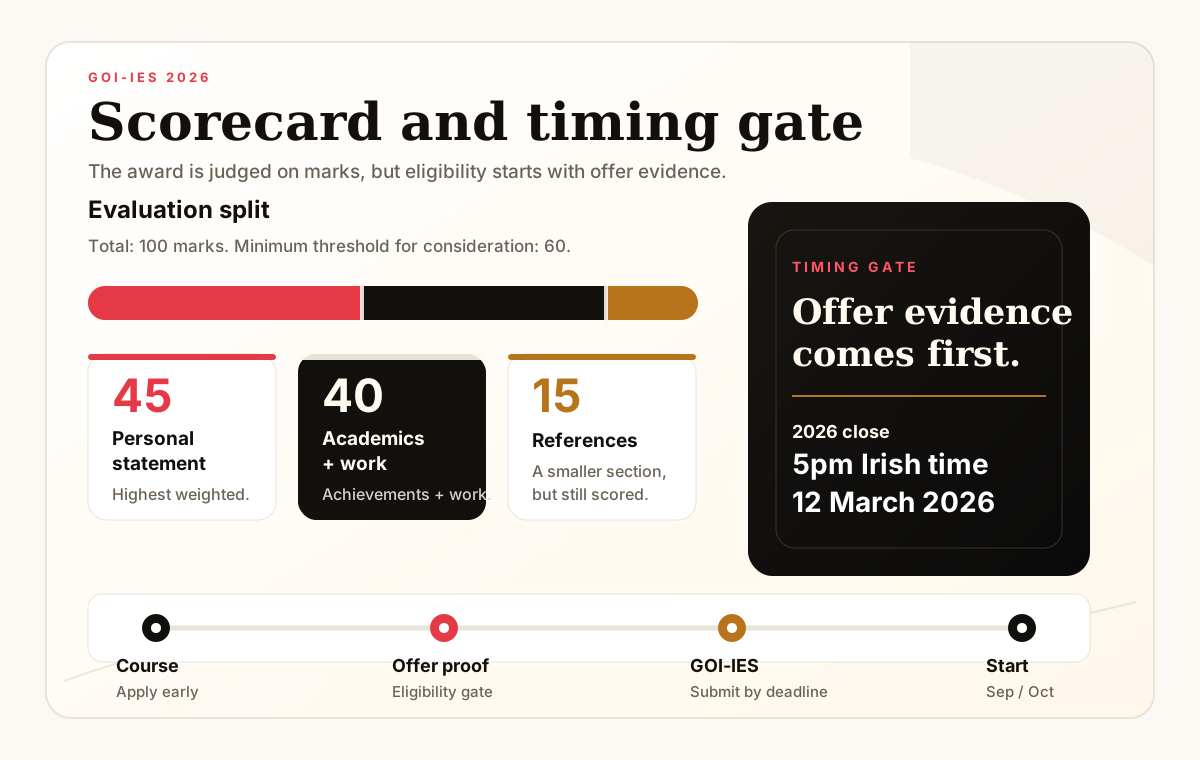
For the 2026 cycle, the GOI-IES call opened in late January and closed at 5pm Irish time on 12 March 2026, with results expected in early June and scholars beginning their programme that September or October.
Inside that roughly six-week window, applicants must already hold a conditional or final offer of admission to an eligible Irish higher education institution, with proof of admission submitted as part of the application.
That single requirement is the real filter. A student who only starts researching GOI-IES in January or February, after the call has opened, is almost never going to have an admission offer in hand by mid-March — because Irish university admissions for a September intake typically open and process applications across the preceding autumn and winter.
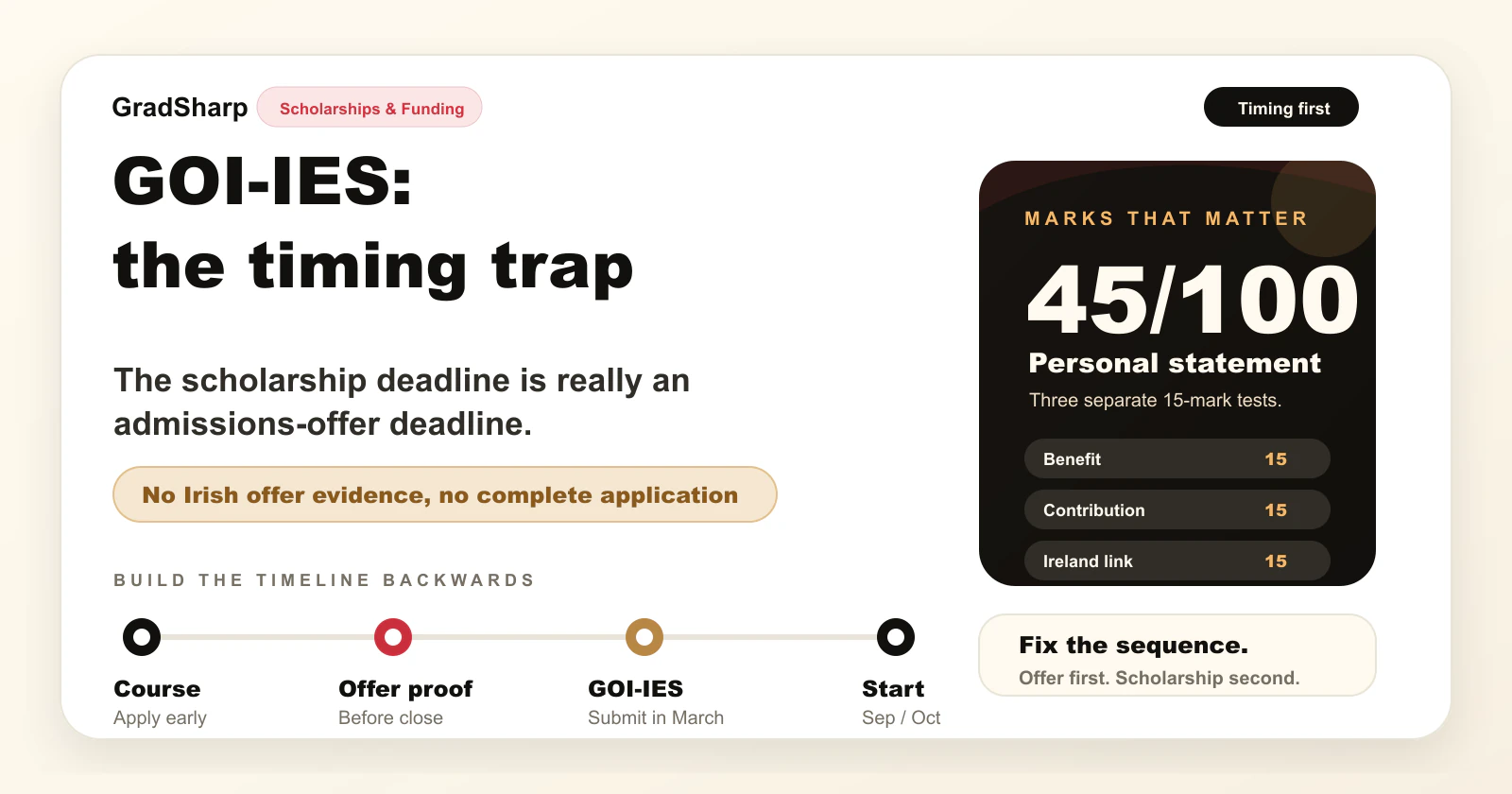
The second filter is the personal statement. It is worth 45 of the 100 total marks; academic qualifications, achievements and work experience are worth 40 marks, and references are worth 15. Most applicants still write it as a generic “why I want to study abroad” essay.
Why the GOI-IES timeline is really an admissions timeline
Every GOI-IES eligibility list includes the same line: applicants need an offer of admission. Most explanations treat this as a documentation requirement — upload the right PDF, move on.
It is not just documentation. It is a scheduling constraint that quietly removes a large share of otherwise strong applicants before assessment even begins.
To be eligible, a candidate must already have an offer of admission to a full-time, in-person master’s, postgraduate diploma or PhD programme at an eligible higher education institution before they submit their GOI-IES application. Proof of admission may be an offer letter, an official admissions email, or a screenshot from the applicant portal confirming a place for the relevant academic year.
That offer has to exist by the March deadline. The programme it funds does not start until September or October.
The practical effect: a student aiming for a September master’s needed to apply to an Irish university early enough in the previous admissions cycle — typically autumn or early winter — to receive a decision before the scholarship deadline in March. Students who follow a more typical international applicant timeline, researching courses over winter and applying in spring, are structurally late for GOI-IES even if they later receive a perfectly good offer for September.
This is why the scholarship rewards applicants who treat course applications and scholarship planning as the same project, not two sequential ones.
What this means in practice
| If your offer arrives | What it means for GOI-IES |
|---|---|
| Before the call opens, usually late January | You can apply as soon as the portal is live. |
| Between the call opening and the deadline | Tight but possible, if the offer lands with enough time to prepare a 45-mark personal statement properly. |
| After 12 March | You have missed that cycle, even if you are admitted for the same September intake. |
Both conditional and final offers are accepted. Since some institutions prioritise final-offer holders during internal GOI-IES shortlisting, it is worth asking the relevant higher education institution directly how they handle conditional offers at this stage.
Why this hits one-year master’s applicants hardest
GOI-IES funds one year only. The scholarship will not be extended beyond one academic year, though host institutions may choose to extend the fee waiver for courses running three semesters, with the stipend amount unchanged.
For a one-year taught master’s applicant, there is effectively one shot: the call that lines up with the start of that single year of study. Discover GOI-IES after arriving in Ireland, or after the March deadline has passed, and there usually is not a second cycle left inside the programme to use.
This is different for research students. Candidates already studying at an eligible institution — for example PhD students or master’s students on two-year programmes — can still apply, provided they submit a document from their institution confirming they will continue their studies into the funded academic year. A PhD candidate has multiple annual calls during their degree to try for the award. A one-year master’s applicant generally has exactly one.
If GOI-IES is part of how you are financing a one-year programme, it needs to be evaluated while you are choosing where to apply to study, not after you have already accepted a place.
The personal statement is testing something narrower than “why Ireland”
The marking scheme tells you what actually matters. Academic qualifications, achievements and work experience are worth 40 marks; the personal statement is worth 45 marks, split into three 15-mark components; and the two references are worth 15 marks. A minimum threshold of 60 marks is required for an application to be considered, and the top 12 ranked applications — the top 20% of the 60 funded places — are awarded automatically on excellence.
The personal statement alone outweighs academics. That is a deliberate design, not an accident. Irish universities have already screened applicants academically through the admissions process. GOI-IES is screening for something else.
The three components, and what each is really asking
The personal statement has three required parts, each worth 15 marks:
-
The benefit question. This asks about the benefit of becoming a GOI-IES scholar to the applicant personally and professionally, to the host institution, to Ireland economically and societally, and to the applicant’s country of origin. Applicants often write only about themselves. The criterion explicitly asks for four separate beneficiaries.
-
The active involvement question. This asks how the applicant will extend themselves beyond their studies to become actively involved in Irish society, in order to maximise their academic and cultural exchange experience and raise awareness of the programme. It is not asking what events the applicant will attend; it is asking how they will contribute.
-
The long-term interest question. This rewards a connection to Ireland that predates the application: prior contact with Irish researchers, engagement with an Irish industry or institution, or academic interests that already point toward Ireland specifically rather than “an English-speaking country in Europe.”
A statement built around “I plan to attend events and explore Irish culture” describes participation. A statement built around mentoring, outreach, organising, or building a concrete link between an Irish institution and a community back home describes contribution.
A weak vs stronger answer, side by side
Weak participation framing:
“I am excited to study in Ireland and look forward to joining student societies, attending cultural events, and experiencing Irish life during my degree.”
Stronger contribution framing:
“Alongside my studies, I plan to volunteer with a specific type of organisation relevant to my field, mentor incoming international students through a specific channel, and help organise an exchange event connecting my home university’s alumni network with the host institution’s international office.”
The second version still mentions broad activities — volunteering, mentoring, events — but answers the actual criterion: contribution, not consumption.
Common mistakes that cost marks, not character
Treating the offer requirement as a formality. It is a hard eligibility gate, checked before the rest of the application even opens. A preliminary eligibility check based on three automated questions, including whether the candidate already holds a conditional or final offer, runs as soon as that section is submitted. Ineligible candidates cannot proceed to the rest of the form.
Writing one generic paragraph for all three personal-statement parts. Each is marked separately out of 15. An applicant who blends all three into one undifferentiated essay risks losing marks on parts that were never properly addressed.
Assuming a conditional offer is automatically fine. It usually is, but some institutions prioritise final-offer holders during internal shortlisting, so check directly with the institution rather than assuming.
Leaving references until the last week. References must be dated at most a year before the call closing date, written in English or accompanied by a notarised translation, and uploaded by the candidate through the portal. Referees cannot upload them directly. A rushed referee request rarely produces the specific, evidence-based reference the marking scheme rewards.
Using AI-generated content or third-party drafting. The call document states applications must be the applicant’s own work and explicitly prohibits AI-generated content or drafting by a third person. Treat this literally, not as boilerplate.
What to actually do, in order
- Decide whether GOI-IES is part of your funding plan before you finalise where you are applying to study. If it is, build your university application timeline backward from the scholarship deadline.
- Apply for admission early enough that an offer is realistic well before the call closes. For the 2026 cycle, that meant having an offer in hand by 12 March, which usually required applying to the Irish institution months earlier.
- Draft each of the three personal-statement components separately. Write against its own 15-mark criterion, rather than writing one flowing essay and hoping it covers everything.
- Ask referees early. Give them the candidate-profile language from the call document so their reference is specific rather than generic.
- Re-read the eligibility and evaluation sections of the live call document yourself before submitting. Requirements and dates change between cycles.
FAQ
When does the GOI-IES call open and close?
For the 2026 cycle, the call opened in late January 2026 and closed at 5pm Irish time on 12 March 2026. Future cycles should be checked on the live HEA page, as dates move year to year.
Do I need an admission offer before I apply for GOI-IES?
Yes. Candidates must already hold a conditional or final offer of admission to an eligible Irish higher education institution at the time of applying, with proof of admission submitted as part of the GOI-IES application.
How much is the GOI-IES scholarship worth?
The scholarship is worth €10,000 for one year of study, paid in two instalments, plus a full tuition fee and registration charge waiver from the host institution.
How is the application scored?
Out of 100 total marks: academic qualifications, achievements and work experience are worth 40; the personal statement is worth 45, split across three 15-mark components; and the two references are worth 15. A minimum threshold of 60 marks is required for an application to be considered.
Can PhD or existing master’s students still apply?
Yes. Candidates already studying at an eligible institution, including PhD students or those on two-year master’s programmes, can apply provided they submit a document from their institution confirming they will continue their studies into the funded academic year.
Can I use AI tools to help write my personal statement?
No. The call document states applications must be the applicant’s own work and explicitly prohibits AI-generated content or drafting by a third person.
Sources checked
This article was checked against the official 2026 GOI-IES Call Document and the 2026 GOI-IES FAQs published by Ireland’s Higher Education Authority. Figures, deadlines, eligibility conditions and the marking scheme reflect the 2026 cycle specifically. Scholarship terms, deadlines and assessment criteria can change between application cycles, so applicants should always confirm details against the live HEA GOI-IES webpage before applying.
Win the nomination before polishing the personal statement
Most GOI-IES advice online is about becoming a more impressive candidate. That matters eventually, but it is not where most applicants actually fail.
Most applicants fail earlier: they do not have an admission offer by the time the application closes, or they spend their effort on academic polish while the 45-mark personal statement gets written as an afterthought.
Fix the sequencing: admission offer first, scholarship planning alongside it, not after. Then answer the three personal-statement questions as the specific criteria they are, not as a generic “why Ireland” essay. That is a more useful place to focus than another general scholarship checklist.