Government of Ireland Postgraduate Scholarship: The €34,000 Research Award Applicants Misread
The Government of Ireland Postgraduate Scholarship is not just a funding award. It is a competitive Research Ireland proposal judged on applicant, project, training and environment.
Most students searching for Irish scholarships make the same mistake.
They start with universities.
Trinity College Dublin. UCD. DCU. University of Galway. Rankings, supervisors, tuition fees, campus life and whether a department looks “strong” on paper.
Those things matter. But for research master’s and PhD applicants, one question often matters earlier:
Can you fund the research well enough to do it properly?
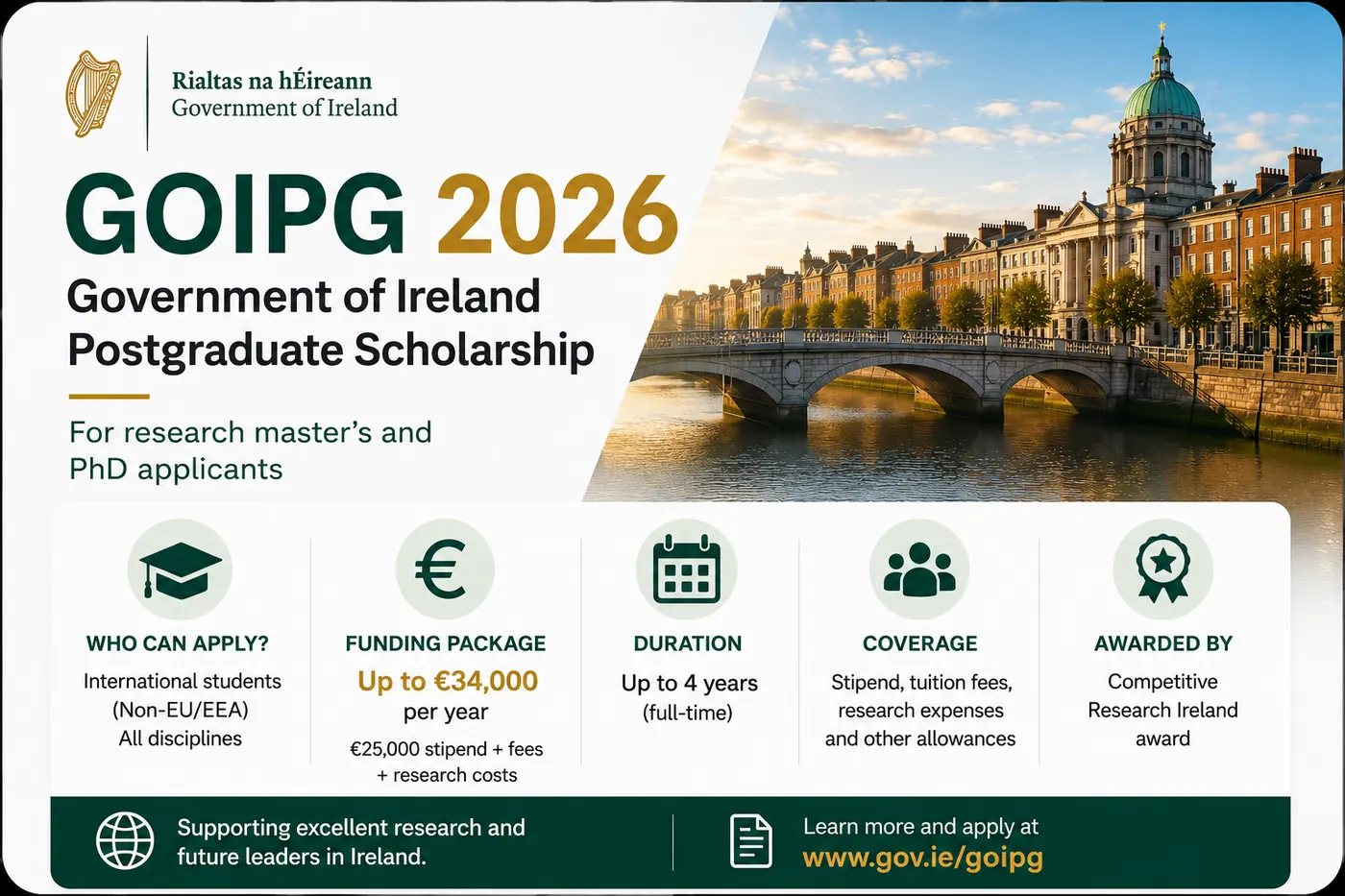
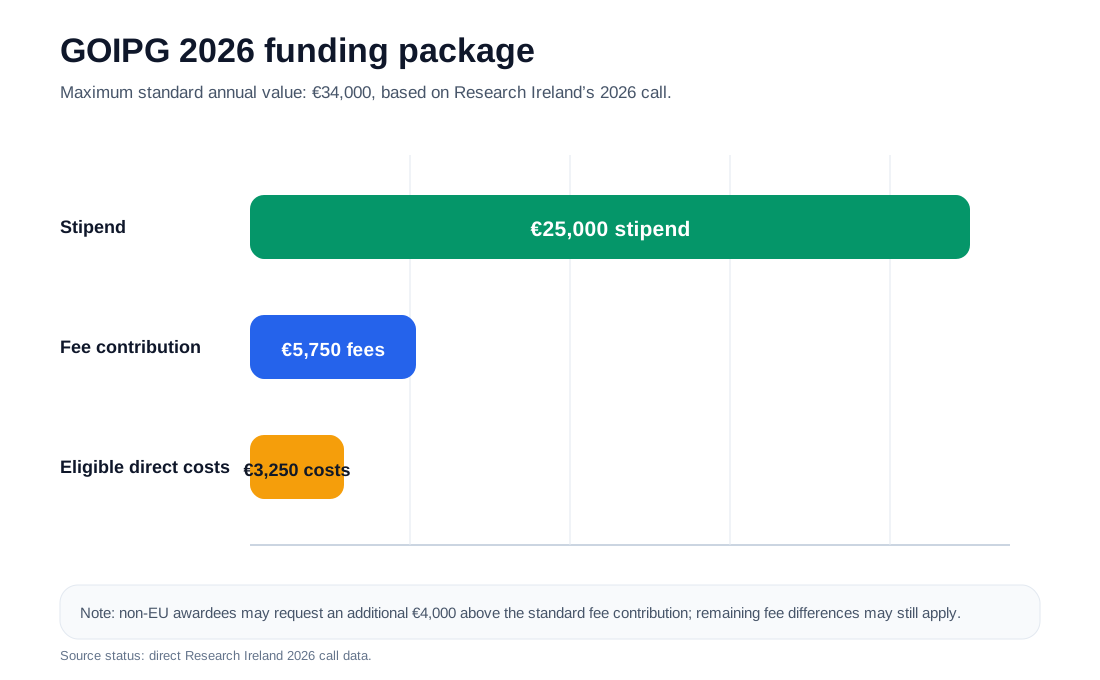
The Government of Ireland Postgraduate Scholarship Programme, often shortened to GOIPG, is one of the most important answers to that question. It is managed by Research Ireland and supports research master’s and doctoral candidates across disciplines. For the 2026 call, the award is worth up to €34,000 per year, made up of a €25,000 stipend, a fee contribution up to €5,750 and eligible direct costs of €3,250. Non-EU awardees may also request an additional €4,000 per year above the standard fee contribution, although any remaining fee difference must still be covered by the awardee and/or research body. Research Ireland 2026 call document
That figure is already a correction to many older articles and reused scholarship posts that still describe GOIPG as a €31,000 award. That was true for the 2025 call, when the stipend was €22,000. For the 2026 call, the stipend rose to €25,000 and the maximum annual value became €34,000. Research Ireland 2026 programme page
But the amount is not the main story.
The real story is that GOIPG is not a normal university scholarship. It is a national research funding competition. Applicants are not only asking for financial support. They are asking independent international reviewers to believe that they, their project, their training plan and their research environment are worth funding.
That is why a strong university offer is not enough. A supportive supervisor is not enough. A good undergraduate grade is not enough.
The application has to make the research case.
For related GradSharp guidance, see the broader guide to international graduates in the UK and Ireland, the Ireland labour-market overview in The 2026 Irish Graduate Market, and the post-study route guide on Stamp 1G to Critical Skills Permit.
What the award actually funds
GOIPG is worth serious attention if you are applying for a research master’s or PhD in Ireland, especially if you want a project that is not tied to a predefined funded position.
Research Ireland describes the programme as distinctive because it offers individual awards in the applicant’s name, uses international independent expert peer review, funds across all disciplines “from archaeology to zoology”, and supports bottom-up, non-directed research, apart from strategic partner strands. Research Ireland programme page
That freedom is valuable. It is also the reason the competition is hard.
Research Ireland says the programme has had an average success rate of 18% over the past five years. For the 2025 competition data published in the 2026 call document, the overall success rate was 12% for STEM and 16% for Arts, Humanities and Social Sciences. Category 2 applicants — broadly, applicants who do not meet the Category 1 nationality and residency conditions — had much lower 2025 success rates: 2% in STEM and 3% in AHSS. Research Ireland 2026 call document
The practical conclusion is this:
Do not treat GOIPG as an admissions form. Treat it as a research-funding proposal.
What GOIPG actually funds
For the 2026 call, the Government of Ireland Postgraduate Scholarship could support one to four years of full-time research, depending on the degree type and whether the applicant was a new entrant or already registered in the first year of the degree. Research Ireland’s 2026 call document lists the following annual award package:
| Funding element | 2026 value |
|---|---|
| Stipend | €25,000 |
| Contribution to fees, including non-EU fees | Up to €5,750 |
| Eligible direct research expenses | €3,250 |
| Maximum standard annual value | €34,000 |
For non-EU awardees, Research Ireland says an additional contribution of €4,000 per year above the standard fee contribution may be requested. However, the call document also makes clear that any remaining fee difference must be covered by the awardee and/or research body. This matters for international applicants because non-EU fees can exceed the standard contribution. Research Ireland 2026 call document
The scholarship can fund research master’s, structured research master’s, traditional doctoral degrees and structured doctoral degrees, with duration depending on category and registration stage. But applicants must check the live call year because funding duration and rules can change.
The 2026 call is now closed. The applicant deadline for the 2026 call was 23 October 2025, with an award start date of 1 September 2026. Future applicants should use these dates only as a planning reference, not as future-cycle deadlines.
Why the scholarship is different from a university-funded PhD
Many PhD applicants look for a supervisor first and funding second. That can work for project-funded PhDs, where a supervisor or research group already has money attached to a defined topic.
GOIPG is different.
It is an individual national award. The applicant proposes the project. The award is made in the applicant’s name. The research does not have to fit a supervisor’s pre-funded project, although supervisor fit is still crucial.
That creates opportunity. It also creates pressure.
You need to show that:
- the research question matters;
- the method is feasible;
- the project is realistic within the degree duration;
- the supervisor and institution are a strong fit;
- the training plan makes sense;
- the applicant has the capacity to deliver the work.
A vague proposal will not be rescued by a prestigious university name. A strong supervisor cannot make a weak project coherent. A good academic record does not replace a clear method.
The success-rate reality
GOIPG is competitive. The success-rate figures are one of the clearest reasons applicants need to take the proposal seriously.
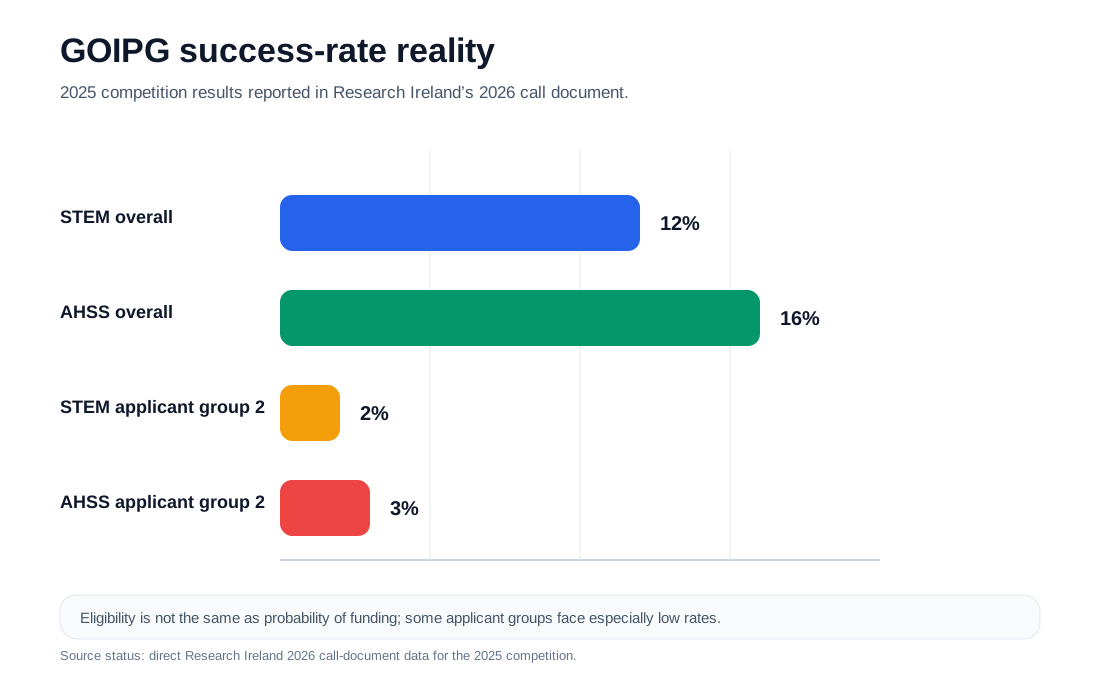
The Category 2 figures are especially important for many international applicants. Research Ireland’s call document states that applicants from any country may hold a scholarship, but applications are divided into Category 1 and Category 2 based on nationality and ordinary residence conditions.
Category 1 includes applicants who meet specified EU, UK, Swiss or EEA nationality and ordinary-residence conditions. Category 2 includes all other applicants. Under the 2026 call, all applicants are eligible for Government of Ireland Postgraduate Scholarships, but eligibility is not the same as probability. The 2025 Category 2 success rates reported in the 2026 call were very low.
That does not mean Category 2 applicants should not apply. It means they should understand the competition and avoid weak applications.
How Research Ireland assesses applications
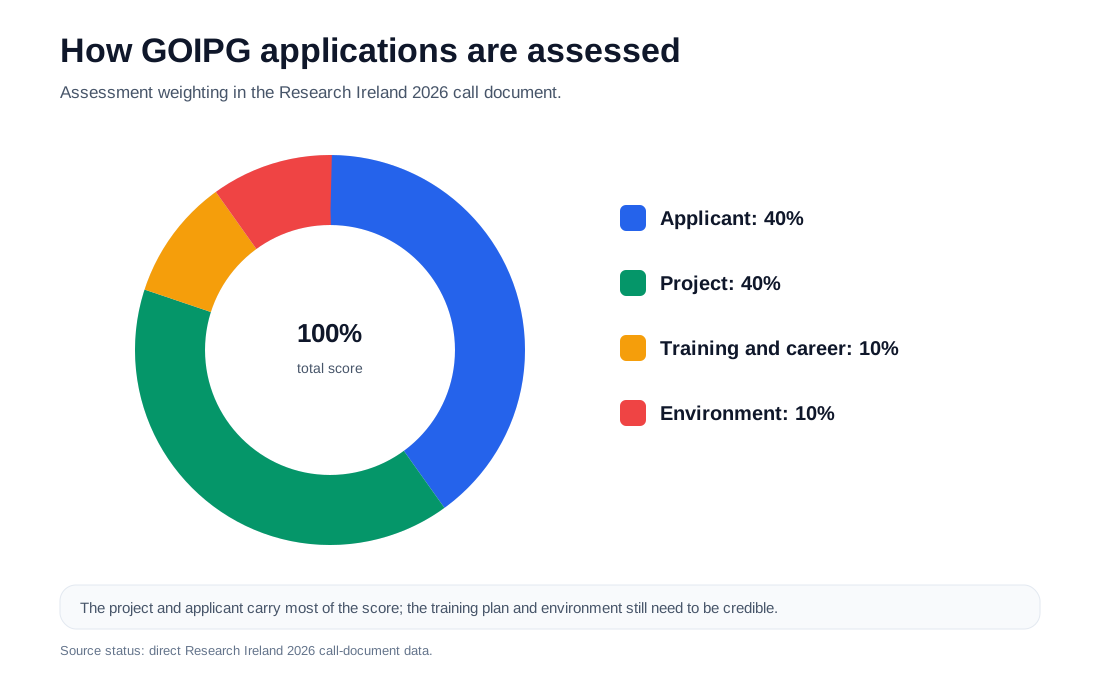
Research Ireland’s 2026 call document gives the assessment weighting clearly:
- Applicant: 40%
- Project: 40%
- Training and career development: 10%
- Environment: 10%
This weighting is useful because it shows what the application is really asking you to prove.
The applicant and project carry the largest weight. That means reviewers need to believe both in the person and in the research idea. The training and environment sections have smaller weightings, but they still matter because they show whether the proposal is connected to a realistic development path and a suitable research setting.
In plain English, a strong GOIPG application says:
I am a credible early-stage researcher, this is a strong and feasible project, this is the right training plan, and this is the right environment to do it.
What matters more than applicants think
Supervisor fit
Research Ireland says applications must identify a primary supervisor willing to supervise the proposed research. The primary supervisor and academic mentor cannot support more than one primary applicant to the programme, although they may support other applicants as secondary supervisors. Research Ireland 2026 call document
This means supervisor conversations matter early. A rushed email two weeks before deadline is not enough.
A useful supervisor email should explain:
- who you are;
- what you want to research;
- why their expertise fits;
- why GOIPG is the funding route;
- what stage your proposal is at;
- what you are asking from them.
Do not send a 2,000-word life story. Send a focused message with a short proposal summary.
Research design
Many applicants write a topic, not a project.
A topic is broad: “climate migration in Europe” or “AI in education” or “mental health among international students”.
A project is sharper. It has a research question, scope, method, evidence base and realistic plan.
Reviewers need to know what you will actually do. They need to see how the research can be completed within the funding period and why the method fits the question.
Feasibility
Feasibility is not boring. It is central.
A proposal can sound impressive and still fail because it is too large, too vague or too dependent on data access that may not happen.
Ask yourself:
- Can I complete this within the degree period?
- Do I have access to the data, archives, field site, lab, participants or tools?
- Are there ethical approvals or GDPR issues?
- Is the method realistic for my stage?
- Does the supervisor environment support this work?
The personal statement
The personal statement should not read like a generic motivation letter.
It should connect your background to the proposed research. Why are you prepared to do this project? What evidence shows you can handle the method, topic and discipline? What have you already done that makes this next step credible?
Strong evidence can include:
- dissertation or thesis work;
- research assistant experience;
- lab or fieldwork experience;
- publications or conference papers, where relevant;
- policy, development, data or professional experience linked to the topic;
- language skills, technical skills or archive access;
- evidence of independent work.
What matters less than applicants think
University brand alone
Trinity, UCD, University of Galway, University College Cork, DCU, Maynooth, UL and other Irish institutions can all host strong projects. The institution matters, but only as part of the research environment.
A weaker project at a famous university is still weak. A strong project with a clear supervisor fit at a less famous institution can be much more persuasive.
If you are comparing Irish universities more generally, GradSharp’s article on Trinity vs UCD and Irish employer perception may help. But GOIPG is a research-funding competition, not a simple university-brand contest.
A long publication list
Most postgraduate applicants do not have a long publication record. Reviewers know this.
One strong dissertation, one well-defined research assistant role, one serious methods module, or one relevant professional project can be more useful than a padded list of minor items.
Last-minute polishing
GOIPG cannot be fixed in the final weekend. The proposal needs development. Supervisor fit needs time. Research office processes need time. References and forms need time.
If you start too late, you may produce a polished but shallow proposal.
The timeline applicants should actually follow
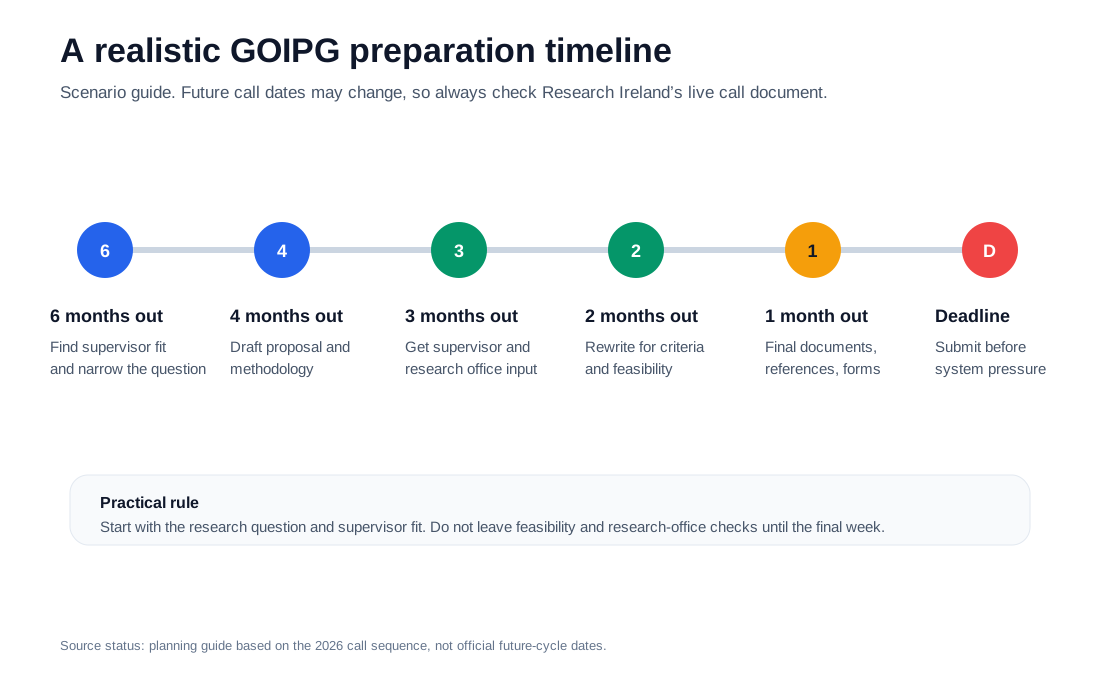
The 2026 call had a specific deadline sequence, including applicant, supervisor, referee and research-office stages. Future calls may differ, but the planning logic is stable: you need to begin well before the official applicant deadline.
A serious applicant should start months before the call closes.
Six months out, identify the research area and potential supervisors. Four months out, write a proper proposal draft. Three months out, get supervisor and research-office feedback. Two months out, revise for the assessment criteria. One month out, finalise documents, references and institutional processes.
This may feel excessive. It is not. It is what a competitive research-funding application needs.
Common mistakes
Treating GOIPG as a university admission form
Admission and funding are not the same. A university may admit you to a research degree, but Research Ireland reviewers still have to rank your funding application against others.
Writing a proposal that is too broad
Broad proposals are easy to imagine and hard to fund. Narrow the question until the method becomes realistic.
Contacting supervisors too late
Supervisors are busy. They may also be limited in how many applicants they can support as primary supervisor. Contact early.
Ignoring the research office
Your institution’s research office or postgraduate office may have internal deadlines before Research Ireland’s deadline. Missing those can end the application before external review.
Assuming international eligibility means equal odds
GOIPG is open to applicants from any country, but Category 2 success rates reported for the 2025 competition were low. International applicants should apply only with a strong, carefully built proposal.
A 48-hour plan for serious applicants
First, read the current Research Ireland programme page and call document. Do not rely on old scholarship blogs.
Second, decide whether your intended degree is a research master’s, structured research master’s, traditional doctorate or structured doctorate. The funding duration can depend on that.
Third, write a one-paragraph research idea. It should include the topic, question, method and why it matters.
Fourth, identify three possible supervisors and read at least two recent publications or project pages for each. You need to understand fit before emailing.
Fifth, email potential supervisors with a concise message: who you are, what you want to research, why their expertise fits, and that you are considering a GOIPG application. Attach a short proposal summary, not a 25-page document.
Sixth, create a deadline tracker with applicant, supervisor and research office dates. The GOIPG process has multiple participants. Your application can fail if someone else misses their form.
FAQ
What is the Government of Ireland Postgraduate Scholarship?
It is a Research Ireland programme supporting full-time research master’s and doctoral candidates in Ireland. It funds individual research proposals across disciplines and uses international independent expert peer review.
How much is the GOIPG scholarship worth?
For the 2026 call, the maximum standard annual value is €34,000: a €25,000 stipend, fee contribution up to €5,750 and eligible direct costs of €3,250. Non-EU awardees may request an additional €4,000 per year above the standard fee contribution, subject to the call terms.
Is GOIPG open to international students?
Yes. Research Ireland states that applicants from any country may hold a Government of Ireland Postgraduate Scholarship. Applicants fall into Category 1 or Category 2 based on nationality and residency criteria, and Category 2 competition is especially strong.
Does GOIPG fund humanities and social sciences?
Yes. Research Ireland says the programme funds across all disciplines, “from archaeology to zoology”. It uses separate broad streams for STEM and Arts, Humanities and Social Sciences.
Do I need a supervisor before applying?
Yes. All applications require a primary supervisor willing to guide the proposed research project. Research Ireland does not find supervisors for applicants.
Does GOIPG require IELTS?
The Research Ireland 2025 FAQ stated that the IRC did not require English language certificates, but applicants should check the English language requirements of the Irish higher education institution where they will be enrolled. Future applicants should confirm this in the current FAQ and with the university.
Is GOIPG only for new PhD students?
For the 2026 call, the programme was open to new entrants and to registered students in the first year of the degree for which they were seeking funding, aligning with a full-degree funding model. Future call years should be checked carefully.
Sources checked
This article was checked against Research Ireland’s Government of Ireland Postgraduate Scholarship Programme page, the 2026 call document and the 2025 FAQ note on English language certificates. The 2026 call is closed; future call years may change funding, deadlines, eligibility rules and documentation requirements, so applicants should confirm the live Research Ireland call page and call document before applying.
Treat GOIPG as a research-readiness test
GOIPG is not just a money award. It is a test of whether you can think like an early-career researcher before the degree has fully begun.
That is what makes it valuable. It is also what makes it difficult.
The applicants who approach it as a form-filling exercise usually underestimate the competition. The applicants who treat it as a research-funding proposal — with a sharp question, credible method, strong supervisor fit and realistic plan — give themselves a better chance.
The next step is not to download ten scholarship templates.
It is to build a research idea that deserves funding.