Graduate Assessment Centres in 2026: What UK and Irish Applicants Should Practise
A practical 2026 guide to the graduate assessment-centre process, employer evidence, final preparation and on-the-day decisions for UK and Irish applicants.
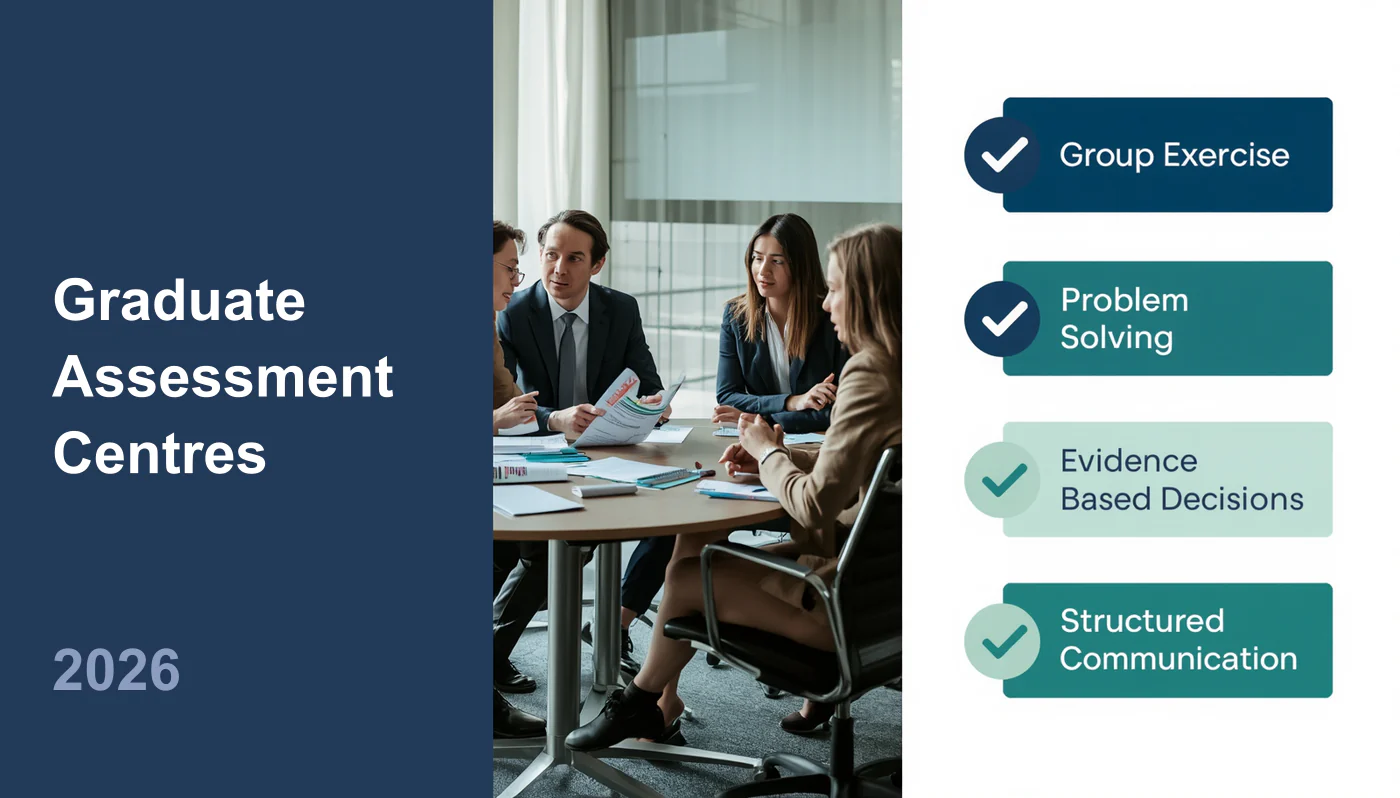
Most graduate assessment centres are not looking for the loudest person in the room. They are looking for evidence that you can think clearly, work with others, explain decisions and stay useful when the task becomes messy.
For UK and Irish graduate applicants, the mistake is usually preparing only for interview questions. Assessment centres often test the same qualities in several formats: a group discussion, a case task, a written exercise, a presentation, a role play, a strengths or competency interview, or a final business conversation.
The practical answer is simple: prepare your examples, but also practise how you behave while solving problems with other people.
The same preparation also supports other parts of your graduate job search. If you are still building your application system, start with GradSharp’s guide to the best UK graduate job boards and employer sites. If your CV is still weak, use the Big 4 graduate CV guide before you reach final-stage interviews. International applicants should also read the UK and Ireland international graduate guide so work-rights questions do not become a last-minute surprise.
What an assessment centre is testing
A strong assessment centre performance usually shows five things:
- You understand the task before rushing into answers.
- You involve other people without dominating them.
- You use evidence, numbers or criteria to justify decisions.
- You communicate in a structured way.
- You recover quickly if challenged, interrupted or corrected.
You do not need to be perfect. You need to be consistently useful.
What is a graduate assessment centre?
A graduate assessment centre is a later-stage selection process where an employer assesses candidates through several exercises, often on the same day or across a short sequence.
It may be called:
- an assessment centre
- an experience day
- a launch pad
- a final selection day
- a virtual assessment
- a final interview stage
The format varies. Some employers use a clearly labelled assessment centre. Others use online assessments and a final interview instead. Always follow the instructions for the specific employer and intake.
What employers are really testing
Assessment centres are not just testing whether you know the company. They are testing how you behave when the situation is realistic but incomplete.
That means assessors may look for:
- Problem solving: can you make sense of information quickly?
- Commercial awareness: do you understand customers, risk, cost, growth or regulation?
- Communication: can you explain a point clearly without over-talking?
- Teamwork: can you build on others’ ideas and help the group progress?
- Judgement: can you prioritise rather than treat everything as equally important?
- Motivation: can you explain why the role, employer and sector fit you?
For international students, the same skills matter, but there is an extra risk: using generic answers because you are trying to apply to many employers quickly. A better approach is to prepare flexible examples, then adapt them to each role.
Understand the exercise mix before you practise
An assessment centre may combine a group task, case study, written exercise, presentation, inbox task, role play and interview. The invitation or candidate pack is more reliable than a generic online list because employers change formats by scheme and intake.
| Exercise family | The preparation question to answer |
|---|---|
| Collaborative task | How will you help a group clarify the objective, use the evidence and reach a decision? |
| Analysis task | Can you identify the objective, trade-offs, recommendation, risk and next check? |
| Communication task | Can you give the right level of detail for the audience and time available? |
| Prioritisation task | Can you explain why one risk, deadline or stakeholder need comes before another? |
| Interview | Can you support your motivation and skills with specific, truthful evidence? |
For exercise-by-exercise frameworks, worked behaviours and a seven-day practice plan, use the dedicated graduate assessment centre exercises guide. This page remains the broader guide to the overall process, evidence preparation and final-stage decisions.
The evidence matrix: how to prepare properly
Most applicants prepare by reading about the employer. That helps, but it is not enough. You also need evidence for the behaviours the employer may test.
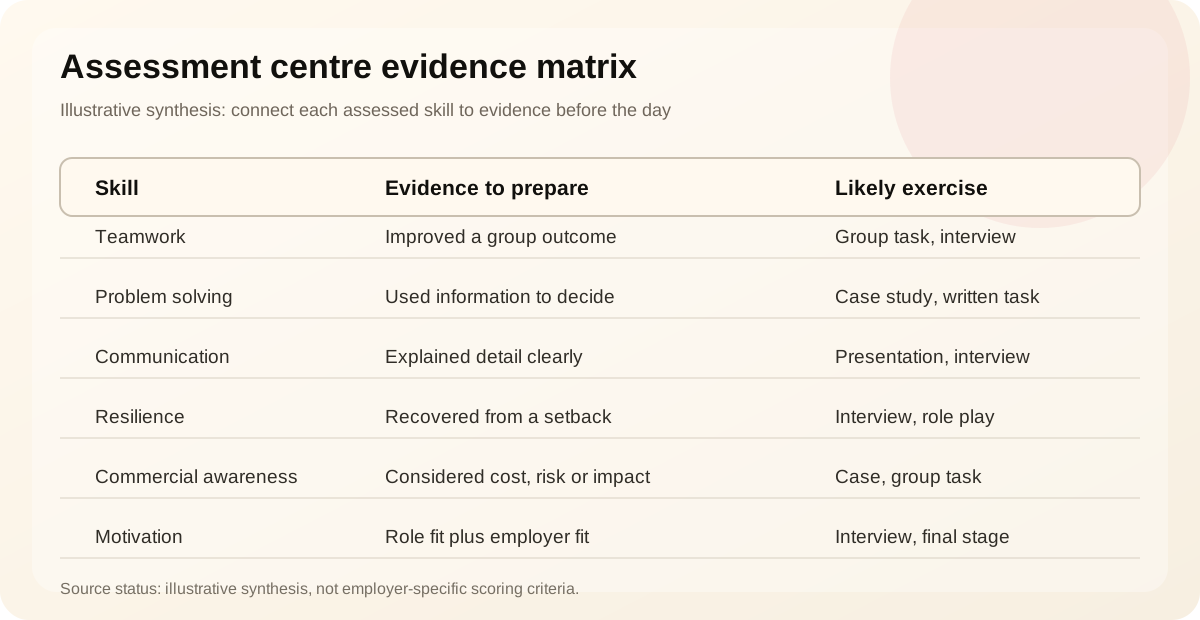
Use this matrix before your assessment centre:
| Skill being assessed | Evidence you should prepare | Exercise where it may appear |
|---|---|---|
| Teamwork | A time you improved a group outcome | Group exercise, interview |
| Problem solving | A time you used information to make a decision | Case study, written task |
| Communication | A time you explained something clearly | Presentation, interview |
| Resilience | A time you recovered from a setback | Interview, role play |
| Commercial awareness | A time you considered cost, customer, risk or impact | Case study, group task |
| Motivation | Why this employer, role and sector fit you | Interview, final conversation |
You do not need a separate example for every question. You need a small bank of strong examples that can be adapted.
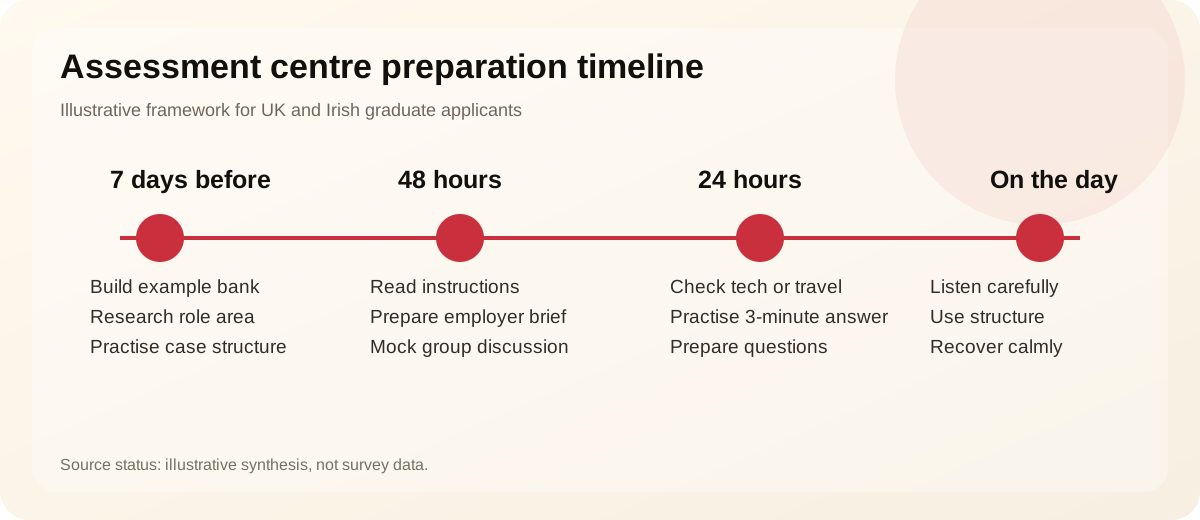
How to prepare in the final 48 hours
1. Re-read the employer instructions
Check:
- date, time and location
- whether it is online or in person
- whether you need ID or right-to-work documents
- dress code or camera expectations
- exercises mentioned in the invitation
- whether calculators, notes or slides are allowed
Do not rely on generic advice when the employer has given specific instructions.
2. Prepare a one-page employer brief
Write one page covering:
- what the employer does
- the business area you applied to
- why the role fits you
- one recent sector issue
- two reasons you are interested
- two questions you could ask
This prevents generic answers.
3. Practise a group discussion out loud
You can practise with friends, classmates or even by speaking through a mock scenario alone.
Focus on:
- summarising
- inviting quieter people in
- disagreeing politely
- tracking time
- linking ideas back to the brief
The goal is to sound clear under pressure, not rehearsed.
4. Practise one short presentation
Give yourself 20 minutes to prepare a three-minute recommendation from a simple case prompt.
Use this format:
- recommendation
- reason one
- reason two
- risk
- next step
Record yourself if possible. Check whether your answer has a clear headline or whether you are just narrating your thinking.
5. Prepare five flexible examples
Choose examples from:
- part-time work
- internships
- university projects
- societies
- volunteering
- family business responsibilities
- technical projects
- customer-facing work
For each example, write:
- situation
- task
- action
- result
- what you learned
The action matters most. Assessors need to know what you personally did.
For an individual interview, use the graduate interview questions and evidence-bank guide to turn those examples into clear answers without memorising a script.
What international students should watch
International students often face three additional problems at assessment centres.
First, they may under-explain context. If your example comes from another country, university system or workplace culture, give one sentence of context before explaining your action.
Second, they may avoid speaking in group tasks because they are worried about interrupting. You do not need to interrupt, but you do need to contribute. A useful contribution every few minutes is better than waiting for the perfect point.
Third, they may focus too much on visa or sponsorship anxiety. Work-rights questions should be answered honestly if asked, but the assessment itself is mainly about role fit, skills and judgement. Do not let sponsorship worries make your answers defensive. For a wider comparison of post-study options, see GradSharp’s guide to international graduates in the UK and Ireland.
What to avoid
Avoid these common mistakes:
- repeating the company website without explaining your own motivation
- trying to lead every discussion
- giving long answers without a clear point
- ignoring the data in a case study
- treating the group exercise as a debate to win
- using examples where your own role is unclear
- blaming teammates, universities or previous employers
- asking questions that are already answered in the candidate pack
- pretending to understand something instead of clarifying it
A good assessment centre candidate is not flawless. They are prepared, aware and easy to work with.
Example: weak vs stronger group exercise behaviour
Weak:
“I think we should choose Option A because it sounds best and I have seen companies do this before.”
Stronger:
“I would lean towards Option A, but only if our priority is short-term customer impact. If the priority is cost control, Option C may be safer. Can we agree which criterion matters most before deciding?”
The stronger answer shows judgement. It does not just give an opinion.
Example: weak vs stronger motivation answer
Weak:
“I want to join because you are a leading company and offer great training.”
Stronger:
“I am interested in this audit graduate role because I want structured professional training, client exposure and a qualification route. Your regional client base also appeals to me because I have enjoyed work where I had to explain detail clearly to different stakeholders.”
The stronger answer connects the employer, role and candidate evidence.
Assessment centre checklist
Before the day, check that you can answer:
- Why this employer?
- Why this role?
- What does the business area actually do?
- What skills are likely to be assessed?
- What examples show those skills?
- What recent sector issue could affect the employer’s clients or customers?
- What questions would you ask at the end?
- What will you do if a group member dominates?
- What will you do if you make a mistake?
- What documents, tech setup or travel plan do you need?
Sources checked
This article was reviewed against public careers guidance and employer recruitment-process information in May 2026. The wording is deliberately cautious because assessment-centre formats change by employer, scheme, country and intake.
Sources checked included public guidance from Prospects and TARGETjobs on assessment-centre formats, public employer recruitment-process pages from major UK and Irish graduate employers where available, and recent reporting on graduate recruitment moving back towards more human or in-person assessment stages.
Readers should always follow the live invitation and candidate pack from the employer, because those instructions are more important than any generic assessment-centre advice.
FAQ
Are graduate assessment centres still used in 2026?
Yes, many graduate employers still use assessment-style exercises, though the format varies. Some use in-person assessment centres, some use virtual exercises, and some use online assessments followed by a final interview.
What should I wear to a graduate assessment centre?
Follow the employer’s instructions. If the invitation does not specify, choose smart, professional clothing that fits the role and setting. For virtual assessments, also check your background, lighting, microphone and camera position.
Can international students attend graduate assessment centres in the UK or Ireland?
Yes, if they are eligible for the role and invited by the employer. Work rights and sponsorship policies vary by employer and role, so international applicants should check the live job advert and employer guidance before applying.
Your next 48 hours before the assessment
In the next 48 hours:
- Choose five examples you can adapt to different questions.
- Practise one group discussion scenario.
- Practise one three-minute recommendation.
- Write a one-page employer brief.
- Re-read the assessment centre invitation carefully.
The aim is not to sound like a perfect candidate. The aim is to show clear thinking, useful teamwork and credible motivation under pressure.