Graduate Assessment Centre Exercises: Group Tasks, Case Studies, Presentations and Written Exercises Explained
A practical exercise-by-exercise guide to graduate assessment centres: what group tasks, case studies, presentations, written exercises and in-tray tasks test, and how to practise.
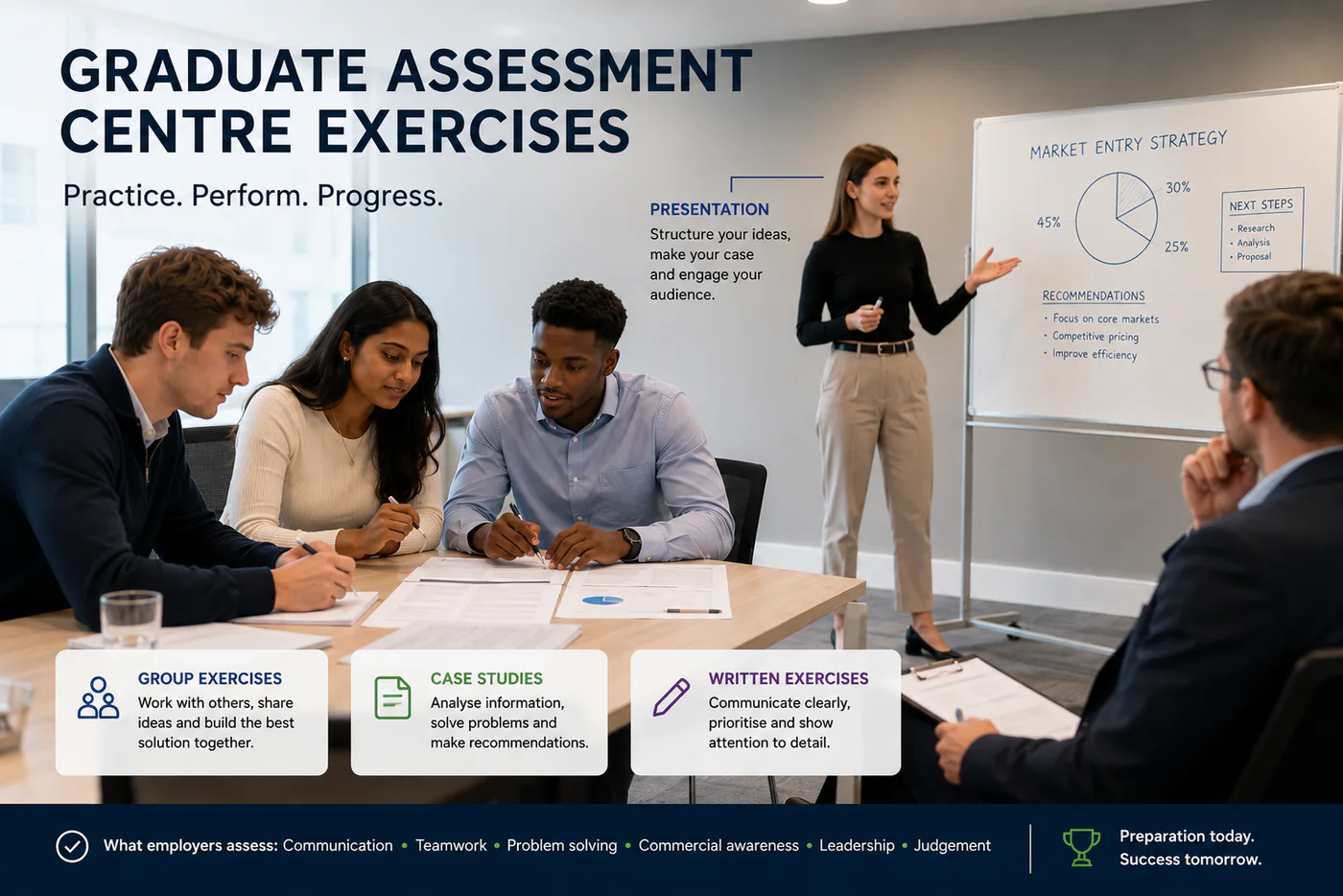
You have reached a graduate assessment centre. The problem is no longer just, “What questions will they ask me?”
The harder question is: what will each exercise make visible about how you think, communicate and work with other people?
This guide is not another general assessment-centre overview. GradSharp already has that in Graduate Assessment Centres in 2026: What UK and Irish Applicants Should Practise. This article is the exercise-by-exercise version: group tasks, case studies, presentations, written exercises, in-tray tasks, role play and interviews.
Use it after you receive an invite or candidate pack. Exact formats vary by employer, role, country and intake, so the live instructions always win. But the same behaviours appear again and again: structure, judgement, teamwork, communication, prioritisation and evidence.
For wider preparation, keep the interviews and assessment centres topic hub open, and use the UK final-year job search timeline if you are still managing multiple applications at once.
Match each exercise to the behaviour
Graduate assessment centre exercises are not random games. They are practical ways to test behaviour under time pressure.
A strong candidate usually does five things:
- understands the brief before rushing into action;
- shows a method, not just an answer;
- communicates clearly without taking over;
- uses evidence, criteria or priorities to justify decisions;
- recovers calmly when challenged, corrected or interrupted.
Prospects lists common assessment-centre activities including case studies, group discussions, in-tray exercises, presentations, psychometric tests, role play, social events and written tests. The National Careers Service frames assessment-centre performance around how candidates work with others, deal with problems, communicate and contribute. KPMG’s public graduate-process page shows the same pattern in employer language: online assessments, video interviews and an in-person final-stage experience are used to see whether candidates can show relevant skills, motivations and potential.
That is the point. The exercise changes. The evidence problem stays the same.
Graduate assessment centre exercises: what each one tests
Use this as a practice map, not as a guarantee that every employer will use every exercise.
| Exercise | What it tests | Weak behaviour | Stronger behaviour | How to practise |
|---|---|---|---|---|
| Group exercise | Teamwork, judgement, listening, communication and decision-making | Dominating, disappearing, repeating others or trying to “win” | Clarifying criteria, inviting input, summarising options and moving the group toward a decision | Run a 15-minute discussion from one brief; practise three useful interventions, not a speech |
| Case study | Problem solving, commercial awareness, analytical thinking and recommendation discipline | Listing facts without choosing, overcomplicating the answer or ignoring trade-offs | Naming the objective, weighing options and giving a clear recommendation with one risk | Turn a one-page business article into a recommendation, risk and next step |
| Presentation | Structure, confidence, judgement and concise communication | Narrating every detail, running out of time or hiding the recommendation | Starting with the answer, giving two reasons, naming a risk and ending with a next step | Prepare a four-minute answer from a short prompt and record it |
| Written exercise | Clear writing, prioritisation, audience awareness and evidence use | Writing a long generic answer, missing the ask or using no structure | Using headings, facts, a recommendation and a tone that fits the audience | Rewrite a messy email or briefing note into a short recommendation |
| In-tray or inbox exercise | Prioritisation, judgement, risk awareness and organisation | Treating every message as equally urgent or answering in arrival order | Sorting by risk, deadline, stakeholder impact and effort, then explaining the order | Rank ten tasks and write why the top three come first |
| Role play | Listening, stakeholder handling, professionalism and calm judgement | Defending yourself, rushing to solve, arguing or ignoring emotion | Clarifying the issue, acknowledging the concern and agreeing a realistic next step | Practise a two-minute difficult conversation with a friend or voice note |
| Interview | Motivation, evidence, reflection and fit | Memorised STAR answers, vague actions or generic motivation | Specific examples tied to the role, employer and behaviour being tested | Build five flexible examples and adapt them to the job description |
| Online test or psychometric task | Reasoning, judgement or work-style fit, depending on the test | Guessing the format or practising the wrong thing | Reading the invite, using official practice material where available and managing time | Complete only relevant practice tests; review errors rather than only scores |
The table matters because most candidates practise in the wrong direction. They research the employer for hours, then arrive unable to show judgement in a group task or structure a written answer in 20 minutes.
If your invitation names a numerical, verbal, logical, situational-judgement or work-style assessment, move to the dedicated graduate psychometric tests preparation guide rather than using generic assessment-centre practice.
Group exercise: how assessors read behaviour
A graduate assessment centre group exercise normally gives several candidates a shared brief: a business problem, a client decision, a policy choice, a project prioritisation task, a budget constraint or a ranking exercise. You may not be asked to “lead”. You are still being watched.
Strong group exercise performance is not the same as talking the most. It is also not the same as being friendly but passive.
Assessors may notice whether you:
- understand the task;
- help the group agree criteria;
- listen before responding;
- use evidence from the brief;
- involve other people;
- disagree without turning the exercise into a personal debate;
- move the group toward a decision before time runs out.
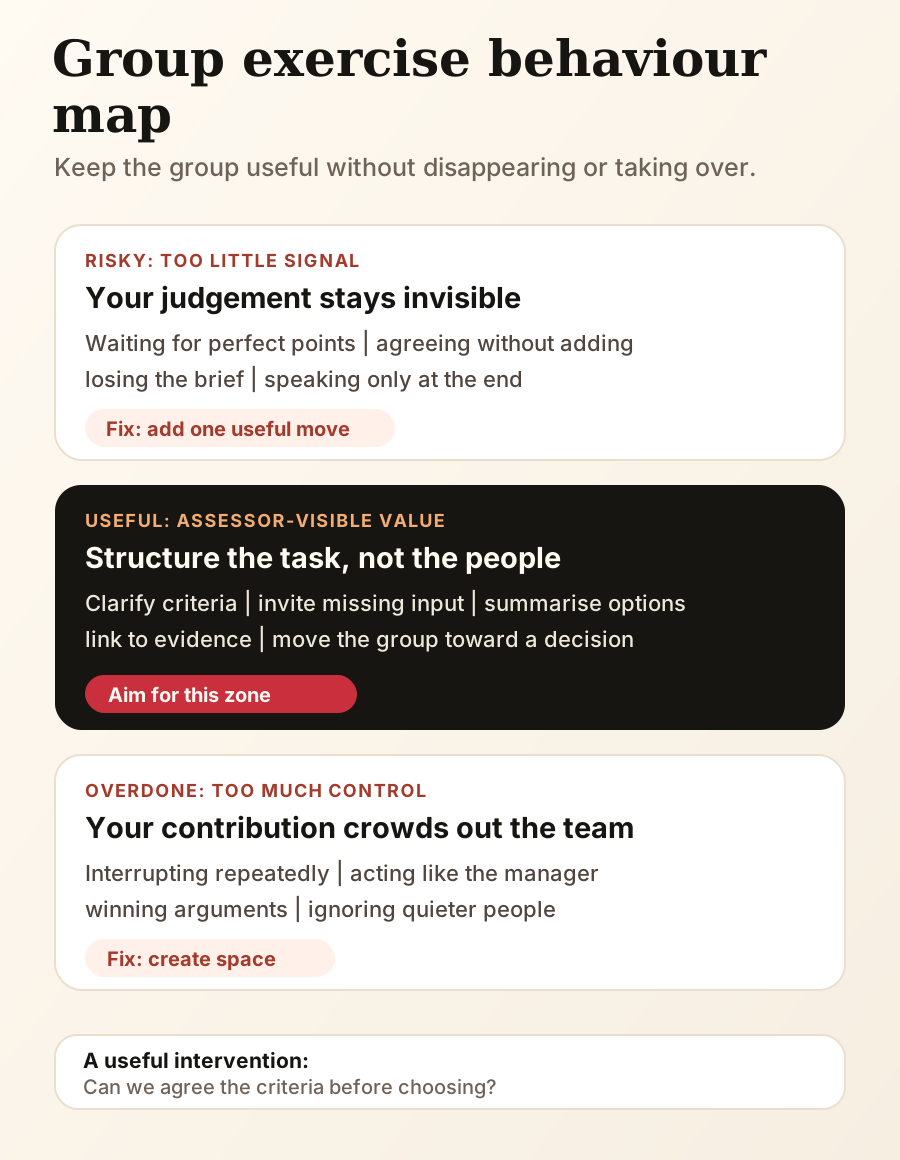
| Behaviour | What it may signal | Stronger alternative |
|---|---|---|
| Interrupting repeatedly | You may struggle to listen or collaborate | Write your point down, then enter with “Can I build on that?” |
| Saying nothing until the end | The group cannot see your judgement | Make one short contribution every few minutes |
| Repeating someone else’s idea with different words | You want airtime but are not adding value | Add a consequence, risk or criterion to the idea |
| Ignoring the brief | You are solving a different problem | Point back to the task objective: “The brief asks us to prioritise cost and speed” |
| Trying to chair the whole discussion | You may be controlling rather than collaborative | Offer structure, then let others own parts of the task |
| Inviting quieter people in | You help the group use more information | ”We haven’t heard from Aisha yet; does your option change the risk?” |
| Summarising options | You help the group make progress | ”So far we have two options: faster but riskier, or slower but cheaper” |
| Changing your mind when evidence changes | You can reason rather than defend ego | ”I started with Option A, but the customer data makes Option B stronger” |
A useful group exercise phrase is usually short and task-linked:
“Before choosing, can we agree the criteria? The brief seems to prioritise customer impact, cost and delivery speed.”
A weaker phrase is often vague or performative:
“I think communication is important and everyone should have a voice.”
The second sentence sounds positive, but it does not move the task forward. In a group exercise, good behaviour is visible through decisions, not slogans.
Case study exercise: the framework that keeps your answer useful
A case study exercise gives you information and asks you to solve a problem. The context could be a client, a market, an internal project, a public-service scenario, a financial decision, an operations issue or a customer complaint.
The trap is reading everything and then trying to show that you noticed everything. Case studies reward selection. You need to decide what matters.
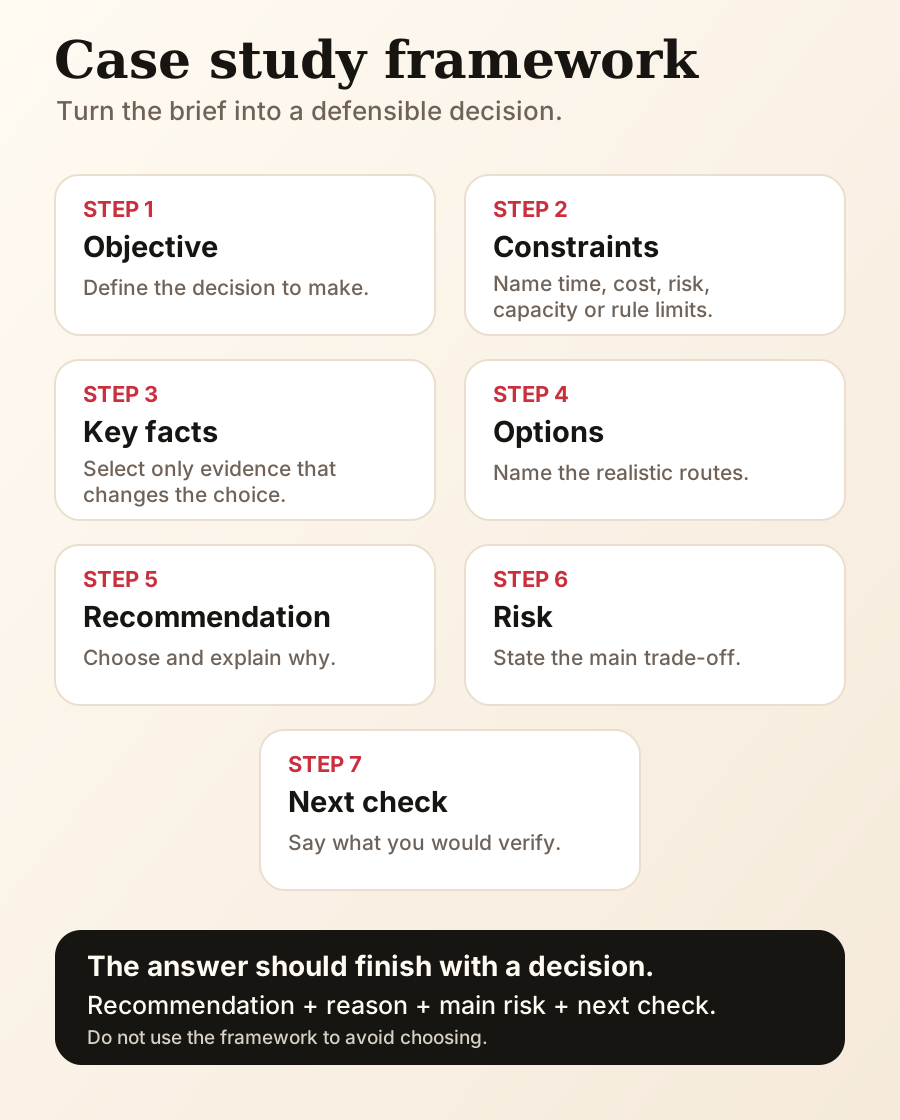
Use this framework:
- Objective: What is the decision or problem?
- Constraints: What limits the answer: time, cost, customer risk, capacity, regulation, data quality?
- Key facts: Which three or four facts are actually decision-relevant?
- Options: What are the realistic routes?
- Recommendation: Which option would you choose and why?
- Risk: What could go wrong?
- Next check: What would you verify before acting?
A weak case-study answer says:
“There are several benefits and disadvantages to each option. More research is needed.”
A stronger answer says:
“I recommend Option B because it meets the customer objective faster while keeping cost risk manageable. The main risk is delivery capacity, so I would test it with a small pilot before full rollout.”
The stronger answer is not necessarily more complex. It is more useful. It gives the assessor a decision, a reason, a risk and a next step.
Presentation exercise: how to structure three to five minutes
A presentation exercise may ask you to present a recommendation from a case study, explain a prepared topic, summarise a brief, or respond to a business scenario. Sometimes you prepare in advance. Sometimes you get a short window on the day.
Do not treat the presentation as a memory test. Treat it as a structure test.
For a four-minute answer, use this timing plan:
| Time | Job of this section | What to say |
|---|---|---|
| 0:00-0:30 | Headline answer | ”I recommend…” or “My conclusion is…“ |
| 0:30-1:30 | First reason | The strongest piece of evidence or criterion |
| 1:30-2:30 | Second reason | A second evidence point or trade-off |
| 2:30-3:15 | Risk | What could go wrong or what needs managing |
| 3:15-4:00 | Next step | What should happen after the recommendation |
If you are given five minutes, add more explanation, not more points. A common graduate mistake is trying to cover six ideas thinly. Two reasons plus one risk is usually easier to follow than a rushed list of everything you read.
After the presentation, expect questions. The assessor may challenge your assumption, ask why you rejected another option, or test whether you can think beyond the script. A useful answer starts by accepting the question:
“That’s a fair challenge. If cost became the main criterion, I would adjust the recommendation. My original choice assumed customer impact was weighted more heavily.”
That sounds better than pretending your answer has no weakness.
Written exercise: how to avoid panic-writing
A written exercise may ask for an email, a short report, a recommendation note, a briefing summary or a response to a stakeholder. The employer is usually checking whether you can read, prioritise and write clearly under time pressure.
The strongest written answers are rarely the longest. They are usually the easiest to follow.
Before writing, answer these eight checks:
| Check | Question to ask |
|---|---|
| Audience | Who is reading this: manager, client, colleague, customer, public user? |
| Objective | What must the reader decide or understand? |
| Key facts | Which facts from the prompt directly support the answer? |
| Recommendation | What should happen next? |
| Risk | What needs caution or escalation? |
| Tone | Should this sound formal, helpful, urgent, reassuring or analytical? |
| Next step | What action should the reader take? |
| Proofread | Are names, numbers, dates and instructions consistent with the brief? |
Use headings if the format allows it. For example:
Recommendation
I recommend...

Reason
The strongest evidence is...

Risk
The main risk is...

Next step
I would confirm...
That is not fancy writing. It is assessor-friendly writing.
For more on turning ordinary experience into evidence, use GradSharp’s guide to what counts as work experience for UK and Irish graduate jobs. Written exercises often reward the same skill: turning messy reality into clear evidence.
In-tray or inbox exercise: prioritisation under pressure
An in-tray or inbox exercise gives you messages, tasks, documents or requests. You may need to rank them, reply to some, escalate others, or explain your plan.
The weak approach is first come, first served. The stronger approach is to sort by criteria.
| Priority bucket | What belongs here | Candidate action |
|---|---|---|
| Urgent and high impact | Safety, legal, customer, client, reputational or delivery risks | Act, escalate or flag immediately |
| Important but not urgent | Strategic work, planning, stakeholder preparation | Schedule and protect time |
| Low impact or admin | Routine updates, non-critical messages, low-risk paperwork | Batch or defer |
| Unclear / needs clarification | Missing facts, conflicting instructions, ambiguous ownership | Ask one clear question before acting |
A strong explanation might say:
“I would handle the client-risk message first because it affects today’s delivery and has reputational impact. I would then update the manager on the resource issue, because that could affect tomorrow’s work. I would batch the routine admin after the time-sensitive items are controlled.”
That answer shows judgement. It does not just list tasks.
Role play: judgement, listening and tone
Not every assessment centre uses role play. When it appears, it usually tests how you handle a stakeholder conversation: a customer complaint, a colleague conflict, a manager request, a client concern or a difficult trade-off.
The goal is not acting. The goal is professional behaviour.
A reliable structure is:
- Listen: Let the concern become clear.
- Clarify: Ask one or two useful questions.
- Acknowledge: Show you understand the impact.
- Set boundaries: Be honest about what you can and cannot do.
- Next step: Agree a realistic action or escalation.
Avoid becoming defensive. Also avoid promising something the brief does not allow. A calm, limited next step is usually stronger than a dramatic promise.
Interview inside the assessment centre
Some assessment centres include a competency, strengths, motivational or final interview. It may come after exercises, which means you could be tired. Do not treat it as separate from the day.
The interview is where assessors may check whether the evidence in your CV, application and exercises lines up.
Prepare five flexible examples:
- teamwork;
- problem solving;
- communication;
- resilience or learning from a setback;
- customer, stakeholder or responsibility evidence.
For each example, know:
| Part | What the assessor needs |
|---|---|
| Situation | Enough context to understand the problem |
| Task | What you personally needed to do |
| Action | The specific steps you took |
| Result | What changed, improved or was learned |
| Reflection | What you would repeat or improve next time |
The action is the most important part. A polished story where your role is unclear is weaker than a simple part-time work example where your judgement is visible.
The 7-day practice plan
Do not spend seven days reading employer websites. Produce outputs.
| Day | Practice task | Output | Why it helps |
|---|---|---|---|
| Day 1 | Decode the candidate pack, job description and employer values | One-page skill map: exercises, behaviours, evidence needed | Stops you preparing for the wrong thing |
| Day 2 | Practise group exercise behaviour | Three useful phrases and one time-check phrase | Makes collaboration visible without dominating |
| Day 3 | Practise a case study framework | One-page recommendation with objective, facts, option, risk and next step | Builds decision discipline under pressure |
| Day 4 | Practise a timed presentation | Four-minute recorded answer | Reveals whether your answer has a headline or only detail |
| Day 5 | Practise written and inbox tasks | One short email and one ranked priority list | Trains clarity and prioritisation |
| Day 6 | Rehearse interview evidence | Five flexible examples tied to the role | Prevents generic STAR answers |
| Day 7 | Logistics, rest and light review | Route or tech check, ID, notes, outfit, sleep plan | Reduces avoidable stress on the day |
If you only have 48 hours, compress the plan. Do Day 1, one case study, one presentation, one written task and five evidence examples. Do not try to learn everything.
Common mistakes
The most common mistakes are not mysterious.
| Mistake | Why it hurts | Better move |
|---|---|---|
| Trying to win the group exercise | It makes teamwork look like competition | Help the group reach a reasoned decision |
| Speaking too much | Assessors may see poor listening | Make fewer, sharper contributions |
| Speaking too little | Assessors cannot score invisible judgement | Add one useful point every few minutes |
| Ignoring the brief | You solve the wrong problem | Read the objective, constraints and required output twice |
| Failing to recommend | You sound analytical but indecisive | Choose, justify, name a risk |
| Writing too much | The main point gets buried | Use headings and short paragraphs |
| Using generic employer research | It sounds copied | Tie research to the specific role or exercise |
| Forgetting live instructions | Generic advice beats the candidate pack in your preparation | The employer’s pack is the source of truth |
| Treating informal moments as fake | You may act careless between exercises | Stay professional without becoming paranoid |
A good candidate is not flawless. A good candidate is prepared, aware and easy to work with.
What to do when the format is virtual
Virtual assessment centres can still test the same behaviours, but the signals are harder to show.
Check these before the day:
- camera, microphone and internet connection;
- platform link and login method;
- whether you need a shared document, whiteboard or calculator;
- whether chat is allowed for questions;
- whether you can use notes;
- how to contact the recruiter if technology fails.
During a virtual group task, signpost your contributions clearly:
“I have one point on customer risk, then I would like to hear from someone who has looked at cost.”
That sentence helps remote collaboration because it tells the group what you are doing and creates space for others.
Do not overuse chat unless the exercise invites it. Chat can support links or short notes, but if the task is a spoken discussion, hiding in chat may make your contribution less visible.
FAQ
What exercises are in a graduate assessment centre?
Common exercises include group discussions, case studies, presentations, written exercises, in-tray or inbox tasks, role play, interviews and psychometric or online tests. Not every employer uses every exercise, so follow the live candidate pack first.
How do I practise graduate assessment centre exercises?
Practise outputs. Write a one-page case recommendation, record a four-minute presentation, rank ten inbox tasks, prepare five evidence examples and run a short group discussion with a time limit.
Is the group exercise the most important part?
Not always. Employers usually look across several exercises. A strong group exercise can help, but it may not outweigh a weak interview, poor written task or unclear motivation.
What is a case study exercise in a graduate assessment centre?
It is usually a short business, client, policy or operational problem where you read information and recommend an action. A useful answer states the objective, key facts, options, recommendation, risk and next step.
How long should an assessment-centre presentation be?
Use the time stated in the candidate pack. If the invite gives three to five minutes, start with the recommendation, give two reasons, name one risk and finish with a next step. Do not fill the time with background.
What is an in-tray or inbox exercise?
It is a prioritisation task. You receive messages, documents or requests and decide what to do first. Strong answers explain priority by risk, deadline, stakeholder impact and effort.
Can you fail one exercise and still pass the assessment centre?
Sometimes a weaker exercise can be balanced by stronger performance elsewhere, but you should not rely on that. Prospects notes that assessment centres let candidates show a wider range of skills than a single interview, and employers may consider performance across the day.
Should I prepare examples before the assessment centre?
Yes. Prepare examples for teamwork, problem solving, communication, resilience and stakeholder work. The examples should be flexible enough for interviews, role play, written tasks and follow-up questions.
Sources checked
This article was checked against Prospects assessment-centre guidance, National Careers Service interview and assessment-centre advice, GOV.UK Civil Service Success Profiles, KPMG public graduate application-process guidance and GradSharp’s existing assessment-centre pillar.
Prospects was used for common exercise types and assessment-centre format. National Careers Service was used for broad preparation guidance and the idea that employers look at how candidates work with others, solve problems, communicate and contribute. GOV.UK Success Profiles was used as a public example of recruitment frameworks that separate behaviours, strengths, ability, experience and technical evidence. KPMG was used as a public employer example showing that graduate processes can combine online assessments, video interviews and in-person final-stage activities.
Assessment-centre formats change by employer, role, country and intake. Always follow the live invitation, candidate pack and employer instructions before relying on any general guide.
Practise the behaviour each exercise exposes
Prepare for graduate assessment centre exercises by practising the behaviour each task makes visible.
A group exercise shows how you work with others. A case study shows how you decide. A presentation shows whether you can structure a recommendation. A written task shows whether you can prioritise and communicate. An in-tray exercise shows judgement under pressure. An interview shows whether your evidence and motivation are real.
That is why vague advice like “be confident” is not enough. Confidence helps only when it carries a useful method.