Stamp 1G to Critical Skills Permit: A Job Search Plan for International Graduates in Ireland
A practical Stamp 1G job search plan for international graduates in Ireland aiming for a Critical Skills Employment Permit.

International graduates in Ireland often treat Stamp 1G as “extra time to find any job”. That is risky. Stamp 1G gives you time to work and search after study, but it is not a long-term work route by itself. If your goal is to stay in Ireland after graduation, your job search needs to be built around permit eligibility from the beginning, especially if you are aiming for a Critical Skills Employment Permit.
The practical answer is this: start with the permit, then work backwards to the job search. Check whether your target roles appear on the Critical Skills Occupations List, whether the salary is likely to meet the current threshold, whether the employer is willing to support the process, and whether your timeline leaves enough time before Stamp 1G expires. This article is general information, not immigration advice. Always check current Irish Immigration Service Delivery and Department of Enterprise, Tourism and Employment guidance before acting.
The route in one page
Stamp 1G is useful because it gives eligible non-EEA graduates time to seek graduate-level employment in Ireland and, where appropriate, apply for an employment permit. But the graduates who use it best do not wait until month ten to think about permits.
A strong Stamp 1G plan has four parts: permit fit, salary fit, employer fit and timing fit. Your target role should be eligible, paid at or above the relevant threshold, supported by an employer who can handle the process, and pursued early enough to avoid expiry pressure.
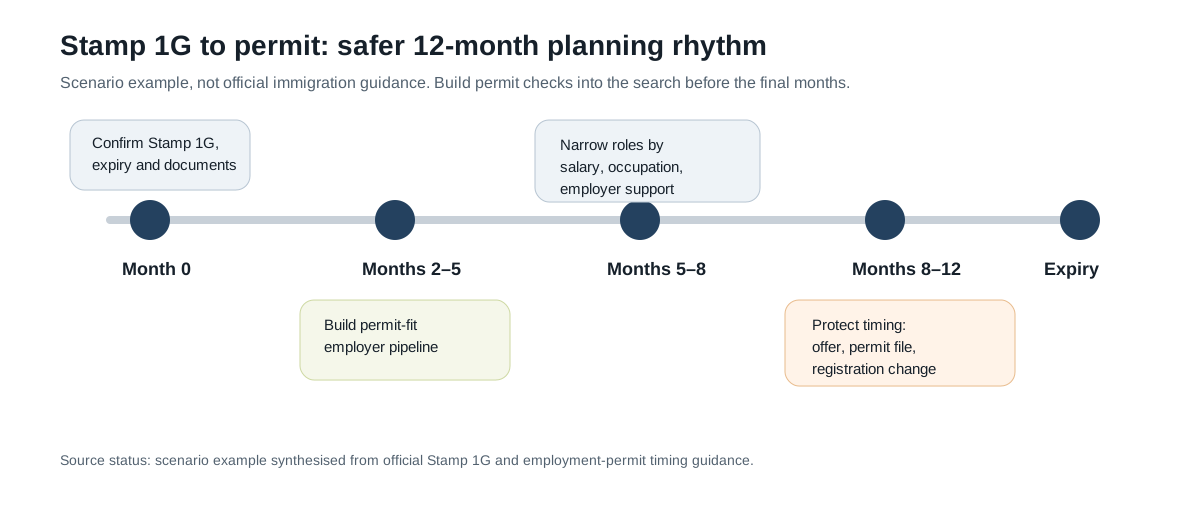
Chart label: scenario example. This timeline is not official immigration guidance. It shows a safer planning rhythm for graduates with 12 months of Stamp 1G permission.
What Stamp 1G does and does not do
Immigration Service Delivery’s Third Level Graduate Programme guidance sets out who can use Stamp 1G after an eligible Irish award and the conditions attached to the permission. The programme is intended to give eligible graduates time to seek graduate-level employment and apply for an employment permit or research hosting agreement.
For Level 8 graduates, the permission is normally 12 months. For Level 9 or above graduates, the permission is initially 12 months and may be renewed for a further 12 months where the graduate satisfies immigration authorities that they have taken appropriate steps to access suitable graduate-level employment. Current official guidance also says graduates must apply within six months of being notified that they achieved the award.
Stamp 1G lets graduate students work full time in accordance with employment law requirements. However, it does not let you operate a business or be self-employed. It is also not a promise that an employer will sponsor you later. If you want to continue working after Stamp 1G expires, you usually need a job that supports an employment permit route.
That distinction matters. A graduate job can be good for experience but weak for immigration progression. A permit-fit job is one where the occupation, pay, contract, employer and timing can realistically support the next permission.
What a Critical Skills Employment Permit requires
The Critical Skills Employment Permit is designed for highly skilled roles and can be attractive because it is linked to longer-term residence options. But it is not available for every graduate job.
Based on current DETE Critical Skills guidance, eligibility is largely determined by occupation and remuneration. The main graduate-relevant route is a role on the Critical Skills Occupations List, with the relevant degree qualification or higher, and minimum annual remuneration of €40,904. Where the applicant received their relevant qualification within the 12 months before the permit application date, the lower recent-graduate threshold is €36,848. Other salary routes and exceptions have additional conditions; verify the live page and current occupation list before relying on a figure.
The job offer normally needs to be for two years in an eligible occupation. The prospective employee must have the relevant qualifications, skills and experience for the role. The employer also has to meet conditions, including the 50:50 rule in many cases, where at least 50% of employees in the firm are EEA nationals at the time of application. There are exceptions for some eligible start-ups supported by Enterprise Ireland or IDA Ireland.
The key point for graduates is that “professional-sounding” is not enough. A business analyst, marketing executive, research assistant, junior developer, engineer, lab scientist or financial analyst role may have very different permit implications depending on its exact occupation code, duties, salary, employer and whether the role is covered by the relevant list.
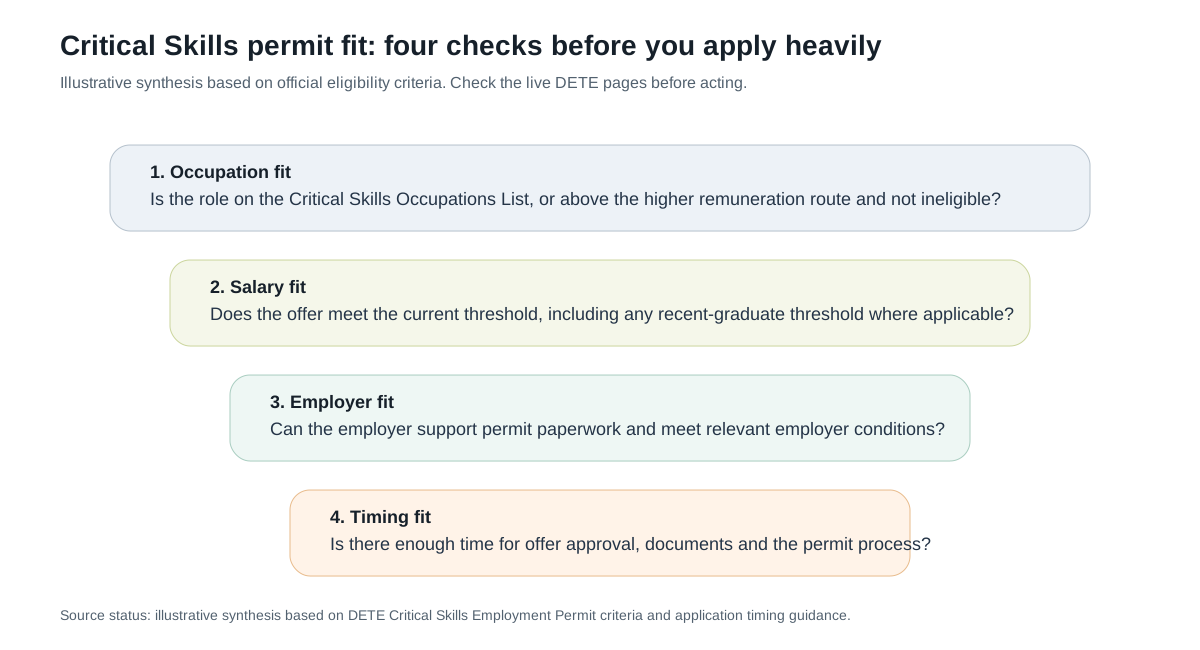
Chart label: illustrative synthesis based on official eligibility criteria. It simplifies the checks graduates should make before investing heavily in an application.
Build your job search around permit fit
Most graduates search by job title first. International graduates on Stamp 1G should search by permit logic first, then job title. Create three employer lists.
List A: high-fit roles
These are roles where the occupation appears likely to match the Critical Skills Occupations List, the salary range appears likely to meet the relevant threshold, and the employer has the scale or international hiring experience to handle permit conversations.
Examples may include some roles in software engineering, data, cyber security, certain engineering disciplines, scientific manufacturing, healthcare and other listed shortage areas. Do not rely on sector labels alone. Check the actual occupation description and live job duties.
List B: possible but uncertain roles
These are roles that could become permit-fit, but only if the duties, salary and employer support line up. Some analyst, operations, product, supply chain, finance, business or consulting roles may sit here depending on the exact role.
For these, do not ask only “Will this company sponsor me?” First ask: does this role have a plausible permit route at all? If the answer is unclear, keep the role in your search but do not let it dominate your pipeline.
List C: experience roles with weak permit progression
These may be useful for income, Irish work experience or confidence, but they are unlikely to convert to a Critical Skills route. They may still matter, especially early in Stamp 1G, but they should not consume the months when you need to build a permit-ready pipeline.
A safer 12-month Stamp 1G plan
The worst plan is to apply broadly for nine months and only investigate permits when an offer appears. By then, you may have too little time to change target roles, negotiate salary, collect documents or wait for processing.
Months 0–2: set the permit strategy
Confirm your Stamp 1G registration, expiry date, course level and award evidence. Save your final award letter, transcript, passport, IRP details and proof of medical insurance where relevant. Then identify your realistic permit routes: Critical Skills, General Employment Permit or research hosting agreement.
Create a spreadsheet with columns for employer, role title, location, occupation fit, salary evidence, permit route, deadline, application stage and follow-up date. Every role should have a permit note. If you cannot explain how the role could support your next permission, mark it as uncertain.
Months 2–5: build a targeted pipeline
Prioritise roles with clear skills alignment. A generic international graduate application usually fails because it tries to be flexible. A stronger application says: “I match this shortage skill, I can do this job, and the employer can justify hiring me.”
For technical roles, show projects, tools, methods, placements and measurable outcomes. For business roles, show commercial evidence, data work, client exposure, process improvement or regulated-sector awareness. Ask careers services, alumni and recruiters which job families in your field have recently led to employment permits.
Months 5–8: narrow and escalate
By the middle of Stamp 1G, your search should become less broad, not more desperate. Review the data. Which roles produce interviews? Which employers respond positively to work-permission questions? Which job titles keep failing because the duties or salary do not fit?
If you are not getting interviews, fix your CV and targeting. If you are getting interviews but no offers, fix your evidence, examples and interview performance. If you are getting offers that cannot support a permit, your role targeting may be wrong.
Months 8–12: protect your immigration timeline
At this stage, timing becomes a risk. Employment permit applications must be received at least 12 weeks before the proposed employment start date, according to current DETE guidance. That does not mean you should wait until 12 weeks before expiry. You need time for interviews, offer approval, employer paperwork, possible clarifications and immigration registration changes.
If you are Level 9 or above and may be eligible for a further 12 months of Stamp 1G, gather evidence that you have taken appropriate steps to access suitable graduate-level employment, such as job applications, interviews and graduate recruitment agency engagement. Do not assume renewal is automatic.
How to discuss sponsorship with employers
Many graduates ask too early or too vaguely. “Do you sponsor visas?” can trigger a fast rejection, especially when the recruiter does not understand your current permission.
A better approach is staged. In the application, be accurate about your current right to work. If a form asks whether you currently have permission to work, answer honestly. If it asks whether you will need sponsorship or an employment permit in future, answer honestly.
At recruiter-screen or interview stage, explain the timing clearly:
“I currently hold Stamp 1G permission, which allows me to work full time. For longer-term employment after that permission, I would need the role and employer to support an employment permit application. I’m checking this early because I want to be transparent about timing.”
Before accepting an offer, check four things in writing where possible: contract length, salary, occupation duties, and who will handle the employment permit process. Also check whether the employer has sponsored similar roles before. A large employer is not automatically sponsor-friendly for every graduate job.
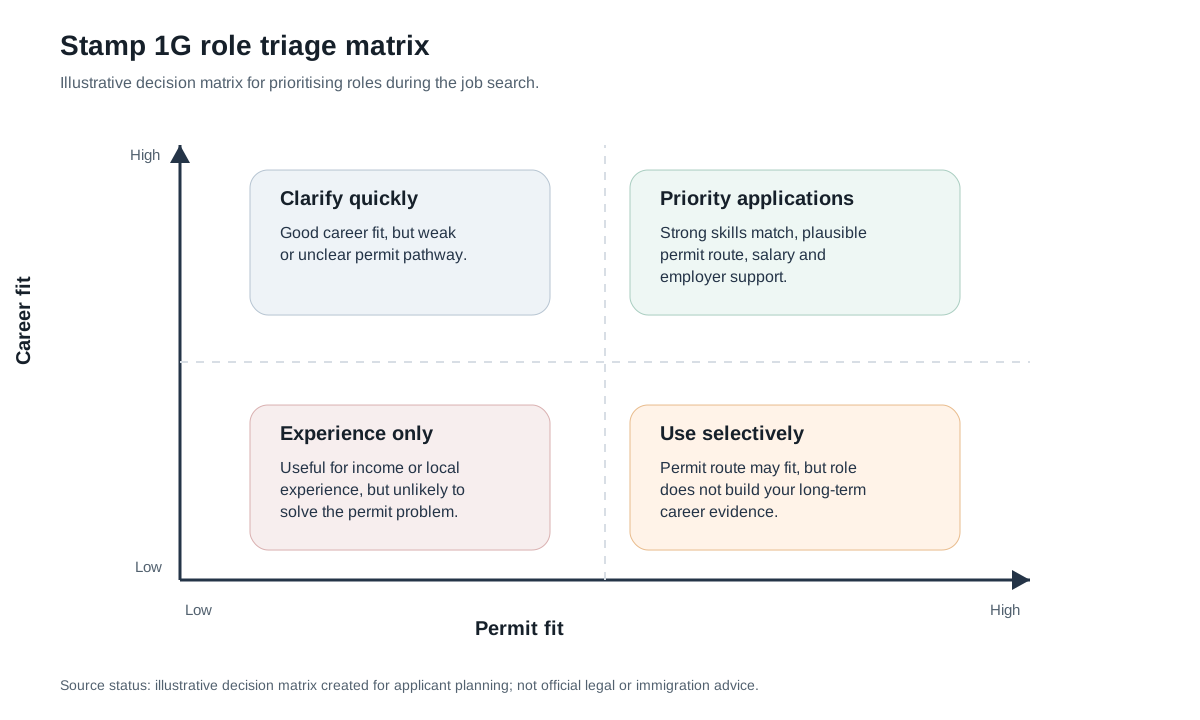
Chart label: illustrative decision matrix. It is designed for applicant planning, not as official legal or immigration advice.
Common mistakes
Mistake 1: treating Stamp 1G as a guarantee
Stamp 1G gives time and work permission, not a permanent pathway. The pathway depends on the job you secure and whether it qualifies.
Mistake 2: applying only to famous graduate schemes
Some large graduate schemes may be excellent, but they are not the whole market. Smaller specialist employers, regulated-sector firms, engineering consultancies, labs, healthcare employers and technology companies may offer better role fit.
Mistake 3: ignoring salary until offer stage
A role below the relevant threshold may be valuable experience, but it may not solve the immigration problem. Salary fit should be assessed early.
Mistake 4: assuming every skilled role is on the Critical Skills list
The Critical Skills Occupations List is specific. Some roles are listed only where particular specialist skills apply. If your employment falls within a broad category but not the listed specialism, you may not be eligible.
Mistake 5: focusing on “any job in Ireland”
For international graduates, the better question is: “Which jobs in Ireland can realistically become a permit-supported job before my current permission expires?”
Checklist before applying heavily to a role
- Is the role graduate-level and aligned with your qualification or experience?
- Does the occupation appear on the Critical Skills Occupations List, or could it meet the higher remuneration route?
- Is the role excluded by the Ineligible List?
- Does the salary meet the relevant threshold, including recent-graduate rules if applicable?
- Is the job offer likely to be for at least two years if aiming for Critical Skills?
- Is the employer based and trading in Ireland?
- Does the employer appear able to support permit paperwork?
- Does your CV prove the skills named in the role description?
- Is there enough time before your Stamp 1G expires?
- Have you checked the latest official guidance?
FAQ
Can I work full time on Stamp 1G?
Graduate students on Stamp 1G can work full time in accordance with employment law requirements. They are not permitted to operate a business or be self-employed.
Is Stamp 1G the same as sponsorship?
No. Stamp 1G is an immigration permission that gives eligible graduates time to seek employment. Sponsorship or employment permit support is a separate employer and permit process.
Do I need a Critical Skills Employment Permit to stay in Ireland?
Not always. Some graduates may use a General Employment Permit or research hosting agreement, depending on their role and circumstances. Critical Skills is attractive for many shortage-skill roles, but it is not the only route.
What salary do I need for a Critical Skills Employment Permit?
As of the March 2026 threshold changes reflected in DETE guidance, the main Critical Skills threshold is €40,904 for listed occupations. A lower €36,848 threshold may apply where the applicant received their qualification within the 12 months before the permit application date. A higher route applies to roles over €68,911 that are not ineligible. Always check the live DETE page before relying on a figure.
Should I tell employers about Stamp 1G?
Yes, but explain it accurately. You can say you currently have Stamp 1G permission to work full time, and that longer-term employment would require the appropriate employment permit process.
Build a permit-aware employer list
First, check your exact Stamp 1G expiry date and whether you are Level 8 or Level 9+. Save your award evidence and registration documents.
Second, open the current Critical Skills Occupations List and Ineligible List. Search for your target job families, not just your preferred job titles.
Third, make a 30-employer list split into high-fit, possible-fit and experience-only roles. For each employer, add salary evidence, likely permit route and application deadline.
Fourth, rewrite the top third of your CV so it proves the skills that matter for your target permit-fit roles. Do not lead with “international student seeking sponsorship”. Lead with the skill evidence that makes the employer want to keep reading.
Finally, book one careers appointment or recruiter conversation with a specific question: “Which roles in my field are most realistic for Stamp 1G graduates trying to move to an employment permit?” Stamp 1G is valuable time. Use it like a conversion window, not a waiting room.
Source and accuracy notes
This article was prepared using official public guidance from Irish Immigration Service Delivery and the Department of Enterprise, Tourism and Employment, checked on 22 May 2026. Immigration and employment-permit rules can change. Readers should check the current official pages before making decisions.
- Irish Immigration Service Delivery: Third Level Graduate Programme
- Irish Immigration Service Delivery: Immigration permission stamps
- Department of Enterprise, Tourism and Employment: Critical Skills Employment Permit
- Department of Enterprise, Tourism and Employment: Critical Skills Occupations List
- Department of Enterprise, Tourism and Employment: Ineligible List of Occupations
- Department of Enterprise, Tourism and Employment: employment permit salary threshold roadmap
Related GradSharp reading
- If your Stamp 1G permission is running down, read Stamp 1G Job Search Timeline: What to Do in Your Final Six Months.
- For broader Ireland targeting, use International Graduates: Where the UK and Ireland Actually Hire.