Stamp 1G Job Search Timeline: What to Do in Your Final Six Months
A practical final-six-month plan for international graduates in Ireland on Stamp 1G, including permit-aware job targeting and timing.

If your Stamp 1G permission in Ireland has six months left, the problem is no longer “how do I find a graduate job?” It is “how do I find a realistic job before my permission runs out, without wasting time on employers or roles that cannot support the next step?”
The honest answer is that your final six months need a permit-aware job search. That does not mean every role must lead directly to a Critical Skills Employment Permit. It means you should understand the difference between a role you can do on Stamp 1G, a role an employer may consider for an employment permit, and a role that is unlikely to help you stay in Ireland after Stamp 1G.
This article is not immigration legal advice. It is a practical job-search plan for international graduates in Ireland who are approaching the end of Stamp 1G. Always check current Irish Immigration Service Delivery and Department of Enterprise, Tourism and Employment guidance before making decisions.
For the broader permit strategy, read GradSharp’s guide to Stamp 1G to Critical Skills Permit. This article is narrower: it focuses only on the final six months.
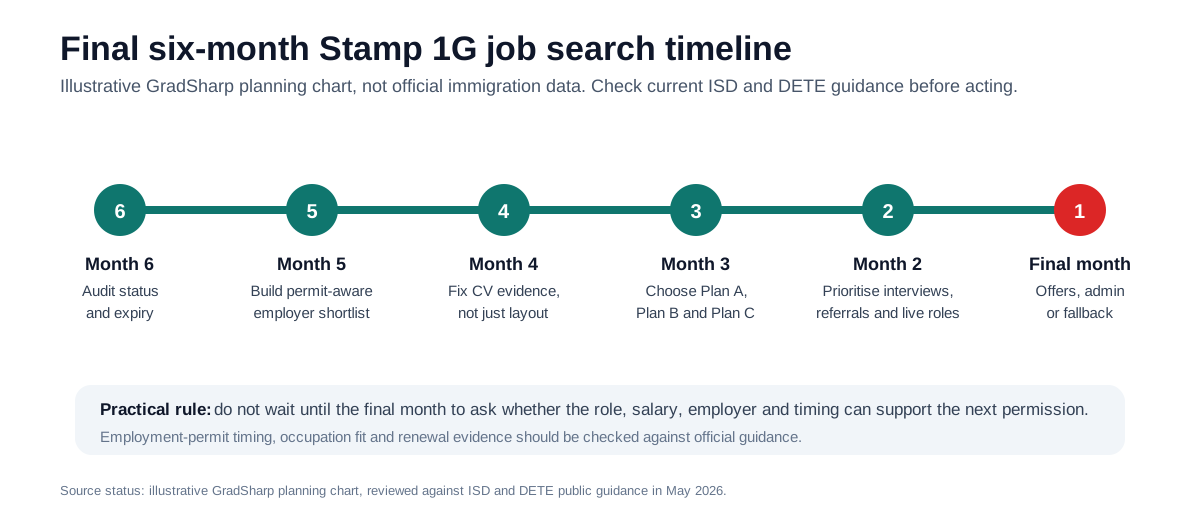
The six-month priority shift
In your final six months on Stamp 1G, your priorities should be:
- Confirm your exact permission end date and renewal position. Do not rely on memory, WhatsApp advice or what applied to a friend.
- Target roles that match your degree, skill level and likely permit route. A job title alone is not enough.
- Build a shortlist of employers that understand international hiring. A large employer is not automatically a sponsor-friendly employer for every graduate role.
- Apply earlier than you think. Some employment permit applications must be received at least 12 weeks before the proposed start date, so leaving everything until the final month is risky.
- Keep evidence of your search. This is especially important if you are a Level 9 or above graduate seeking a further 12 months under the Third Level Graduate Programme.
- Have a fallback plan by month three. The fallback may be a different role type, a different Irish region, a return-home plan, another country, or further study only where it is genuinely sensible.
First: what Stamp 1G actually gives you
Immigration Service Delivery’s Third Level Graduate Programme guidance states that eligible Level 8 graduates may receive 12 months, while Level 9 or above graduates may receive 12 months initially and, subject to conditions, a further 12 months. It also says applicants for that further period must show appropriate steps towards suitable graduate-level employment. Check the live page for the complete conditions and time limits.
That final point matters. Stamp 1G is not just “extra time in Ireland”. It is time to progress towards suitable employment. If your plan is vague until the final few weeks, you are making the route harder for yourself.
ISD’s Stamp 1G information also lists documents for the Third Level Graduate Programme, including a copy of the award, passport, medical insurance and a registration fee. Requirements can change, so check the live ISD page before registering or renewing.
Why the final six months are different
At the start of Stamp 1G, you can test the market. You can apply broadly, learn how Irish employers respond to your CV, improve interview answers and work out which sectors are realistic.
With six months left, the search becomes more constrained. You still need a job, but you also need enough time for the employer to understand your status, issue the right offer, prepare documents if a permit route is relevant, and handle delays. The Department of Enterprise, Tourism and Employment says an employment permit application must be received at least 12 weeks before the proposed employment start date. That does not mean every graduate role needs a permit immediately, but it does show why a last-minute job search is dangerous.
The other issue is salary and occupation fit. A role may be legal for you to do while you have Stamp 1G, but not suitable for a later employment permit. For example, Critical Skills Employment Permit eligibility depends heavily on the occupation, remuneration and job offer. DETE guidance says a Critical Skills role generally needs a job offer of at least two years and must meet occupation and pay criteria. General Employment Permits have different criteria and include a broader range of occupations, but still require eligibility checks and salary thresholds.
Your six-month plan should therefore sort roles into three groups:
- Strong target roles: closely linked to your degree or experience, at a realistic salary, and in an occupation area that may fit Critical Skills or General Employment Permit rules.
- Useful bridge roles: can build Irish experience and income, but may not solve your long-term permission issue.
- Low-value applications: unlikely to interview you, unlikely to progress you, or unlikely to fit any permit route.
The goal is not to become an immigration expert. The goal is to stop spending most of your energy on the third group.
Month six: audit your status before applying harder
When six months remain, start with an audit. Many graduates skip this because it feels less productive than sending applications. It is often the most important step.
Create one document with:
- your IRP expiry date;
- your qualification level;
- your award date;
- whether this is your first or second year on Stamp 1G;
- your target occupations;
- your current CV version;
- your interview pipeline;
- your salary floor;
- your location flexibility;
- your evidence of job-search activity.
Then check your permission category against official guidance. ISD’s Third Level Graduate Programme page is the starting point for Stamp 1G duration, renewal and document requirements. If you are not sure whether you are eligible for a further period, ask the relevant official service or a qualified adviser rather than guessing.
This is also the month to decide whether your target market is too wide or too narrow. A common mistake is applying for “anything in business” or “anything in tech”. Employers hire for specific jobs with specific duties, salary bands and business needs. By the end of month six, you should be able to describe your target role, sector, location range and reason for fit in one sentence.
Month five: build a permit-aware employer shortlist
Month five is about focus. You need a shortlist of employers and roles that are worth repeated attention.
Start with sectors where your degree and experience make sense. Common examples for international graduates in Ireland include pharma and biopharma, medical devices, engineering, data analytics, software, accounting, audit, financial services, construction, supply chain and some healthcare-related roles. This does not mean those sectors are easy. It means they are more likely to contain structured graduate hiring, skills shortages or roles where the business case for international hiring can be clearer.
Then test each role against three questions.
First, does the job actually match my qualification and evidence? A data analytics graduate with no SQL, Python, dashboard or business-analysis evidence will struggle to compete for analyst roles.
Second, does the role appear to sit in an eligible occupation area? For Critical Skills, DETE publishes a Critical Skills Occupations List, and some broad categories only qualify where specific skills are present. Do not assume that every “analyst”, “engineer” or “manager” role qualifies.
Third, does the salary look credible? DETE’s guidance lists remuneration thresholds, including lower figures for some recent graduates where conditions are met. DETE checklist guidance also says salary can refer to basic pay rather than bonuses, shift allowances or overtime. Always check live rules because thresholds and definitions can change.
Your shortlist should include employer names, role titles, location, application link, closing date, permit relevance, contact notes and status. A simple spreadsheet is enough. The important part is that you can see where your time is going.
Month four: fix the CV problem, not just the CV layout
By month four, you should have enough evidence from applications to diagnose what is happening.
If you are getting no interviews, the issue may be one of these:
- your target roles are too competitive;
- your CV does not show role-specific evidence;
- your degree is not linked clearly to the job;
- you are applying too late;
- your work-rights explanation is unclear;
- your applications are too generic;
- your salary or location expectations do not fit the market.
A Stamp 1G CV should make three things easy for the recruiter:
- what you can do;
- why the role fits your background;
- what your current work permission is.
Do not hide your status, but do not make your entire CV about immigration. A practical line near the top can work: “Stamp 1G permission in Ireland until [month/year]. Available for full-time roles; open to discussing longer-term employment-permit requirements where relevant.”
Your bullets should also become more evidence-heavy. “Worked on data projects” is weak. “Built an Excel and Power BI dashboard using 18 months of sales data to identify weekly demand patterns” is stronger. For pharma, engineering or finance roles, name the process, method, tool, standard, lab technique, validation document, quality issue or operational result.
Month three: force a decision point
Month three is the danger zone. Many graduates still feel they have “some time left”, but the real runway is shrinking.
This is the month to divide your search into Plan A, Plan B and Plan C.
Plan A is your ideal permit-aware graduate role. Plan B is a closely related role that builds Irish experience even if it is not your dream job. Plan C is your non-Ireland fallback, such as another country, a home-country role, or a multinational employer with offices outside Ireland. Plan C is not failure. It is risk management.
At this stage, you should also be more direct in interviews. You do not need to ask “will you sponsor me?” in the first sentence. But before final stages, you should understand whether the employer can consider your longer-term work-permission position. Otherwise, you may spend weeks in a process that cannot progress.
A useful question is:
“I currently hold Stamp 1G and can work full-time in Ireland. Because I am planning beyond that permission, could you confirm at what stage the company discusses employment-permit requirements for candidates who may need them later?”
This is calmer and more professional than asking for a guarantee.
Month two: prioritise interviews, referrals and live vacancies
With two months left, the balance changes again. You should reduce low-probability cold applications and increase direct activity.
That means:
- following up on warm contacts;
- asking alumni for 15-minute calls;
- applying to roles posted in the last few days;
- using recruiters who understand your sector;
- attending targeted careers events;
- preparing intensely for interviews already in motion;
- checking whether offers are likely to meet salary and occupation requirements.
You should also stop applying for roles where the employer clearly says applicants must already have unrestricted long-term work authorisation, unless you have a very specific reason to believe the role is still realistic. Some candidates keep applying because “maybe they will make an exception”. In the final two months, exceptions are not a strategy.
Interview preparation should become role-specific. For each live interview, prepare why this role, why this employer, why Ireland, your work-rights explanation, two technical examples, two teamwork examples, your salary and start-date position, and your questions about next steps. If the role might require a permit later, understand the basic vocabulary: Stamp 1G, Critical Skills Employment Permit, General Employment Permit, job-offer duration, basic salary and occupation eligibility.
Final month: do not let hope replace administration
The final month is emotionally difficult. It is easy to keep refreshing job boards and avoid admin because admin makes the deadline feel real.
Do both.
Keep applying to genuine live opportunities, but also prepare for each possible outcome:
- offer received and employer can proceed;
- offer received but permit position unclear;
- interview pipeline still active;
- no offer yet;
- leaving Ireland temporarily or permanently;
- applying elsewhere;
- seeking regulated advice if your situation is complex.
If you have an offer, check whether the offer terms match what the employer and any permit application may need. DETE guidance says employment permit applications require details such as the proposed employment, start date, remuneration and supporting information. For General Employment Permits, the Department also describes the application process and fee structure, and notes that applications are processed through defined stages.
If you do not have an offer, avoid overstaying or relying on informal advice. Your legal position matters more than optimism. Check official guidance and, where needed, speak to a qualified immigration professional.
What good evidence looks like for a Stamp 1G extension
For Level 9 or above graduates seeking the further 12 months under the Third Level Graduate Programme, ISD refers to taking appropriate steps to access suitable graduate-level employment, such as interviews or signing up with graduate employment agencies.
In practical terms, keep a folder with:
- applications submitted;
- interview invitations;
- rejection emails;
- recruiter registration emails;
- careers-fair attendance;
- employer-event bookings;
- networking messages;
- CV versions;
- short notes from calls;
- evidence of role relevance.
Do not fabricate activity. Do not rely only on a long list of Easy Apply submissions. The stronger record shows that you targeted suitable graduate-level roles and adapted your search.
Common mistakes in the final six months
Applying to every job with “graduate” in the title. Graduate roles vary widely. Some are structured schemes; others are normal entry-level jobs; some will not consider candidates needing future permission.
Ignoring salary until offer stage. Salary is not just personal preference. It can affect permit feasibility. Check current official thresholds before assuming a role can support your next step.
Assuming a multinational will sponsor any role. Large employers may sponsor some occupations, locations or levels but not others.
Waiting for the perfect role. The perfect graduate scheme may not arrive in your timeline. A credible entry-level role in your field can be better than another three months of waiting.
Being vague about work rights. Recruiters need clarity. A concise Stamp 1G line is usually better than hiding the issue.
Treating Stamp 1G as a guarantee of staying. Stamp 1G gives time and work permission under conditions; it does not guarantee an employment permit, a job offer or employer sponsorship.
FAQ
Can I stay in Ireland after Stamp 1G if I do not have a job?
Do not assume that you can remain without a valid permission. Your options depend on your individual circumstances, qualification level, timing and current immigration rules. Check current Irish Immigration Service Delivery guidance and get qualified advice if your situation is complex.
Should I only apply to Critical Skills roles?
No. Critical Skills roles can be attractive because the route is designed for strategically important occupations, but not every graduate profile fits the list or salary criteria. Some graduates may target General Employment Permit roles, regulated training routes, or roles that build experience before a longer-term move. The key is to understand the route instead of applying blindly.
Should I tell employers I am on Stamp 1G?
Yes, you should be clear about your current work permission. You can phrase it professionally: “I currently hold Stamp 1G permission in Ireland until [date] and can work full-time. I am also planning for longer-term permission requirements where relevant.”
What if my salary offer is below the permit threshold?
Do not assume bonuses, overtime or allowances will fix the problem. DETE guidance distinguishes remuneration components and checklist guidance notes that salary can refer to basic pay rather than variable extras. Check the live rules and ask the employer or a qualified adviser before relying on an offer.
Is another course a good backup?
Sometimes, but it should not be used as a panic move. Further study can make sense where it clearly improves your career prospects, fits immigration rules and is financially realistic. It is usually a weak fallback if it only delays the same job-search problem.
Complete the final-six-month status audit
Open your calendar and mark your exact Stamp 1G expiry date. Then create a one-page job-search tracker with five columns: target role, employer, permit relevance, application status and next action.
Next, choose 20 employers or roles that genuinely match your qualification and experience. Remove any that are obviously low value. Rewrite the top third of your CV so a recruiter can understand your role fit in 15 seconds.
Finally, write one clear work-rights line for your CV and interview notes. You are not trying to make immigration the centre of your application. You are trying to remove confusion, focus your search and give yourself enough time to move before the deadline moves for you.
Sources checked
This article was checked against official public guidance from Irish Immigration Service Delivery and the Department of Enterprise, Tourism and Employment in May 2026. Immigration and employment-permit rules can change, so readers should confirm current official guidance before making decisions.
- Irish Immigration Service Delivery: Third Level Graduate Programme.
- Irish Immigration Service Delivery: Immigration permission and stamps.
- Department of Enterprise, Tourism and Employment: Critical Skills Employment Permit.
- Department of Enterprise, Tourism and Employment: General Employment Permit.
- Department of Enterprise, Tourism and Employment: Critical Skills Occupations List.
- Department of Enterprise, Tourism and Employment: Critical Skills and General Employment Permit checklists.
Related GradSharp reading
- For the full permit-aware job-search route, read Stamp 1G to Critical Skills Permit.
- For sectors where Ireland can be more realistic, use International Graduates: Where the UK and Ireland Actually Hire.