UK vs Ireland for Indian Students: Graduate Jobs After Study
UK or Ireland for Indian students? Compare graduate jobs, post-study work, sponsorship, sectors and job-search risks before choosing where to study.

Indian students choosing between the UK and Ireland usually ask the wrong first question. It is not “which country is better?” It is: which country gives you the best chance of turning your course, work rights and job applications into a sponsorable graduate role?
The quick answer is this: the UK normally offers a larger graduate-employer market, while Ireland can offer a more focused route for students targeting sectors such as technology, pharma, medtech, finance, consulting and certain engineering roles. Neither country guarantees sponsorship. Your subject, university choice, timing, salary level, employer list and visa route matter more than the country name on its own.
This article supports our main guide, Indian Graduate Jobs in the UK and Ireland: A 2026 Reality Check. Read that next if you are already studying or actively applying for graduate jobs. Use this article if you are still choosing where to study, comparing UK vs Ireland after a master’s, or trying to understand which route gives Indian students a more realistic graduate job search.
Accuracy note: Immigration rules change. This article is based on public guidance checked on 23 May 2026. It is general careers information, not legal advice. Always check GOV.UK, Irish Immigration Service Delivery and Ireland’s Department of Enterprise, Trade and Employment before making visa or permit decisions.
Quick verdict: UK or Ireland for Indian students?
Choose the UK if you want access to a larger employer market, more graduate schemes, more regional city options and a wider range of industries. It is usually stronger for students who want to apply to many structured graduate programmes in consulting, finance, technology, engineering, retail leadership, public services, professional services and large corporate roles.
Choose Ireland if your course and career target match sectors where Ireland has a concentrated graduate market, especially technology, pharma, medtech, life sciences, finance, aircraft leasing, business operations and some engineering roles. Ireland’s market is smaller, so your employer targeting has to be sharper, but the route can work well when your profile fits the roles that are actually hiring.
Do not choose either country only because a university agent, ranking table or social media video says the post-study route is “easy”. Post-study permission gives time to search and work. It does not make an employer sponsor you, waive salary thresholds, ignore occupation rules or convert every entry-level job into a long-term route.
The visa difference Indian students must understand
For many Indian students, the UK and Ireland both look attractive because they offer post-study work permission. The practical difference is what happens after that permission.
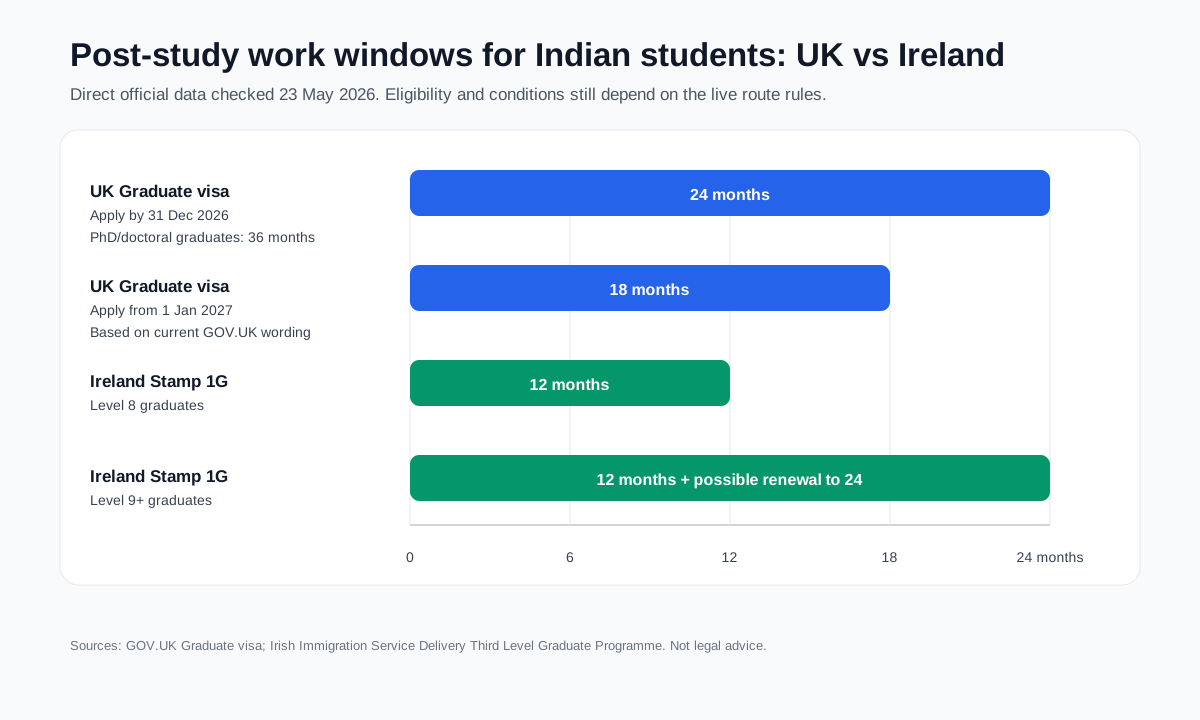
In the UK, the Graduate visa allows eligible students to stay after successfully completing a UK course. GOV.UK’s Graduate visa page states that the route lasts 2 years if you apply on or before 31 December 2026, 18 months if you apply on or after 1 January 2027, and 3 years for PhD or other doctoral qualifications. During that period, graduates can work without employer sponsorship for the Graduate visa itself, but a later Skilled Worker application has separate employer, job and salary rules.
For Skilled Worker sponsorship, GOV.UK’s job and salary guidance gives the standard salary rule and explains the lower-rate exceptions. The applicable figure depends on the occupation code and the applicant’s circumstances, so a UK graduate job offer is not automatically a sponsorable offer.
In Ireland, the Third Level Graduate Programme gives eligible graduates Stamp 1G permission. Immigration Service Delivery explains the qualification, duration and renewal conditions; applicants should check those live conditions rather than treating the maximum period as automatic.
For Ireland’s Critical Skills Employment Permit, DETE’s live guidance sets remuneration, occupation and job-offer conditions. Thresholds and occupation lists can change, so verify the current rule for the exact role and application date.
The practical lesson is simple: post-study work is only the bridge. Sponsorship or an employment permit is the destination. Indian students should choose the country, course and city with the bridge and destination in mind.
UK vs Ireland: what actually affects your graduate job chances?
The biggest mistake is treating “UK vs Ireland” as a lifestyle choice only. It is also a labour-market choice.
For Indian students, five factors usually matter most:
- Course-to-role fit: A data analytics MSc, finance MSc, computer science MSc or pharma-related qualification will only help if it maps clearly to the roles you apply for.
- Employer density: The UK has more large graduate employers and more advertised graduate schemes. Ireland has fewer roles but strong clusters in specific sectors.
- Sponsorship or permit feasibility: Some jobs are too low-paid, too junior, too temporary or outside the relevant occupation rules.
- Application timing: Many graduate schemes open months before graduation. Waiting until exams are finished is often too late.
- Location and cost pressure: London, Dublin, Manchester, Birmingham, Edinburgh, Cork, Galway and Limerick can all work, but rent and commuting costs can change whether a “good salary” is actually manageable.
Employer volume: the UK advantage
The UK’s main advantage is scale. HESA reported that India sent more students to the UK than any other overseas country for the third consecutive year in 2024/25. That does not mean every Indian student finds a graduate job, but it does mean the UK has a large international-student ecosystem and a broad graduate recruitment market.
For Indian students who want structured graduate schemes, the UK usually gives more options. Large employers in the UK often recruit across annual intakes, use online tests and assessment centres, and advertise early. That structure can help if you are organised, but it also means you compete with thousands of applicants and must meet strict eligibility requirements.
The UK may be stronger if you are targeting:
- investment banking, asset management, accounting or consulting
- technology roles across large employers and startups
- engineering and infrastructure roles
- retail, logistics, operations and commercial graduate schemes
- public-sector-adjacent routes where eligibility permits
- regional graduate roles outside London
The risk is that many attractive UK graduate jobs do not sponsor every role, and some salaries may not meet the Skilled Worker threshold or the going rate for that occupation. Indian students should check sponsorship early, not after receiving an offer.
Sector concentration: the Ireland advantage
Ireland’s advantage is not size. It is concentration.
For Indian students with the right course and work experience, Ireland can be attractive because many multinational companies run European operations, technology teams, finance functions, pharma manufacturing, medtech activity, business operations and customer-facing regional roles from Ireland.
Ireland may be stronger if you are targeting:
- pharmaceutical, life sciences or medtech roles
- software, cloud, data, cybersecurity or product-support roles
- finance, risk, compliance or funds roles
- business operations, multilingual or EMEA support functions
- engineering roles linked to manufacturing, energy or infrastructure
- roles where Irish employment permit eligibility is plausible
The risk is that the Irish market is smaller. A student who applies only to a handful of famous employers in Dublin may run out of options quickly. Irish job search success often depends on building a wider employer list, including Cork, Galway, Limerick and other locations where sector clusters exist.
Decision matrix for Indian students
The right choice depends on your profile. A student with a computer science degree, internship experience and strong projects may have a different best option from a student with a general management MSc and no work experience.
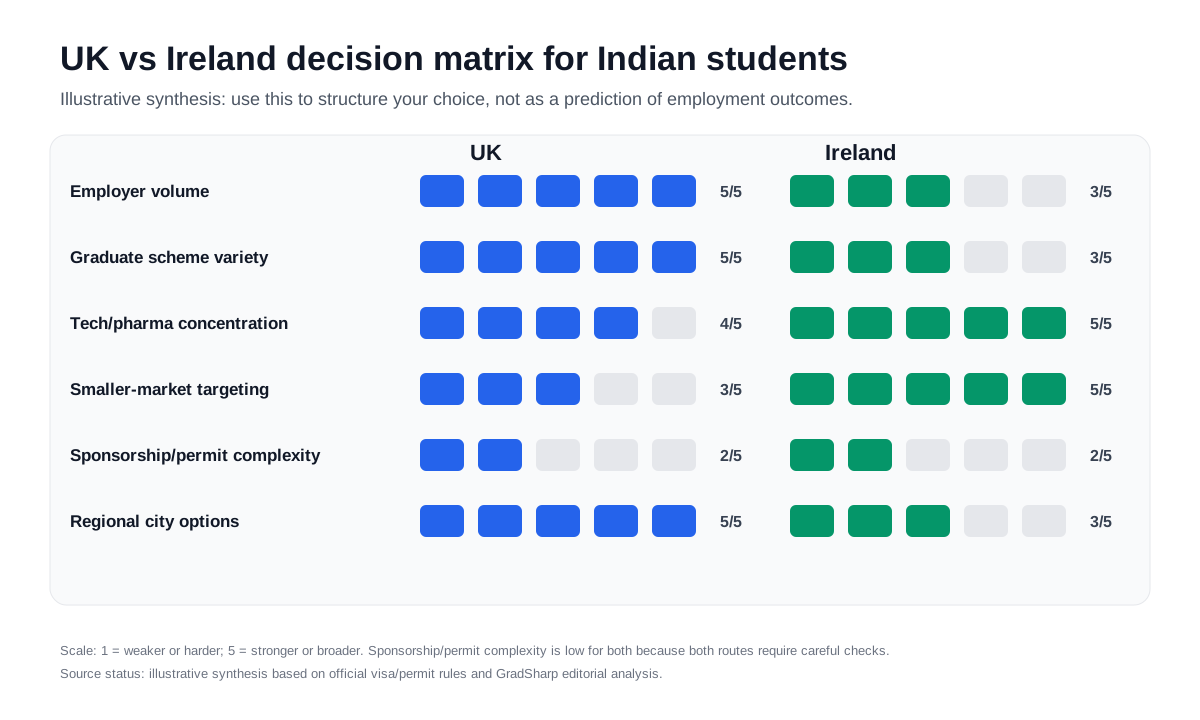
Use this matrix as a starting point, not a prediction. Your personal outcome depends on your course, grades, applications, interview performance, employer choices and work-rights situation.
Application timing: why many Indian students start too late
A common mistake is arriving in September, focusing only on settling in, then starting applications after Christmas. By then, many graduate schemes may already have closed or moved to final stages.
A stronger plan is to start before you fly.
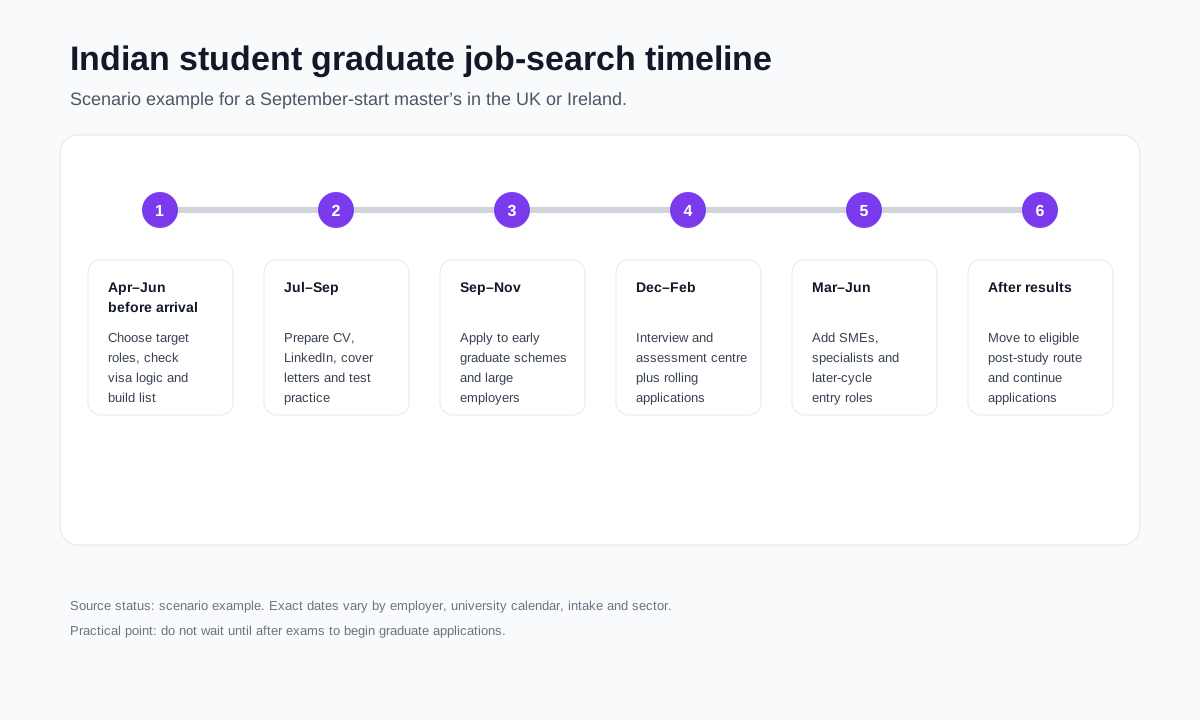
For a September-start master’s, a practical timeline looks like this:
- April to June before arrival: shortlist roles, understand sponsorship rules, build a target employer list and improve your CV.
- July to September: prepare graduate CVs, LinkedIn, cover letter examples, online-test practice and sector research.
- September to November: apply to major graduate schemes and early-closing employers.
- December to February: continue applications, prepare interviews and assessment centres.
- March to June: apply to later-cycle roles, SMEs, entry-level jobs and internships where work rights fit.
- After results: move from student permission into the relevant post-study route if eligible, then continue permit-aware or sponsorship-aware applications.
This does not mean you should ignore your studies. It means your job search should run alongside your master’s from the beginning.
SEO reality: “jobs in UK for Indian students” is not one job market
When Indian students search for “jobs in UK for Indian students” or “jobs in Ireland for Indian students”, the results often mix part-time student jobs, internships, graduate schemes, sponsored jobs and post-study roles. These are different markets.
A part-time job during study may help with confidence and local experience, but it rarely proves you can move into a sponsored graduate role. A graduate scheme may offer training and structure, but may close early and may have strict eligibility. An entry-level job may be more flexible, but sponsorship can be harder if the employer is not licensed or the salary is too low.
For SEO and reader clarity, GradSharp should treat this article as a country-choice and graduate-outcome guide, not a generic “jobs abroad” article. The search intent is: “I am an Indian student choosing between the UK and Ireland. Which one gives me a better chance after study?”
Course choice matters more than many students think
A high-ranking university can help, but it cannot rescue a poorly matched course. Indian students should ask four questions before choosing a master’s:
- Which roles does this course realistically lead to?
- Do those roles appear on sponsor-friendly or permit-friendly pathways?
- Are the salaries realistic for graduate-level applicants?
- Does the university have credible employer links in that sector and city?
For example, a student choosing data science should compare modules, projects, placement options, employer links and technical depth, not just the overall university ranking. A finance student should check whether the programme prepares them for risk, audit, funds, analytics, corporate finance or investment roles, because each has different employer behaviour.
Common mistakes Indian students make
The first mistake is assuming post-study work equals permanent settlement. It does not. Post-study permission gives time, but long-term stay normally depends on meeting a work route’s rules.
The second mistake is choosing a course based only on the lowest tuition fee. Cost matters, but a course with weak labour-market fit can be expensive in a different way.
The third mistake is applying only to famous companies. Big names attract intense competition. A stronger list includes large employers, mid-sized firms, sector specialists, regional employers and roles where your skills match the vacancy.
The fourth mistake is ignoring salary thresholds and occupation rules until the final interview. By then, you may have spent months chasing roles that cannot support your next immigration step.
The fifth mistake is writing a CV for India and expecting it to work unchanged in the UK or Ireland. Graduate recruiters usually expect clear evidence, concise bullets, relevant projects, measurable outcomes and a top third that shows fit quickly.
Checklist before choosing UK or Ireland
Before accepting an offer, Indian students should check:
- Is the course strongly linked to a real job family?
- Are graduates from this course entering relevant roles?
- Does the country have enough employers in your sector?
- Can you name at least 40 target employers before arrival?
- Do the likely roles meet sponsorship or permit requirements?
- Are you comfortable applying early, often before graduation?
- Can you afford the city if the job search takes longer than expected?
- Does the university offer useful careers support for international students?
- Have you checked official immigration sources, not just social media?
- Do you have a backup plan if sponsorship or permit conversion takes longer?
Internal links for GradSharp readers
If you are still choosing between the UK and Ireland, start here. Then read:
- Indian Graduate Jobs in the UK and Ireland: A 2026 Reality Check
- International Graduates: Where the UK and Ireland Actually Hire
- The 2026 Irish Graduate Market: What Actually Got Harder
- Cover Letters in 2026: Still Required, Often Screened Before a Human Reads Them
FAQ
Is the UK better than Ireland for Indian students?
The UK is usually better for employer volume and graduate scheme variety. Ireland can be better for students targeting concentrated sectors such as technology, pharma, medtech, finance and some engineering roles. The best choice depends on your course, sector, sponsorship path and employer list.
Is Ireland easier than the UK for Indian students to get a job?
Not automatically. Ireland has a smaller market, so there may be fewer vacancies. But students with strong sector fit and a targeted employer list can do well. The UK has more roles, but also more competition and strict sponsorship rules.
Can Indian students stay after studying in the UK?
Eligible students can apply for the UK Graduate visa after successfully completing a qualifying course. Current GOV.UK guidance states different durations depending on application date and qualification level. Always check GOV.UK before relying on the route.
Can Indian students stay after studying in Ireland?
Eligible graduates may apply under Ireland’s Third Level Graduate Programme for Stamp 1G permission. The duration depends on the qualification level and current rules. Check Irish Immigration Service Delivery before planning your timeline.
Should Indian students choose the cheapest university?
Not by price alone. A lower tuition fee may be sensible, but only if the course, location and employer access support your career target. The cheapest option can become expensive if it leaves you with weak employability or poor sector fit.
What should Indian students do before arriving?
Build a target employer list, prepare a UK/Ireland-style CV, research sponsorship or permit rules, practise online tests and identify early graduate scheme deadlines. Do not wait until the end of your master’s to start.
Test the comparison against your target roles
Make a two-column shortlist: UK and Ireland. Under each country, list your target sector, 20 employers, likely job titles, visa or permit route, salary risk and application deadlines. If you cannot name realistic employers and roles in one country, that is a warning sign.
Then read the supporting GradSharp article on Indian graduate jobs in the UK and Ireland and compare your plan with the sponsorship and job-search realities explained there.
Finally, check official immigration sources before making a financial decision. A good study-abroad choice is not the country with the best marketing. It is the country where your course, skills, timing and work route form a realistic graduate-career plan.
Sources checked
- GOV.UK, Graduate visa overview
- GOV.UK, Graduate visa course eligibility
- GOV.UK, Skilled Worker salary requirements
- GOV.UK, Skilled Worker lower salary circumstances
- Irish Immigration Service Delivery, Third Level Graduate Programme
- Irish Immigration Service Delivery, student permission FAQ
- Department of Enterprise, Trade and Employment, Critical Skills Employment Permit
- Department of Enterprise, Trade and Employment, General Employment Permit
- HESA, UK higher education student statistics by location, 2024/25
- HEA, Ireland higher education key facts and figures