What Counts as Work Experience for UK and Irish Graduate Jobs?
A practical guide for UK and Irish students turning part-time work, volunteering, projects and responsibilities into credible graduate evidence.
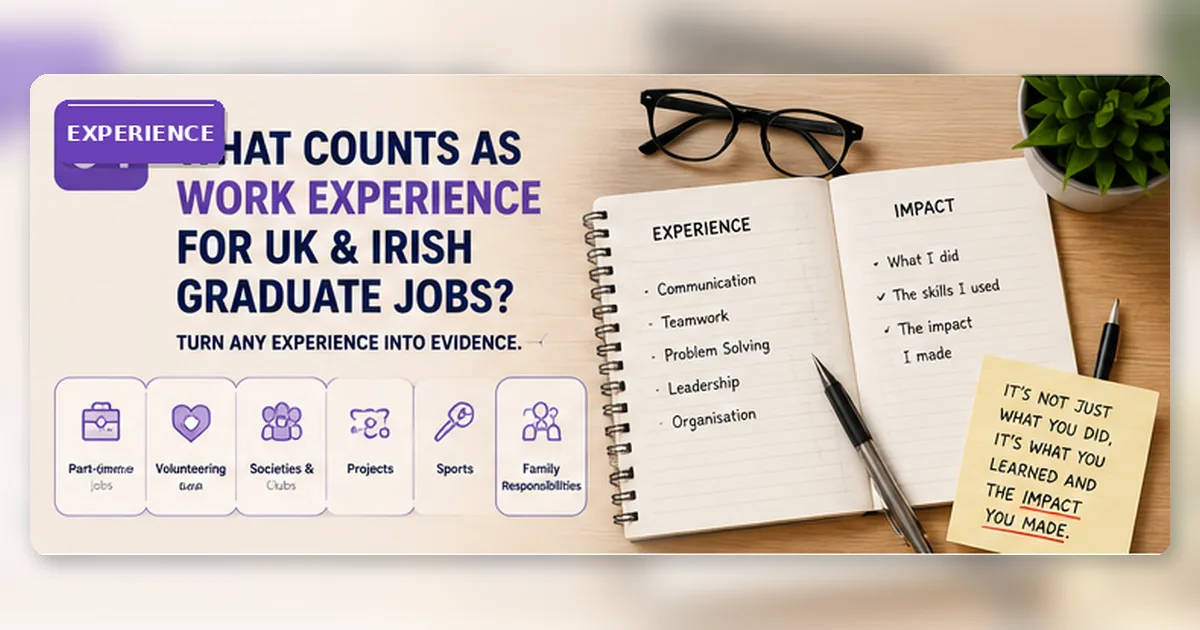
Most students have more work experience than they think.
The problem is that they do not recognise it yet, or they describe it so weakly that employers cannot see the value.
For graduate jobs in the UK and Ireland, “experience” does not only mean a named internship at a large company. It can include part-time work, volunteering, care responsibilities, society roles, course projects, family business support, placement years, freelance work, research assistance, sports leadership, tutoring and community activity.
The question is not “was it glamorous?” The question is “what did it prove?”
What employers can count as evidence
Work experience counts when it shows responsibility, judgement, skill, teamwork, communication, customer or stakeholder contact, delivery, learning, reliability or measurable contribution.
It does not have to be paid. It does not have to be in your target sector. It does not have to sound impressive to your friends. It does have to be true, specific and relevant to the role you are applying for.
A stronger graduate application answers three questions:
- What did you actually do?
- What skill or behaviour did it prove?
- Why does that matter for this role?
The UK National Careers Service describes work experience as a way to test career ideas, identify strengths, build skills such as teamwork and problem solving, and develop contacts. UCD Careers Network makes a similar point for Irish students: part-time work is often underrated and can give valuable transferable skills when students reflect on it properly.
Once you have translated the evidence, use it in the places employers actually screen: your CV, LinkedIn profile and application answers. GradSharp’s guides to Big 4 graduate CVs, KPMG CV screening and 2:2 graduate schemes show how evidence gets judged.
When an interview invitation arrives, the graduate interview evidence-bank guide shows how to organise the same material into seven flexible stories rather than dozens of scripts.
The evidence translator
Use this simple formula:
Activity → responsibility → skill → result → relevance
| Activity | Weak description | Stronger evidence |
|---|---|---|
| Retail job | Worked in a shop | Handled customer queries, managed stock checks and supported busy weekend shifts. |
| Hospitality | Served food | Worked under pressure, resolved customer issues and coordinated with kitchen and floor staff. |
| Society role | Helped with events | Booked rooms, promoted events, tracked attendance and worked with committee members. |
| Course project | Did a group project | Analysed data, divided tasks, presented findings and responded to questions. |
| Volunteering | Helped at charity | Supported service users, organised donations and followed safeguarding or confidentiality rules. |
| Family responsibility | Looked after siblings | Managed routines, solved problems and balanced responsibility with study. |
The stronger version is not more dramatic. It is more precise.
Before and after: CV bullets that work
Part-time work
Weak:
Worked part-time in Tesco.
Better:
Served customers during high-volume weekend shifts, handled payment queries and helped maintain stock accuracy across two aisles.
Society role
Weak:
Member of finance society.
Better:
Coordinated three speaker events for a student finance society, managed sign-up forms and helped communicate event details to 120 members.
Academic project
Weak:
Completed a marketing project.
Better:
Analysed survey responses from 85 students, identified three customer segments and presented campaign recommendations in a 12-minute group presentation.
Volunteering
Weak:
Volunteered at a charity shop.
Better:
Sorted donations, supported customers and worked with a small team to prepare stock for weekly sales targets.
Relevance, responsibility and reflection beat prestige
Relevance beats prestige. A part-time job with clear customer responsibility can be more useful than a vague internship where you did not do much.
Specificity beats adjectives. “Hard-working team player” is weaker than “trained two new staff on closing routines”.
Reflection beats activity collecting. Employers want to see what you learned and how it connects to the role.
Job titles, pay status and sector labels matter less
The exact job title matters less than the evidence. Whether it was paid matters less than the responsibility. Whether it was in your target sector matters less than whether you can connect it to the target role.
Trying to make everything sound corporate can backfire. A genuine café, care, tutoring or warehouse example is often stronger than a fake-sounding “stakeholder optimisation” sentence.
How to use this on LinkedIn
Your LinkedIn Experience section does not need every tiny task. It needs short evidence bullets.
Use two or three bullets per role:
- one responsibility;
- one skill;
- one result or learning point.
Example:
Part-time café team member — served customers during peak periods, handled payments and supported new staff with opening routines. Built confidence under pressure and learned how small operational errors affect customer experience.
That is enough.
Quick audit
List every activity from the last three years. For each, ask:
- Did I serve customers or users?
- Did I handle money, data, equipment or confidential information?
- Did I organise people, events, stock, schedules or documents?
- Did I solve problems?
- Did I work under pressure?
- Did I explain something to someone else?
- Did I improve anything?
- Did I learn a tool, process or sector language?
If the answer is yes, it may count.
Keep, cut or rewrite?
Use this filter before adding experience to a CV or LinkedIn profile.
| Evidence | Keep it if… | Cut or rewrite it if… |
|---|---|---|
| Part-time work | It shows reliability, customer contact, pressure, money handling, training or operational responsibility. | It is listed as a job title only with no evidence of what you handled. |
| Volunteering | It shows service, organisation, safeguarding, communication, fundraising or commitment over time. | It is included only because it sounds nice, with no specific action. |
| Society roles | You organised events, managed budgets, promoted activity, led people or solved a real problem. | You only attended meetings and cannot explain your contribution. |
| Academic projects | The project used data, research, coding, writing, presentation or teamwork relevant to the role. | It repeats module titles without showing method, output or learning. |
| Personal responsibilities | They explain organisation, judgement, resilience or practical responsibility without oversharing. | They disclose more personal detail than you are comfortable discussing. |
The strongest graduate evidence usually survives three tests:
- Can I prove it? You should be able to explain what happened if asked in interview.
- Can I connect it to the role? The reader should understand why it matters for this employer.
- Can I make it specific? Numbers, frequency, scope, tools, audience and outcome are better than adjectives.
If an example fails only the third test, rewrite it. If it fails the first two tests, leave it out or keep it in your private evidence bank until you can explain it better.
Turn one experience into employer evidence
Hour one: list everything that might count. Do not judge it yet.
Hour two: build an evidence bank with activity, responsibility, skill, result and role relevance.
Hour three: rewrite six weak bullets.
Hour four: match those bullets to three live adverts.
Day two: update your CV and LinkedIn profile. Remove vague adjectives. Add real evidence.
FAQ
Does part-time retail or hospitality count as work experience?
Yes, if you translate it into evidence. Customer service, pressure, reliability, teamwork and problem solving are all relevant to many graduate roles.
Does volunteering count?
Yes. It can show responsibility, communication, values, organisation and service experience.
Do university projects count?
They can, especially when they involved research, data, presentation, teamwork, technical tools or a real client brief.
Should I include caring responsibilities?
Sometimes. You do not need to disclose personal details. But if it explains responsibility, organisation and resilience, it can be part of your evidence bank.
What if I genuinely have very little experience?
Start small. Add one project, one volunteering task, one society contribution or one short work-shadowing activity. Then describe it honestly.
Source-checked notes
Checked on 15 June 2026 against National Careers Service guidance, UCD Careers Network material, UCAS LinkedIn student guidance, HESA Graduate Outcomes and HEA Graduate Outcomes. Examples are editorial scenarios, not claims about one employer.