What Employers Actually Screen First on a Graduate CV
An evidence-led guide to what employers check first on a graduate CV, with practical screening tests and bullet rewrites for students.
A graduate CV is not a life story.
It is usually something less romantic and more stressful: a document being opened by someone who has too many applications, too little time, and a job advert in front of them. The first question is rarely, “Is this student impressive in every possible way?”
It is closer to this:
Can I see enough fit and evidence quickly enough to keep reading?
That is the CV problem most students are actually solving. Not sounding clever. Not looking busy. Not collecting every experience since sixth form. Just making real evidence easy to find before doubt builds up.
For more specific CV guidance, use this article with How to Write a Graduate CV for the Big 4, How KPMG Screens Graduate CVs, What Counts as Work Experience? and Cover Letters in 2026.
The answer before the template
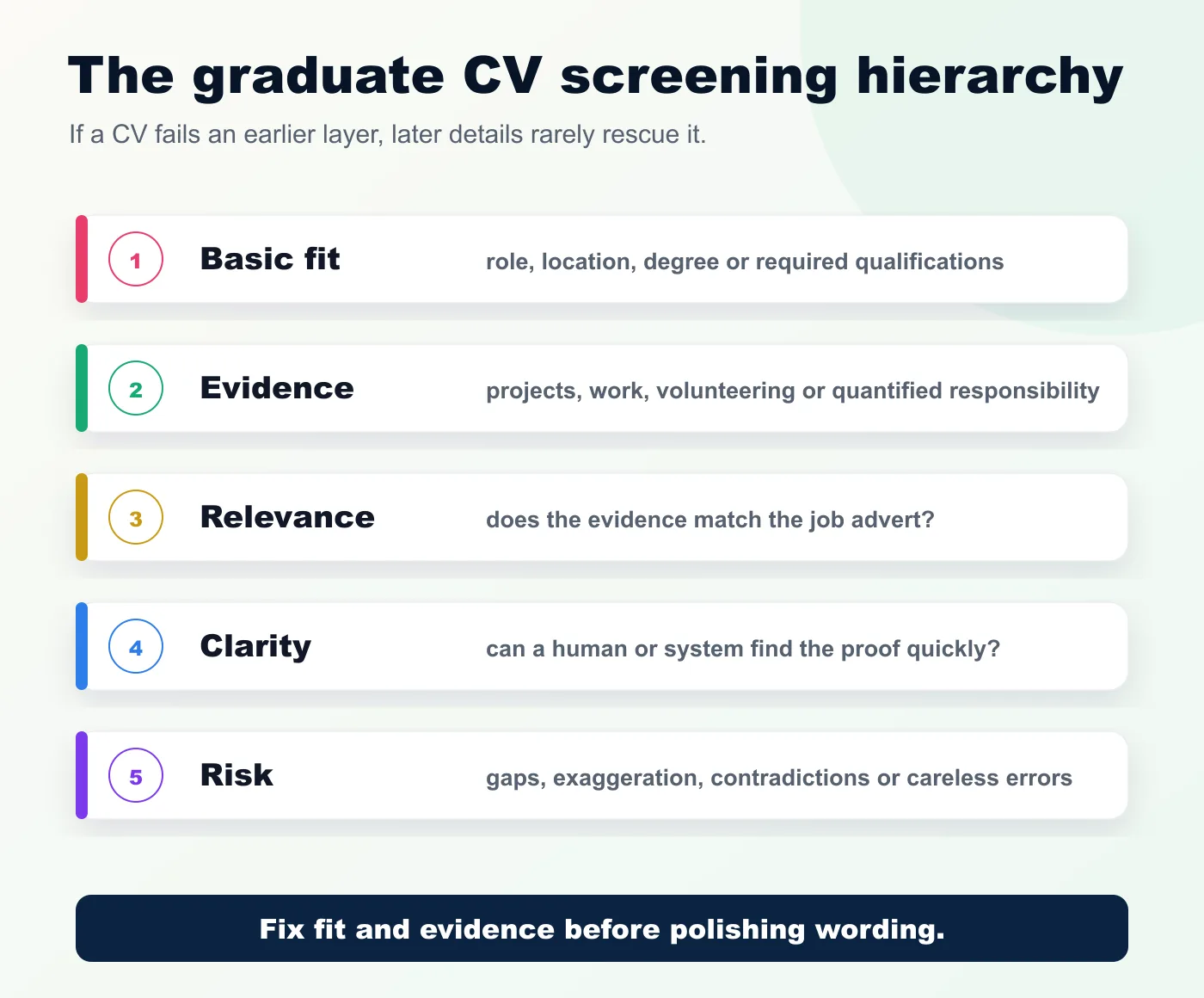
Employers usually screen a graduate CV for five things before they care about polished wording:
- Basic fit — does the applicant appear eligible and relevant for this role?
- Evidence — is there proof of responsibility, skill, delivery or learning?
- Relevance — does that proof connect to the job advert?
- Clarity — can the reader find the proof without effort?
- Risk — are there errors, contradictions, exaggerations or missing details that make the application harder to trust?
A strong CV is not the one with the most adjectives. It is the one that lowers screening friction.
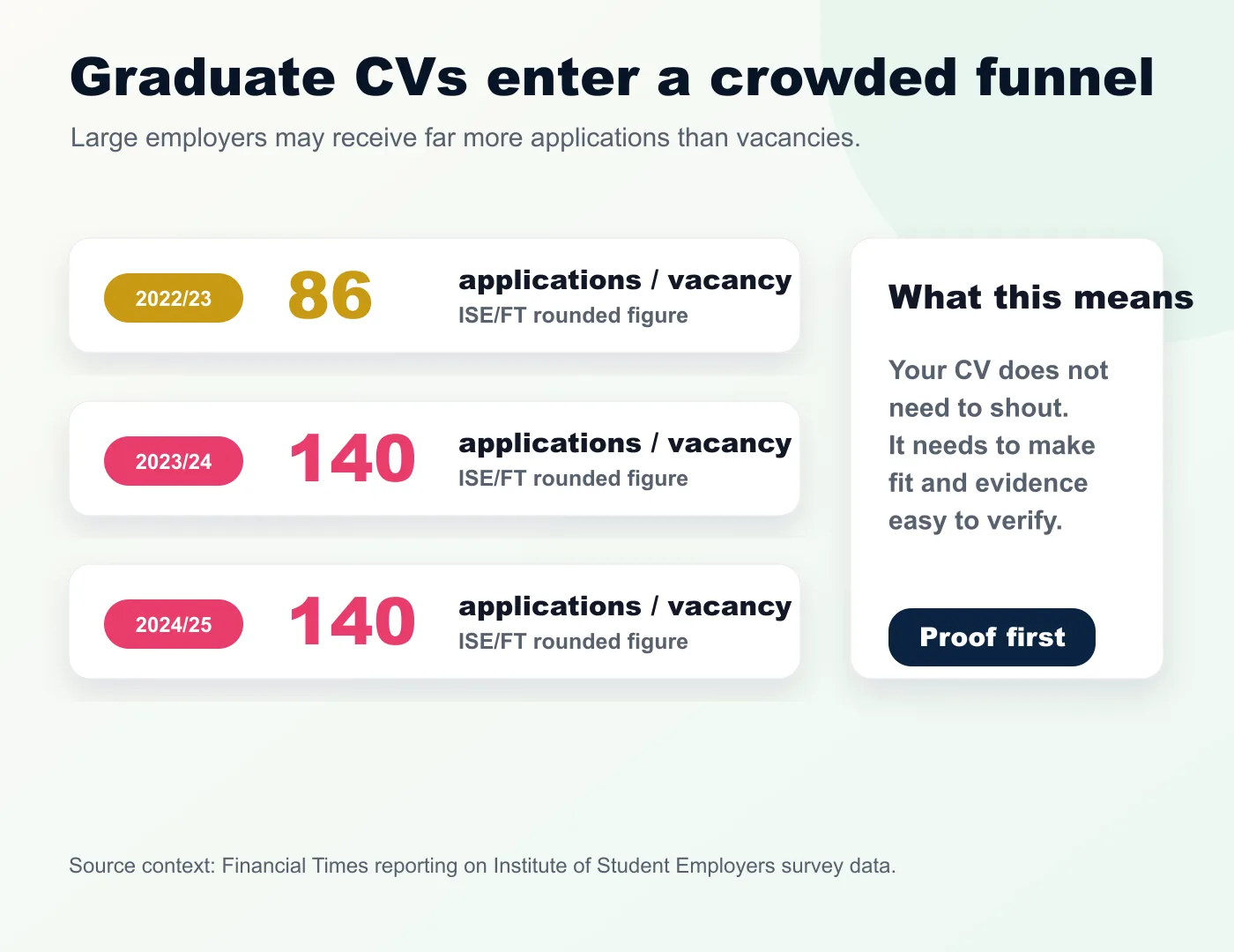
The Institute of Student Employers’ 2025 summary said its employer members received about 140 applications per graduate vacancy for a second consecutive year, up from 86 in 2022/23. This describes the large employers in ISE’s survey, not every UK vacancy. The Times, reporting on HESA Graduate Outcomes 2023/24, said 57% of graduates were in full-time employment 15 months after graduation, 7% were unemployed, and 75% of UK-employed graduates were in highly skilled roles.
Those figures should not make you panic. They should make you edit differently. A crowded market rewards CVs that make proof quick to verify.
The first-pass screen is not a careful read
Many students imagine a recruiter reading every line with patient interest.
Sometimes that happens later. It is rarely the first screen.
The first pass is more like sorting a pile into “likely”, “maybe” and “not enough evidence yet”. The employer is trying to avoid spending time on an application that cannot progress because the role fit is unclear, the evidence is thin, the formatting is hard to parse, or the candidate appears to have ignored the job advert.
The National Careers Service says employers receive lots of CVs and need to decide quickly who to interview, so a CV should be clear, easy to read and tailored to the job. Prospects gives similar advice: avoid generic claims, use clear formatting, and back claims with evidence rather than adjectives.
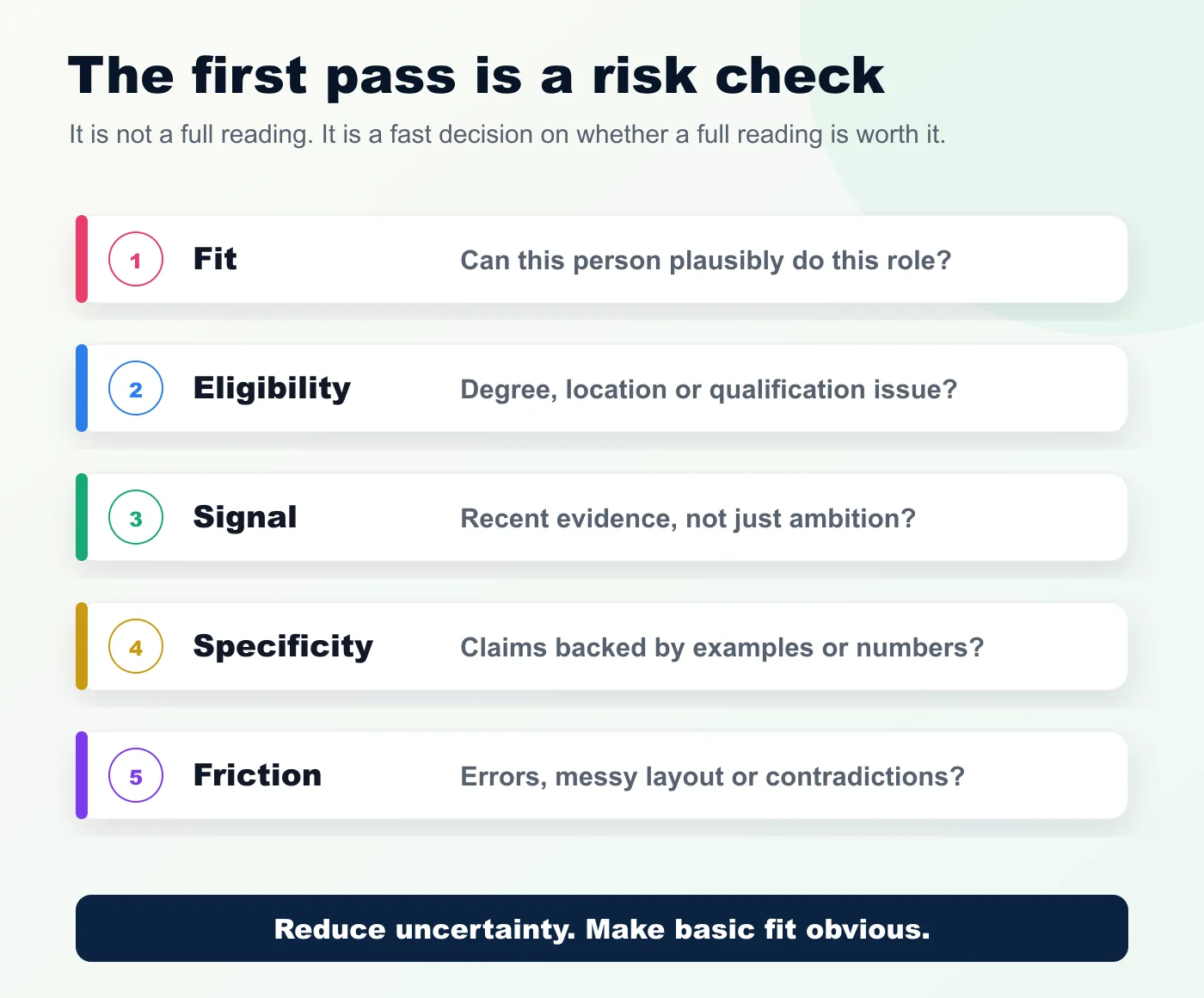
| First-pass question | What the employer is trying to avoid | What your CV should show |
|---|---|---|
| Does this person fit the role family? | A generic application sent to everything | A profile and evidence that point in the same direction |
| Can we check the basics? | Missing degree, dates, location or required qualifications | Clear education, dates, expected grade and relevant requirements |
| Is there real evidence? | Empty claims with no proof | Work, projects, volunteering, societies, part-time responsibility or outputs |
| Can we find the evidence quickly? | Slow screening | Clear headings, readable bullet points, simple structure |
| Does anything feel risky? | Exaggeration, errors or contradictions | Accurate grades, honest dates, consistent story and professional details |
The graduate CV screening hierarchy
Most CV advice starts with formatting. Formatting matters, but it is not the first strategic layer.
1. Basic fit
This is the boring layer that quietly decides a lot. Employers may check degree subject, expected grade, graduation year, location, availability, language requirements, technical prerequisites, course accreditation, portfolio links or other stated requirements.
Do not hide these basics. If the advert asks for a numerate degree, Python, Excel, a portfolio or a specific language, the relevant answer should be easy to find where appropriate.
2. Evidence
Evidence is the part many students underestimate.
A recruiter cannot shortlist “hardworking”. They can shortlist signs of responsibility, reliability, analysis, organisation, customer handling, technical learning or judgement.
Evidence can come from part-time work, internships, placements, volunteering, course projects, society roles, tutoring, freelance work, competitions or portfolio projects. The weakness is often not that students have no experience. The weakness is that they describe experience as a list of tasks instead of proof.
Weak:
Worked in a café and served customers.
Stronger:
Served customers during high-volume weekend shifts, handled payment queries and helped train two new staff on opening and closing routines.
The second version is not inflated. It simply gives the employer responsibility, pressure, communication and reliability signals.
3. Relevance
Relevance is where many decent CVs become average. A student may have good examples, but if those examples do not connect to the role, the employer has to infer the link. In a crowded process, inference is a tax on the reader.
A finance applicant should not make the employer dig for Excel, accuracy, reporting or commercial judgement. A marketing applicant should not bury customer research, campaign planning or analytics. A data applicant should not hide Python, SQL, statistics or dashboard work under “university project”.
4. Clarity
Clarity is not decoration. It is a screening aid.
Prospects notes that applicant tracking systems may screen for keywords from job descriptions and advises candidates to avoid images, logos or graphics because systems may not read them. That does not mean every employer uses the same system. It means the safe default is a clean, text-first CV that both people and systems can read.
5. Risk
Risk signals are often small doubts that accumulate: dates that do not line up, a LinkedIn profile that contradicts the CV, an unclear grade, a claim such as “advanced Excel” with no Excel example, an unprofessional email address, or a profile trying to target four unrelated sectors at once.
One risk signal may not reject you. Several can.
The advert-to-evidence method
Many students tailor a CV by adding keywords from the job advert. That is only half the work.
A better method is:
- identify the job-ad phrase;
- translate what the employer may be testing;
- find a real example from your evidence bank;
- write the CV bullet around that proof.
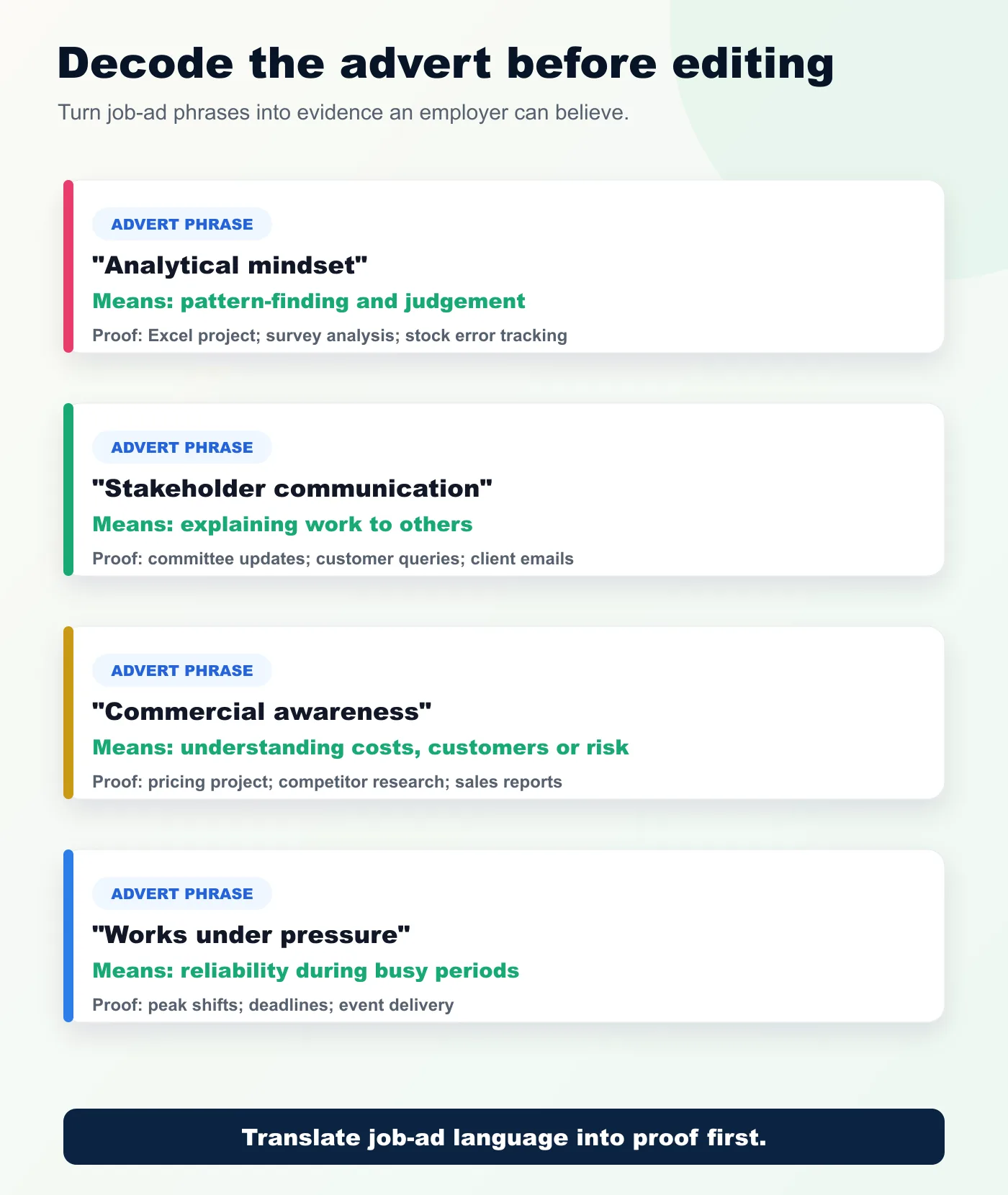
| Job advert phrase | What it may be testing | Weak CV response | Stronger CV evidence |
|---|---|---|---|
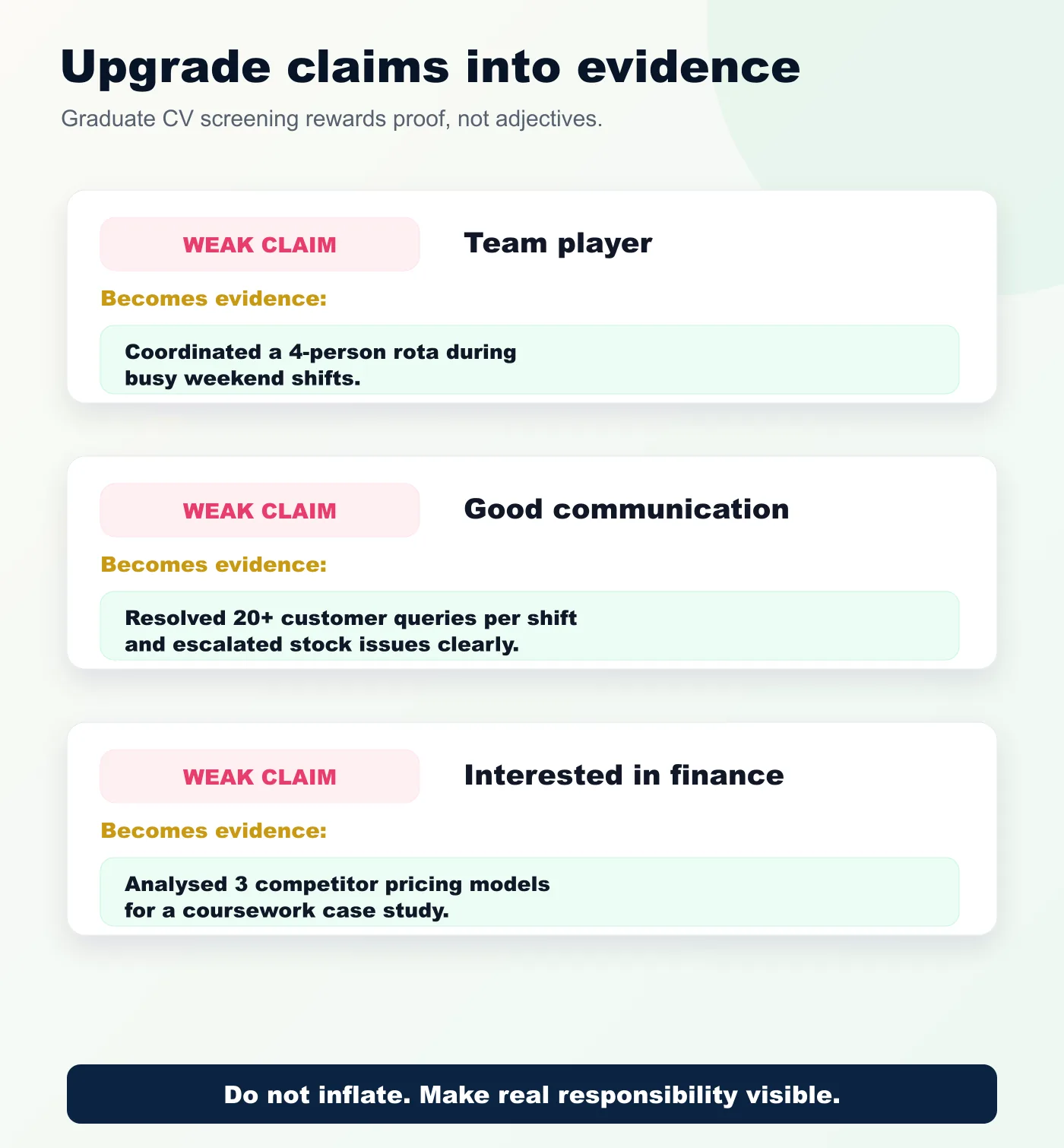
| Analytical mindset | Can you handle information and make sense of it? | “Analytical thinker” | “Analysed 120 survey responses in Excel and presented three customer segments in a project report.” |
| Stakeholder communication | Can you explain things to people with different needs? | “Good communicator” | “Handled customer complaints during weekend shifts and escalated refund issues using store policy.” |
| Commercial awareness | Do you understand customers, costs, revenue or risk? | “Interested in business” | “Compared three competitors for a pricing coursework project and recommended a lower-cost acquisition channel.” |
| Attention to detail | Can you avoid avoidable errors? | “Detail-oriented” | “Checked stock records against delivery notes and flagged repeated discrepancies to the supervisor.” |
| Teamwork | Can you contribute without being carried? | “Team player” | “Coordinated task allocation for a four-person group project and delivered the final presentation section on time.” |
The key is honesty. If you do not have evidence for a job-ad phrase, do not fake it. Build it, use a different example, or apply to roles where your current evidence is a better match.
Keywords only help when they point to proof
Automated screening advice is often exaggerated. Some advice makes applicant tracking systems sound like secret robots rejecting everyone. Other advice says to ignore them completely.
The practical middle ground is better. Many recruitment systems help employers organise, search, filter or rank applications. Some may use screening questions, keyword matching or workflow tools. Human judgement is still often involved, but the first pass may be structured by the information the system can read.
A keyword without evidence is just decoration. If a role asks for “data analysis” and your CV says “data analysis” once in a skills section, that is weaker than a project bullet showing the dataset, tool, method and output.
A better structure is:
Skill keyword + tool/context + action + result or outputExamples:
- “Analysed 120 survey responses in Excel and summarised findings in a 10-slide presentation.”
- “Used SQL joins to clean a small sales dataset and identify repeat-purchase patterns for a coursework dashboard.”
- “Created a weekly rota for 12 society volunteers and reduced last-minute event cover gaps.”
- “Handled customer queries during peak weekend shifts and trained two new staff on closing routines.”
A UK vacancy-analysis study by Bone, Ehlinger and Stephany, based on around 11 million online job adverts from 2018 to mid-2024, found evidence of skill-based hiring emerging in AI roles. That does not mean degrees no longer matter. It means that in some areas, employers are looking closely at usable skills, not only formal labels.
Evidence density: the line-by-line test
Evidence density means how much useful proof appears in one line.
Low-density bullet:
Helped with social media and teamwork.
Higher-density bullet:
Scheduled three weekly Instagram posts for a student society, tracked engagement in a spreadsheet and helped increase event sign-ups from 35 to 58 over one term.
The second bullet gives action, tool, context and result. The numbers are modest, which makes them believable.
The CV evidence bank
Before editing your CV, build an evidence bank. This prevents you from rewriting the same vague bullet for every application.
| Experience | Responsibility | Skill shown | Result or output | Best use |
|---|---|---|---|---|
| Part-time retail | Customer queries, stock checks, training | Communication, accuracy, reliability | Trained two new staff; handled peak shifts | CV and interview |
| Society treasurer | Budget tracking, event costs | Excel, responsibility, reporting | Kept spending within agreed budget | CV, cover letter |
| Data coursework | Survey design and analysis | Excel, analysis, presentation | Presented findings to seminar group | CV, application form |
| Volunteering | Organised donations | Teamwork, service, confidentiality | Supported weekly charity shop stock flow | CV, interview |
| Personal project | Dashboard or portfolio | Technical learning, communication | Published GitHub or portfolio page | CV, LinkedIn |
Then select evidence for the role. Do not put every experience into every CV. A finance CV, marketing CV and data CV may share some evidence, but the order and emphasis should change.
The 30-minute CV screening audit
Before applying, audit your CV as if you were screening it quickly.
Minute 0-5: fit
Check whether the role direction is visible. If the employer wants a specific degree, skill, location or availability, can the reader find the relevant answer?
Minute 5-10: evidence
Highlight every bullet that proves something. If a bullet only describes a task, rewrite it.
Minute 10-15: relevance
Open the job advert. Mark the top five requirements. For each one, identify where your CV gives evidence. If there is no evidence, decide whether to add it, build it, or accept that the role may be a weak fit.
Minute 15-20: clarity
Check headings, dates, bullet length, file name, contact details and formatting. Remove clutter.
Minute 20-25: risk
Check for exaggeration, unsupported claims, grade confusion, spelling errors, employer-name mistakes and contradictions with LinkedIn.
Minute 25-30: final decision
Ask: would this CV still make sense to someone reading it quickly with 50 other applications open?
If not, do not submit yet.
What to do if your evidence feels thin
Do not compensate with adjectives.
In 48 hours, you can rewrite existing experience properly, create a small role-relevant project, analyse a public dataset, ask for a defined responsibility in a part-time job, volunteer for a specific task, update your LinkedIn profile to match your CV, or build a better application tracker.
In two weeks, you can complete a small portfolio project, interview someone in the sector, take on a society responsibility, build a one-page case study, practise application-form answers, or improve technical evidence.
If your grade is the concern, use GradSharp’s guide on whether a 2:2 blocks graduate schemes. If your profile does not match your CV, use The LinkedIn Profile Final-Year Students Actually Need.
A practical CV checklist
Before sending the CV, check:
- the role family is clear in the top third;
- the degree, university, dates and expected grade are easy to find;
- the strongest evidence appears early;
- each bullet shows action, context and proof;
- at least three bullets are clearly matched to the job advert;
- technical skills are backed by examples;
- part-time work is translated rather than dismissed;
- file name is professional;
- LinkedIn does not contradict the CV;
- the employer’s requested file format is followed;
- there are no fake metrics or inflated claims.
FAQ
What do employers look for first on a graduate CV?
Usually basic fit, evidence and clarity. They want to know whether you meet obvious requirements, whether you have proof of useful skills and whether the CV is easy enough to screen quickly.
Do employers read every graduate CV carefully?
Not always at first. Large graduate recruiters may use application systems, screening questions and human review stages. The first pass is often triage, not a full reading of every line.
Should I write my CV for ATS software or for humans?
Write for both. Use clear, text-based formatting and relevant job-ad language so systems can parse the CV. But make sure the evidence is meaningful for a human recruiter or hiring manager.
Should I include keywords from the job advert?
Yes, but only where they match real evidence. Copying keywords without proof is weak. Translate the advert into examples from work, projects, volunteering, societies or technical practice.
What if I have no internship?
Use other evidence: part-time work, projects, volunteering, societies, tutoring, family responsibilities, freelance work or portfolio projects. Employers need proof of behaviours and skills, not only famous internships.
Can I use AI to improve my CV?
You can use AI cautiously for structure, proofreading and role-research prompts. Do not use it to invent experience, exaggerate evidence or produce a generic CV that does not sound like you.
Source-checked notes
Checked on 6 July 2026.
- National Careers Service: How to write a CV: clear formatting, tailoring, contact details, education, work history and personal-information guidance.
- Prospects: How to write a CV: formatting, tailoring, ATS, AI-use and evidence guidance.
- Institute of Student Employers: top recruitment statistics from 2025: first-party applications-per-vacancy context for ISE employer members.
- The Times reporting on HESA Graduate Outcomes 2023/24: reported graduate employment, unemployment and highly skilled role figures.
- Bone, Ehlinger and Stephany, Skills or Degree?: UK vacancy-analysis context on skills-based hiring.
Recruitment practices vary by employer, role and intake. Some employers rely heavily on CVs; others use application forms, screening questions, online tests, work samples, video interviews or assessment centres. Always follow the live employer instructions for the role you are applying to.
Make the evidence easy to find
The best graduate CV is not the one with the most impressive adjectives. It is the one that makes real evidence easy to find.
Before your next application, do not ask, “Does this sound professional?” Ask a harder question:
If a recruiter had 30 seconds, what proof would they see?
If the answer is vague, the CV is not ready.