Rhodes Scholarship Oxford: The Leadership Profile Oxford Actually Selects For
A practical Rhodes Scholarship guide explaining the leadership trajectory, eligibility checks and application signals that matter before applying to Oxford.
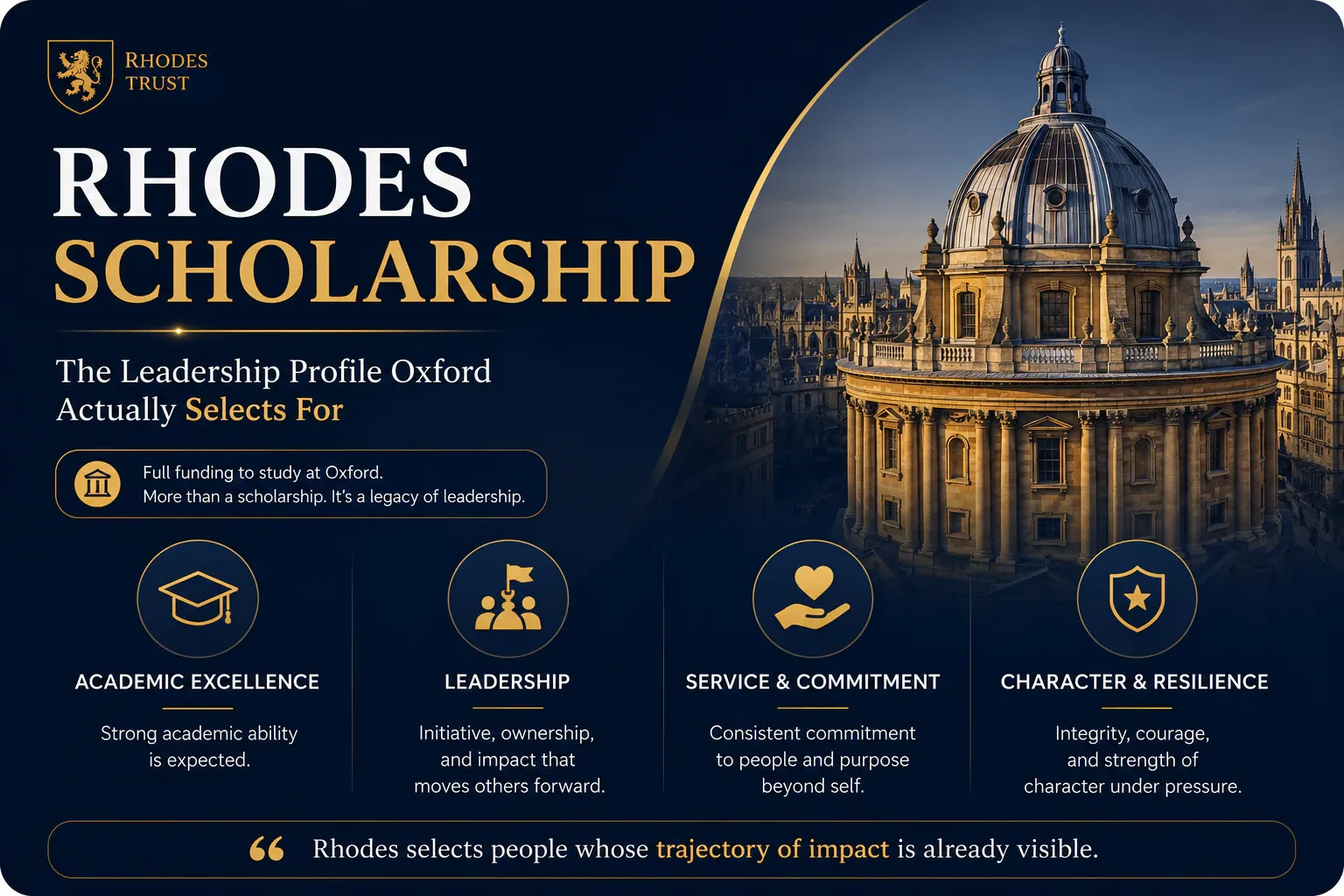
Most applicants search for the Rhodes Scholarship expecting a simple answer: excellent grades, leadership roles, service experience and a persuasive personal statement.
That description is not wrong. It is incomplete.
The Rhodes Scholarship is not looking for a generic “well-rounded student” with a long list of impressive activities. It is looking for evidence that a candidate already has intellectual seriousness, public-spirited leadership, character and a visible direction of influence before Oxford enters the picture.
That distinction matters because many strong students prepare the wrong way. They add more activities, collect more titles and polish more achievements, when the harder question is whether their profile shows a deepening trajectory of impact.
The Rhodes Trust describes the scholarship as a fully funded postgraduate award enabling talented young people from around the world to study full-time at the University of Oxford, with a purpose of developing public-spirited leaders and promoting international understanding and peace. Source: Rhodes Trust, checked 6 June 2026.
If you are comparing major scholarship routes, use this alongside GradSharp’s guide to GOIPG preparation before the portal opens and the UK Global Talent Visa guide if your long-term plan includes the UK after postgraduate study.
What the leadership criterion demands
The Rhodes Scholarship is not mainly a reward for having done many impressive things.
It is closer to a test of trajectory:
- Academic strength: can you thrive at Oxford?
- Leadership: have you initiated, owned or changed something?
- Service and character: do your choices show values under pressure?
- Direction: does Oxford logically accelerate the work you are already doing?
If your profile is mostly high grades plus short-term extracurricular involvement, you may still be early. If your profile already shows sustained responsibility, measurable change and a coherent area of influence, Rhodes may be worth serious preparation.
Duplicate check
Classification: New.
Closest existing GradSharp article: GOIPG preparation before the portal opens.
Why it is distinct: the GOIPG article focuses on Ireland research-funding structure, supervisor fit and portal timing. This article focuses on Rhodes Scholarship selection logic, leadership trajectory and Oxford-readiness.
Recommended action: publish as a new Scholarships and Funding article.
What Rhodes actually selects for
The Rhodes Trust says the selection criteria that determined the first Rhodes Scholars in 1902 still guide selection today. The official criteria include academic excellence, energy to use one’s talents fully, truth and courage, devotion to duty, sympathy for and protection of the weak, kindliness, unselfishness and fellowship, plus moral force of character and instincts to lead. Source: Rhodes Trust selection criteria, checked 6 June 2026.
Applicants often read those criteria as four separate boxes. A stronger way to read them is as one connected profile.
| Official area | What applicants often think it means | What a stronger application shows |
|---|---|---|
| Academic excellence | High grades only | Intellectual curiosity, rigour and readiness for Oxford-level study |
| Energy to use talents fully | Lots of activities | Mastery, discipline and sustained effort beyond the classroom |
| Service and character | Volunteering hours | Values, responsibility and commitment when no one is rewarding you |
| Instincts to lead | Formal leadership titles | Initiative, courage, ownership and the ability to move others toward change |
The important point is that Rhodes is not simply asking whether you are talented. It is asking whether your record already shows what you do with talent.
Academic strength is required, but usually not enough
A Rhodes application needs serious academic credibility because the scholarship funds full-time postgraduate study at Oxford.
But among serious applicants, academic strength alone rarely explains the difference between a good candidate and a selected candidate.
Strong academic evidence may include:
- consistently high performance;
- demanding courses or research preparation;
- independent academic thinking;
- research output or a strong academic direction;
- referees who can explain how you think, not just how you score.
The Rhodes Trust selection page describes academic excellence through intellectual curiosity, critical thinking and ability to thrive in academically rigorous courses. Source: Rhodes Trust selection criteria, checked 6 June 2026.
So grades matter. But if the rest of the profile does not show leadership, service, character and direction, grades become a threshold rather than a differentiator.
Leadership means initiative, not just position
The weakest version of a Rhodes leadership claim is a list of titles.
President of a society. Committee member. Team lead. Founder. Ambassador. Volunteer coordinator.
Those can help, but only if they point to change.
A stronger leadership claim answers:
- What problem did you see?
- What did you initiate or take responsibility for?
- Who was affected?
- What changed because of your involvement?
- What continued after you stepped back?
The Rhodes Trust selection criteria refer to courage to act on initiative and inspire others to follow, and leadership in both thought and action. Source: Rhodes Trust selection criteria, checked 6 June 2026.
That is very different from passive participation.
A candidate with one long-term project that changed something may read stronger than a candidate with ten impressive but shallow activities.
The real selection model: trajectory, agency and intellectual seriousness
A practical way to understand Rhodes selection is this:
Trajectory of impact + evidence of agency + intellectual seriousness.
Everything else supports that.
Selectors are effectively asking:
- What direction is this person already moving in?
- What scale of impact is emerging over time?
- Do they act with courage and responsibility when the path is not easy?
- Does Oxford accelerate their trajectory, or merely decorate their profile?
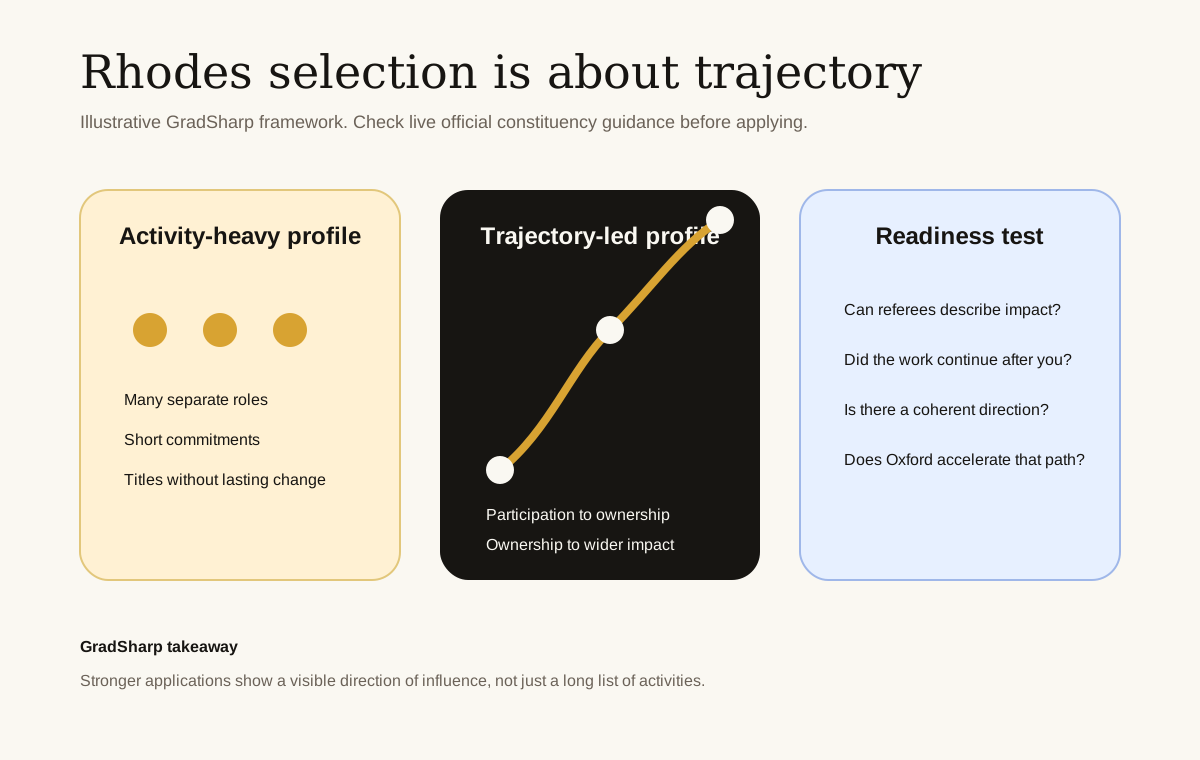
This is why high-achieving applicants can be rejected without being weak. Their record may be excellent but horizontal: many activities, many awards, many commitments, but no clear deepening direction.
A stronger profile often has vertical movement: a repeated concern, increasing responsibility, deeper ownership, and clearer consequences for people or systems beyond the applicant.
Eligibility: check your constituency first
Eligibility is not global in one simple way. It is constituency-based.
The Rhodes Trust says applicants should find out which constituency they are eligible to apply through, and its eligibility page asks applicants to select their country or territory; it also notes that those with dual citizenship or experience across countries should consider the country with the strongest connection. Source: Rhodes Trust applications page, checked 6 June 2026.
The Trust also explains that a constituency can be a country, group of countries, territories, regions or states grouped together for administering scholarships. Source: Rhodes Trust constituency information, checked 6 June 2026.
That means you should not rely on a generic internet summary for eligibility.
Before preparing seriously, check:
| Eligibility area | What to verify |
|---|---|
| Constituency | Which country, territory or region you apply through |
| Age | Exact age rule for that constituency and cycle |
| Academic stage | Whether you meet degree and Oxford course requirements |
| Application materials | Documents, references and statements required for your constituency |
| Deadline | Local application timeline for your constituency |
Age limits and documents can vary. Treat the official Rhodes Trust constituency page as the source of truth.
How the application path usually works
The exact process varies, but a typical applicant should expect a sequence like this:
- Check the Rhodes constituency and eligibility rules.
- Choose an Oxford course that fits the long-term academic direction.
- Prepare the required statements, academic record, curriculum vitae and references.
- Submit the Rhodes application through the correct constituency process.
- Complete shortlisting and interview stages if selected.
- If selected as a Rhodes Scholar, proceed with Oxford admission steps for the chosen course.
The Rhodes Trust application overview is the best starting point for current process details. Source: Rhodes Trust application overview, checked 6 June 2026.
The practical point: do not start with essay polishing. Start with eligibility, course fit, references and evidence trajectory.
Three applicant profiles and how they read
1. The high performer
This candidate has excellent grades, several awards and many activities.
The risk: the application reads as achievement collection rather than leadership trajectory.
This candidate needs to show what changed because of them, not just what they joined.
2. The local builder
This candidate may have fewer headline achievements but has owned a problem deeply: a community project, student initiative, research programme, education intervention, social enterprise, advocacy campaign or institutional change.
The strength: visible responsibility and outcomes over time.
This profile can be more competitive than it looks if the evidence is specific and referees can describe the candidate’s impact.
3. The systems thinker
This candidate connects intellectual work to structural change. They may work across research, policy, technology, public health, education, climate, law, journalism or social impact.
The strength: they can explain not only what they did, but why it matters and what larger system it changes.
This profile is rare because it combines academic seriousness with direction of influence.
The failure pattern: activity without residue
A useful readiness test is this:
What remains after your involvement ends?
If removing your name leaves no structure, no changed process, no people developed, no improved service, no research output, no ongoing programme and no evidence of learning for others, the activity may read as participation rather than leadership.
Rhodes applications are stronger when the candidate can show residue:
- a programme that continued;
- people trained or supported;
- policy, process or practice changed;
- research or knowledge produced;
- resources created;
- a community strengthened;
- a problem reframed for others.
That does not mean everything must be huge. It means the evidence must show agency.
What matters less than applicants assume
These things can help, but they are weaker when isolated:
- the number of leadership titles;
- prestigious internships without clear contribution;
- generic volunteering without responsibility;
- short-term activities with no continuity;
- a personal statement that sounds noble but is not evidenced;
- a list of awards without a clear direction.
The strongest applications do not simply say, “I care about change.”
They show where the candidate has already acted with seriousness and responsibility.
Build a leadership evidence inventory
Before writing a personal statement, run this diagnostic.
1. Map impact, not activity
Create a table with three columns:
| Activity | What changed because of me? | What evidence proves it? |
|---|---|---|
| Example project | People served, system improved, research produced, programme sustained | Data, outputs, references, artefacts, continuation |
If the second and third columns are hard to fill, the profile may still be activity-heavy.
2. Find your escalation story
Write one sentence:
I started by doing ___, then took responsibility for ___, and now I am trying to influence ___.
If the sentence does not work, your narrative may not yet be trajectory-led.
3. Audit your referees
Ask whether each referee can describe specific evidence, not just praise you generally.
A strong referee can say:
- what you initiated;
- how you handled difficulty;
- how others responded to your leadership;
- how your thinking developed;
- why Oxford fits the next stage.
4. Check constituency rules
Find your constituency and read the official guidance for age, citizenship or residency, documents, deadlines and required references.
Do this before you invest weeks in essay drafting.
5. Test whether Oxford is necessary
Ask: why this Oxford course, and why now?
A convincing Rhodes application should show that Oxford is the logical accelerator of an existing direction, not simply a prestigious next step.
FAQ
Who is eligible for the Rhodes Scholarship?
Eligibility depends on the applicant’s Rhodes constituency. A constituency can be a country, group of countries, territory, region or state grouping. Start with the official Rhodes Trust eligibility and constituency pages.
Is there an age limit?
Yes, but the exact rule varies by constituency and application cycle. Do not rely on a generic age summary. Check the live constituency guidance.
Can I apply straight after graduation?
Many applicants apply during their final undergraduate year or soon after graduation, depending on constituency rules. The key question is not only timing, but whether the profile already shows academic strength, leadership, service, character and direction.
Do I need Oxford admission before applying for Rhodes?
In many cases, applicants apply through the Rhodes process first and selected scholars then proceed with Oxford course admission steps. Check the current constituency guidance and application overview for your route.
Does Rhodes only support future politicians or lawyers?
No. Rhodes Scholars study and work across many fields. The official scholarship page says scholars may apply to study most full-time postgraduate courses in almost any field offered by Oxford. Source: Rhodes Trust, checked 6 June 2026.
Is IELTS required?
Rhodes eligibility and Oxford course admission are separate issues. Depending on your course and background, you may need to meet Oxford English-language requirements. Always check your Oxford course page and constituency guidance.
Source-checked notes
This article was reviewed against Rhodes Trust official pages on the scholarship, selection criteria, applications, constituency information and application overview on 6 June 2026.
Eligibility, age rules, deadlines, documents and constituency requirements can change. Applicants should confirm live rules on the official Rhodes Trust website before applying.