UK Final-Year Student Job Search Timeline: What to Do From September to Graduation
A practical UK final-year job search timeline for students applying to graduate schemes, direct-entry roles and backup routes before graduation.
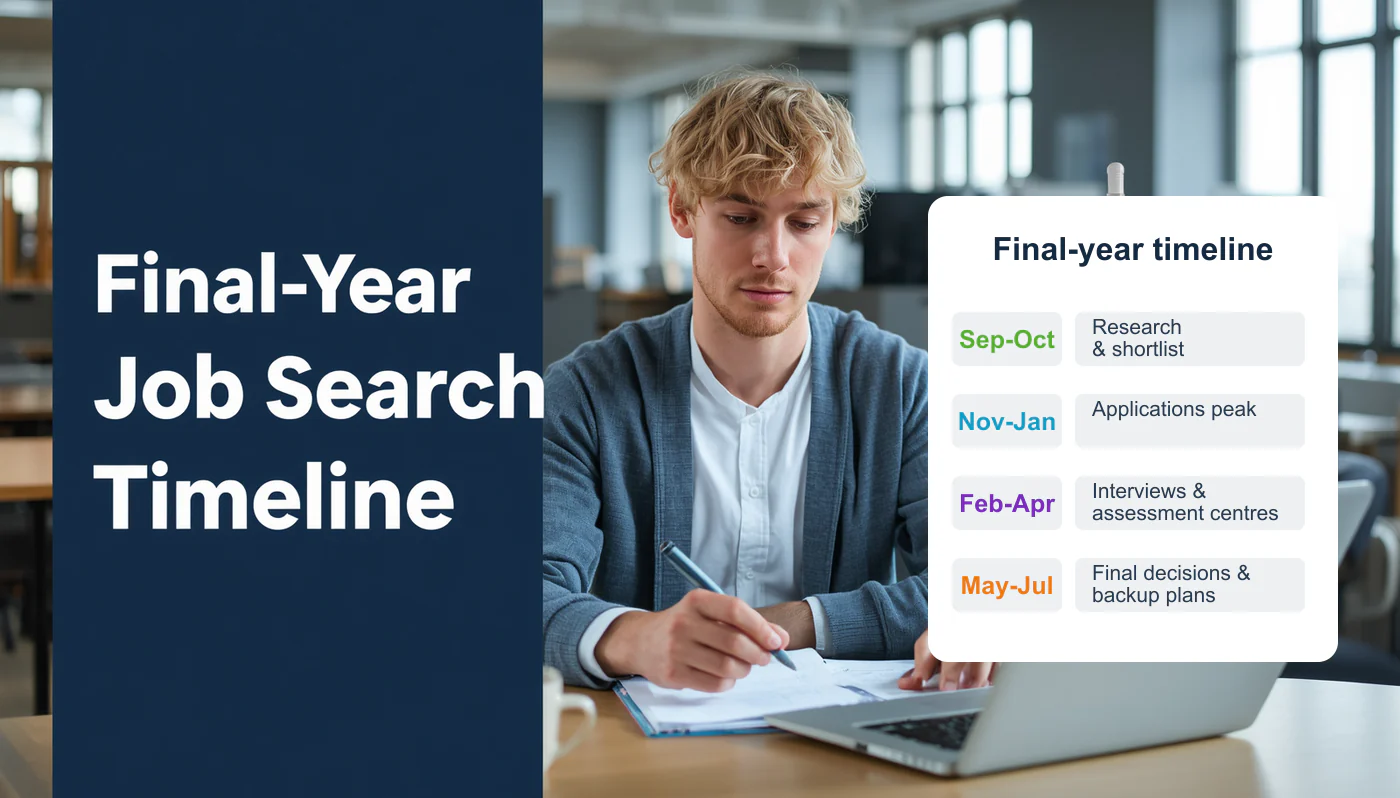
If you are starting final year in the UK and you want a graduate job after university, the mistake is not simply “starting late”. The real mistake is using one timeline for every kind of role.
Large graduate schemes often open in September or October and some close before Christmas. Some employers assess candidates on a rolling basis, so waiting until the official deadline can still leave you behind. Direct-entry graduate jobs, smaller employers, internships that convert into roles, temp-to-permanent jobs and public-sector opportunities can appear throughout the year. The right plan is not to apply everywhere at once. It is to match your actions to the hiring pattern of the role you want.
This guide is written for UK final-year students and recent graduates who already have unrestricted UK work rights. International students should use the same application discipline, but must also check visa, sponsorship and Graduate Route or Skilled Worker timing separately. If that is your situation, read GradSharp’s guide to international graduates in the UK and Ireland and the country-choice guide for Indian students comparing the UK and Ireland.
The short answer: use September to November for competitive graduate schemes, December to February for assessments and backup applications, March to May for direct-entry roles and smaller employers, and June onwards for fast-moving vacancies, internships, temp roles and reapplications.
If your concern is degree classification rather than timing, start with whether a 2:2 blocks you from UK graduate schemes. If your target is professional services, use this alongside the GradSharp guide to writing a graduate CV for the Big 4.
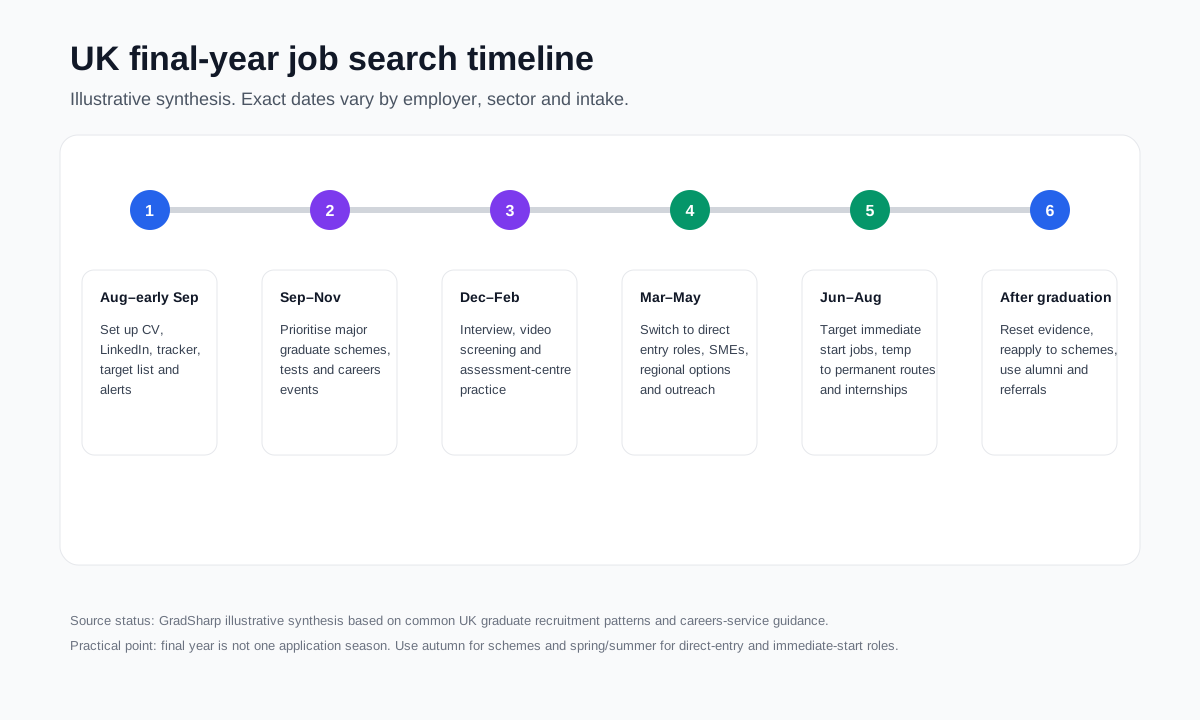
Chart: illustrative synthesis based on common UK graduate recruitment patterns. Exact dates vary by employer, sector and intake.
The main problem: students confuse graduate schemes with graduate jobs
A graduate scheme is usually a structured programme with training, rotations, assessments and a fixed start date. A graduate job is broader. It may be an entry-level role where a degree is useful or required, but it does not always have a formal scheme structure.
That difference matters because the timelines are different.
Many large graduate schemes recruit far ahead of the start date. Careers platforms and employer pages commonly describe autumn as the main application window for schemes, with assessments running through winter and offers often made months before graduation. Some schemes remain open longer, and some reopen, but the safest assumption is that the most competitive roles need early attention.
Direct-entry graduate jobs behave more like normal vacancies. An employer with a live business need may not want to wait nine months for someone to start. These roles often appear closer to graduation or immediately afterwards. That does not make them worse. For many students, especially those without a spring week, internship or highly polished CV, direct-entry roles can be the most realistic first step.
The practical conclusion is simple: apply early for structured schemes, but do not panic if you reach spring without an offer. The spring and summer market is different, not dead.
Your final-year timeline at a glance
| Period | Main focus | What to prioritise | What to avoid |
|---|---|---|---|
| August to early September | Set up your campaign | CV, LinkedIn, target list, careers service, employer alerts | Waiting for lectures to start before planning |
| September to November | Graduate schemes and early deadlines | High-quality applications, online tests, careers fairs, sector research | Sending rushed applications to every famous employer |
| December to February | Assessments and backup routes | Interviews, assessment centres, second-wave schemes, direct-entry watchlist | Treating rejections as proof you are unemployable |
| March to May | Direct-entry graduate jobs | Smaller employers, regional roles, public sector, internships, speculative outreach | Only applying to schemes that closed months ago |
| June to August | Fast-moving roles and conversion routes | Immediate-start jobs, temp-to-permanent work, summer applications, reapplications | Waiting for the “perfect graduate job” before doing anything |
| September after graduation | Reset and refine | Stronger CV evidence, alumni networking, repeat-cycle schemes | Repeating the same weak applications unchanged |
This is not a rulebook. It is a planning map. Your subject, sector, location, grades, work experience and confidence with interviews will change the best route.
August to early September: build your job-search system before the rush
Before final year gets busy, build a simple system. You do not need a colour-coded spreadsheet with 80 employers. You need enough structure to avoid missing deadlines and enough clarity to stop yourself applying for jobs you do not actually want.
Start with four lists:
- Priority employers: roles you would genuinely accept.
- Backup employers: less famous but still relevant options.
- Direct-entry targets: smaller employers, regional firms and role titles to watch.
- Evidence gaps: skills or examples you need to strengthen before applying.
Your CV should be ready before the first employer deadline, not half-written at midnight. The top third of the CV matters most because recruiters often decide quickly whether your experience looks relevant enough to keep reading. For a more detailed CV structure, see How to Write a Graduate CV for the Big 4 in 2026 and the narrower guide to KPMG graduate CV screening.
If your experience feels thin, do not wait until you have “real” experience. Translate what you already have. Retail work can show customer judgement, pace and reliability. Society roles can show planning and stakeholder management. A dissertation can show research and analysis. A part-time job alongside study can show time management more convincingly than a generic claim.
Set alerts on employer careers pages and graduate job boards, but do not rely only on alerts. Some roles close early when they receive enough applications. Build a habit of checking your target list twice a week in autumn.
September to November: treat autumn as the graduate scheme window
Autumn is the key period for many UK graduate schemes. Guidance from major graduate careers platforms commonly describes September to December as the main application window for structured schemes, although the exact timing varies by employer and sector. Some employers use rolling recruitment, which means early applications can be reviewed before later ones.
Your autumn goal is not to send the highest number of applications. It is to submit enough strong applications before the strongest windows close.
A good weekly rhythm looks like this:
- two carefully researched applications;
- one online test practice session;
- one employer event, careers fair or webinar;
- one CV or application review;
- one hour improving examples for competency or strengths questions.
This is enough to create momentum without destroying your degree work.
Do not use the same answer for every employer. You can reuse your evidence, but you must adapt the emphasis. The same principle applies to written answers and cover letters; GradSharp’s cover letter guide for 2026 explains why specificity matters even when applications are screened quickly.
A weak application says: “I am excited to join your graduate programme because it offers development and responsibility.”
A stronger application says: “I am applying for the audit graduate programme because my part-time finance assistant role and final-year accounting modules have shown me that I enjoy evidence-based work, deadline pressure and explaining figures clearly to non-specialists.”
The second version is not longer. It is more specific.
December to February: prepare for the part most students underestimate
By December, many students have either sent applications and heard nothing, received online test invitations, or been rejected by several employers. This is the stage where confidence drops. It is also where preparation starts to matter more than volume.
Online tests, video interviews and assessment centres are not random hurdles. They are designed to reduce a large applicant pool. Instead of sending another 20 low-quality applications, spend time improving the stages where you are currently failing.
Use this diagnostic:
- No responses: your target list, CV or eligibility may be weak.
- Online tests but no progress: practise numerical, verbal or situational judgement tests.
- Video interviews but no progress: improve examples, structure and delivery.
- Assessment centres but no offer: work on group exercises, commercial judgement and reflection.
For online-test invitations, use the graduate psychometric-tests guide to identify the real format, run a baseline and review errors instead of cycling through unrelated question banks.
A rejection is useful only if it changes the next application. If your next application is identical, you have not learned anything from the process.
Graduate schemes vs direct-entry jobs: which should you prioritise?
The best route depends on your sector, profile and risk tolerance.
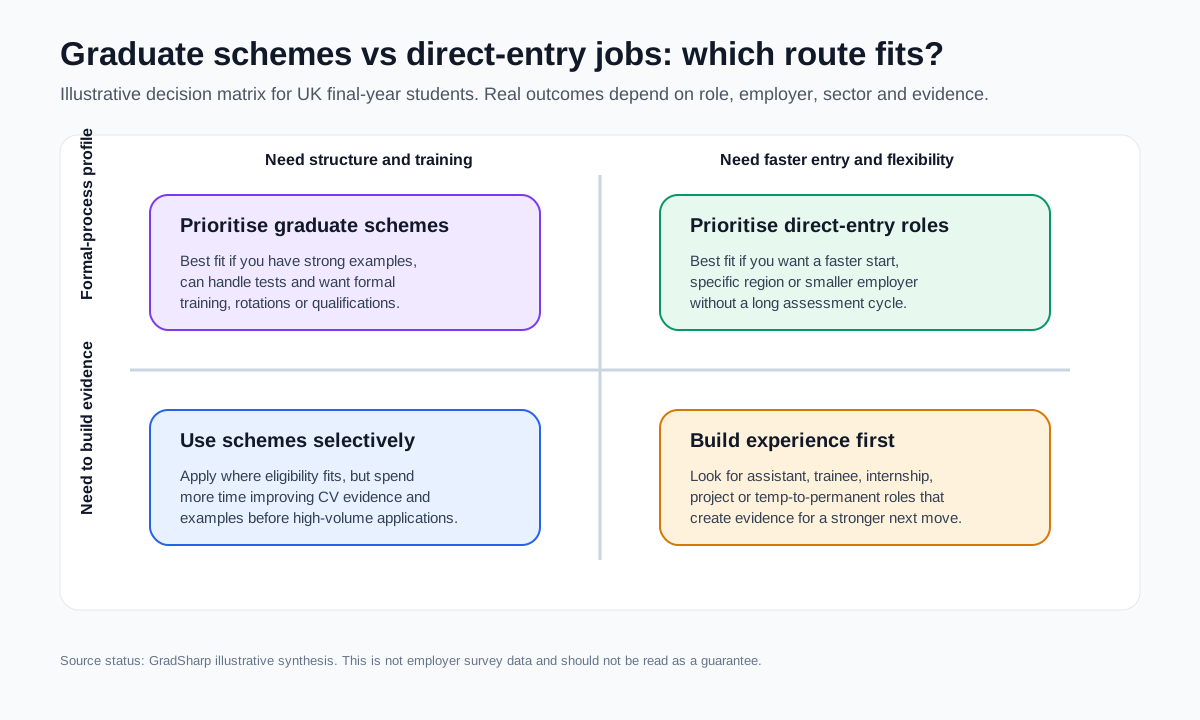
Chart: illustrative decision matrix. It compares typical patterns, not guaranteed outcomes.
Graduate schemes are worth prioritising if you want structured training, a recognised employer brand, professional qualification support, rotations or a defined cohort. They can be especially useful in accounting, banking, consulting, engineering, public sector leadership, technology and large corporate functions.
Direct-entry jobs are worth prioritising if you want to start sooner, build experience quickly, work for smaller employers, stay in a specific region, avoid long assessment processes or enter a field where structured schemes are limited.
The mistake is treating direct-entry roles as second-class. Many strong careers start in ordinary job titles: analyst, assistant, coordinator, trainee, junior consultant, project assistant, lab technician, marketing executive, finance assistant, operations associate or software developer. What matters is whether the role gives you credible experience, not whether the title has “graduate scheme” in it.
A good first job should give you at least two of the following:
- manager feedback and training;
- measurable work outputs;
- exposure to clients, customers, data, projects or operations;
- a recognised skill, tool, qualification or sector;
- a realistic path to a better second role.
If a direct-entry role gives you that, it can be a better move than waiting months for a scheme that may never reply.
March to May: switch from prestige filtering to evidence building
By spring, many major schemes have closed or moved deep into assessment stages. Some late schemes remain open, but you should widen your strategy.
This is when smaller employers, regional roles, public-sector campaigns, internships, fixed-term contracts and role-specific entry jobs become more important. The application style also changes. A structured scheme may ask broad competency questions. A direct-entry employer usually cares more about whether you can help with the specific job.
That means your CV should become more targeted.
For example, if you are applying for a marketing assistant role, your CV should show content, campaigns, analytics, customer insight or writing evidence. If you are applying for a finance assistant role, show Excel, accuracy, numeracy, part-time responsibility, finance modules or bookkeeping exposure. If you are applying for data analyst roles, show tools, projects, datasets, dashboards and problem framing.
A spring job search is not “less ambitious”. It is more specific.
June to August: the market becomes faster, not easier
After exams, more students start searching seriously. Employers with immediate needs also move faster. They may want someone who can start in two to six weeks, not the following September.
This is a good time to consider:
- immediate-start graduate jobs;
- temp-to-permanent roles;
- internships with possible conversion;
- research assistant or project roles;
- local SMEs;
- public-sector and charity roles;
- startup roles where evidence matters more than formal intake cycles.
The risk is drifting. You may feel that because the main scheme season has passed, there is no structure left. Create your own structure: apply weekly, track responses, follow up, keep improving your examples and ask for feedback when possible.
If you graduated without an offer, you have not failed. You are now in a different hiring market. Treat it like one.
Sector timing: where your calendar may need to change
Different sectors move differently.
Investment banking and some consulting routes often move very early. Spring weeks, internships and early insight programmes can matter before final year. If you reach final year without that background, you may need a broader route into finance or consulting.
Big 4 and accountancy often have structured autumn recruitment but may also have later vacancies or regional routes. If you are rejected by Big 4, do not ignore mid-tier firms and regional accountancy practices.
Technology varies widely. Large employers may recruit early, while startups and scaleups hire closer to need. A portfolio, project evidence and technical tests can matter more than application volume.
Public sector routes vary by department and scheme. Some open early, some follow different annual cycles, and some require nationality or security eligibility. Always check the live advert.
Creative, marketing and media roles often behave more like direct-entry roles than graduate schemes. Portfolios, writing samples, internships and networking can matter more than a formal scheme pipeline.
Example: two students using different timelines
Student A wants a structured audit graduate scheme. Their September to November calendar should be intense: CV ready, applications to Big 4 and mid-tier firms, online test practice, firm research and assessment-centre preparation. If they reach January with no progress, they should widen to regional firms, finance assistant roles and accounting-related direct-entry jobs.
Student B wants a marketing role in Manchester. Their autumn should still include applications, but they should not rely only on national schemes. They should build a portfolio, apply to smaller agencies, track entry-level executive roles, attend local events and use part-time or volunteering evidence to show content, campaigns and analytics.
Both students are doing a final-year job search. They should not use the same timetable.
How to make applications specific without spending all day on each one
You do not need to write every application from scratch. You need a bank of honest evidence that can be adapted.
Create six core examples:
- teamwork;
- leadership or responsibility;
- problem solving;
- communication;
- resilience or learning from difficulty;
- role-specific technical or commercial evidence.
For each example, write the situation, action, result and what you learned. Then adapt the emphasis for each employer.
This is faster and better than copying generic answers. It also protects you from sounding like an AI-generated applicant. Employers are increasingly sensitive to applications that are polished but empty.
How to judge whether a role is worth applying for
Before applying, ask five questions:
- Would I accept this job if offered?
- Can I show evidence for at least half the essential criteria?
- Does the deadline or rolling process make timing urgent?
- Does this role build skills or sector evidence for the next move?
- Am I applying because it fits, or because I am panicking?
If the role fails all five, skip it. Your time is limited.
If the role passes three or more, tailor the application properly.
What parents, lecturers and friends often misunderstand
Well-meaning advice can be misleading. “Just apply everywhere” creates low-quality applications. “Only apply to prestigious schemes” ignores the direct-entry market. “Wait until exams are over” misses the autumn scheme window. “Take anything” can push you into a role that gives little useful evidence.
A better approach is balanced. Apply early to structured schemes, keep direct-entry options open, protect your degree work, and keep evidence building throughout the year.
Timing and application balance compound
- Applying before rolling schemes fill.
- Showing evidence in the top third of the CV.
- Practising online tests before the real one.
- Knowing why a specific role fits you.
- Preparing interview examples before invitations arrive.
- Tracking application outcomes so you can spot patterns.
- Using the university careers service before access becomes limited.
What matters less than students fear
- Having one perfect dream employer.
- Knowing your whole career path at 21.
- Getting rejected by one famous scheme.
- Having only society or part-time work experience.
- Taking a first job that is not called a graduate scheme.
The first role matters, but it is not the whole career.
Common mistakes to avoid
The biggest mistake is sending too many weak applications. Application volume matters only if the applications are credible.
The second mistake is treating all rejections the same. A rejection before tests means something different from a rejection after assessment centre.
The third mistake is not preparing for online tests. Many students spend hours editing CV wording but almost no time practising the test that will decide whether the CV is ever read.
The fourth mistake is waiting for confidence. Confidence usually comes after action, not before it.
The fifth mistake is ignoring smaller employers. Smaller employers may offer better responsibility, faster learning and a clearer path to a second role.
A realistic weekly plan for final-year students
During busy teaching weeks, aim for:
- one or two applications;
- one test practice session;
- one careers or employer event;
- one improvement to CV, LinkedIn or examples;
- one tracker update.
During quieter weeks, increase applications or interview preparation.
Do not build a plan that requires four hours every night. You will abandon it. Build a plan you can repeat.
Final-year checklist
Before October:
- CV ready and reviewed.
- LinkedIn updated.
- 20 to 30 target employers or role types listed.
- Careers fair dates in your calendar.
- Online test practice started.
- Strong examples drafted for teamwork, leadership, problem solving, resilience and communication.
Before Christmas:
- Priority scheme applications submitted.
- Application tracker updated.
- At least one mock interview completed.
- Backup list created.
- Direct-entry role titles identified.
- Weak CV areas improved.
Before Easter:
- Spring applications active.
- Interview examples refined.
- Portfolio, project or skills evidence added if relevant.
- Smaller employers and regional options researched.
- Rejection patterns reviewed.
Before graduation:
- Direct-entry applications active.
- Immediate-start roles monitored.
- Careers service support used before access changes.
- References prepared.
- Reapplication plan drafted if needed.
Sources checked
Timing and application-window claims were checked against public UK graduate recruitment guidance from TARGETjobs, Bright Network, Prospects, graduate-jobs.com, The Times Top 100 Graduate Employers, the University of Manchester Careers Service and Institute of Student Employers reporting on graduate applications.
Dates, vacancies and employer eligibility rules change by intake, so students should check live employer pages before applying.
FAQ
When should UK final-year students apply for graduate schemes?
For many structured graduate schemes, students should start in September or October of final year. Some deadlines fall later, but competitive or rolling schemes can close earlier than expected. Always check the live employer page.
Is January too late to apply for graduate jobs?
January is late for some major schemes but not too late for the graduate job market. Some schemes remain open, and many direct-entry graduate jobs, smaller employers and immediate-start roles appear later in the academic year.
Should I apply before I know my final degree result?
Yes, if the employer allows it. Many final-year students apply using predicted or expected grades. Be honest about your current position and check each employer’s eligibility requirements.
Are graduate schemes better than normal graduate jobs?
Not always. Graduate schemes can offer structure, training and brand recognition. Direct-entry jobs can offer faster responsibility, earlier start dates and more realistic access. The better choice depends on your sector, goals and evidence.
How many graduate applications should I send?
There is no magic number. A useful target is enough applications to create opportunity without sacrificing quality. Ten tailored applications are usually better than fifty rushed ones with weak motivation answers.
What should I do if I graduate without a job?
Keep applying, widen your role titles, consider temp or contract roles, improve your CV evidence and review where applications are failing. Graduating without an offer is stressful, but it does not mean you have missed the whole market.
Set up the semester application calendar
Do not try to solve your entire career this weekend. Build the first version of your system.
- Choose three role families you are willing to apply for.
- List 15 employers or job titles across schemes and direct-entry roles.
- Update the top third of your CV for one target role.
- Find five live or recently closed job adverts and note the common requirements.
- Book one careers service CV review or mock interview.
- Set up a tracker with deadlines, stages and next actions.
- Start one online test practice session if your target employers use them.
The final-year job search is easier when you stop treating it as one huge decision. It is a sequence of small, timed decisions: which windows matter now, which evidence needs improving, which roles deserve your best application, and when to switch strategy.
Start early, apply carefully, learn from each stage and keep more than one route open.