IND Recognised Sponsors in the Netherlands: How International Graduates Should Use the List Before Applying
A practical Netherlands job-search guide for international graduates using the IND recognised sponsor list without mistaking it for a sponsorship guarantee.
The IND recognised sponsor list is useful. It is also easy to misuse.
If you are an international graduate in the Netherlands, especially on a zoekjaar or planning to use the Highly Skilled Migrant route, the list should help you avoid wasting applications. But it does not tell you which graduate roles are sponsored, which teams hire in English, or whether a recruiter will support your permit before your current permission ends.
That distinction matters. A recognised sponsor can apply for a Highly Skilled Migrant residence permit, but the role still has to fit the salary rules, the employer still has to choose to use that route, and the legal entity in the register has to match the hiring organisation.
Use the sponsor register as a filter
Use the IND recognised sponsor list as a filter, not as a promise.
A stronger Netherlands job search usually starts with three checks:
| Check | Why it matters |
|---|---|
| Is the employer in the IND Public Register Work? | Only an employer recognised by the IND can apply for a Highly Skilled Migrant permit. |
| Is the job likely to meet the 2026 salary criterion? | Recognition alone is not enough if the offer sits below the required monthly salary. |
| Is the employer actually willing to use the route for this role? | A sponsor licence/register entry does not mean every vacancy is open to sponsored graduates. |
The IND says the public register recognised sponsors can be used to check whether a company, school or organisation has been recognised as a sponsor, and that public registers are updated once a month. For work purposes, use the Public Register Work, not the study register. The work register shows recognised sponsors for work and Highly Skilled Migrant residence purposes.
That sounds simple, but your search should go deeper than “company is on the list”.
What a recognised sponsor actually means
A recognised sponsor is an organisation recognised by the Dutch Immigration and Naturalisation Service, the IND. For international graduates, the key point is the Highly Skilled Migrant route. The IND’s Highly Skilled Migrant page states that only an employer recognised by the IND can apply for your permit.
That gives you a practical rule: if your plan is to move from zoekjaar, study permission or another temporary route into a Highly Skilled Migrant permit, recognised-sponsor status matters before you spend hours tailoring an application.
But it does not answer whether the vacancy is senior enough, whether the salary meets the threshold, whether the team hires non-Dutch speakers, whether the entity advertising the job is the entity listed by IND, or whether the employer sponsors early-career candidates. The list tells you who can be part of the immigration route. It does not tell you who will do it for you.
Why this matters more during your zoekjaar
The orientation year, often called zoekjaar, can feel generous because you can work freely during it. The IND says orientation-year holders may work freely in the Netherlands, do an internship, work as an independent entrepreneur, self-employed person or freelancer, and the employer does not need a TWV work permit. The residence permit is valid for one year and cannot be extended.
That freedom can hide the deadline. A company may hire you during the orientation year without being a recognised sponsor. But if you want to remain in the Netherlands afterwards through the Highly Skilled Migrant route, the employer will normally need recognised-sponsor status and the offer must meet the relevant salary criterion.
This is where applicants lose time: they accept an interesting role at a non-sponsor, assume “we will sort the visa later”, and discover too late that the employer cannot or will not support the switch.
The 2026 salary check you should do before applying
The recognised-sponsor check is only half the filter. The salary filter is the other half.
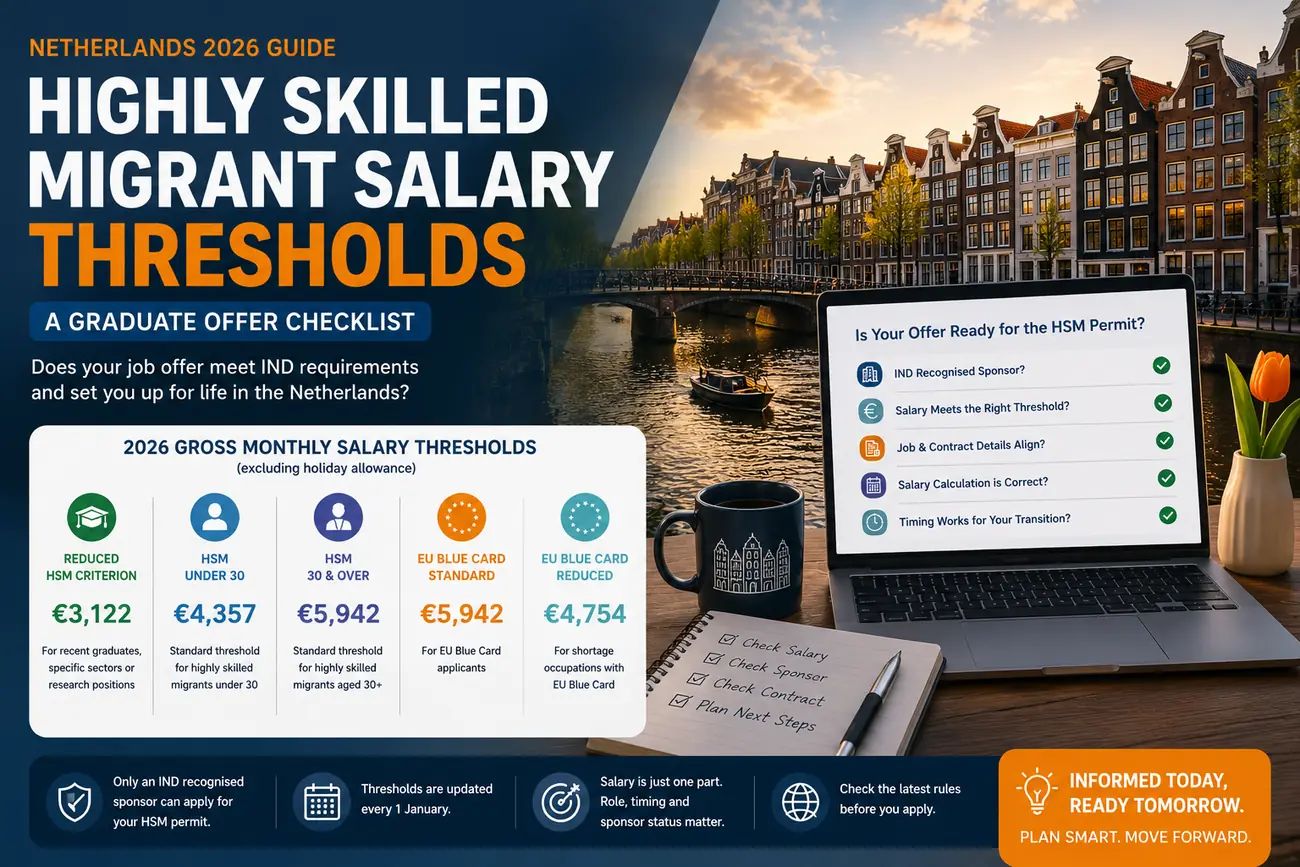
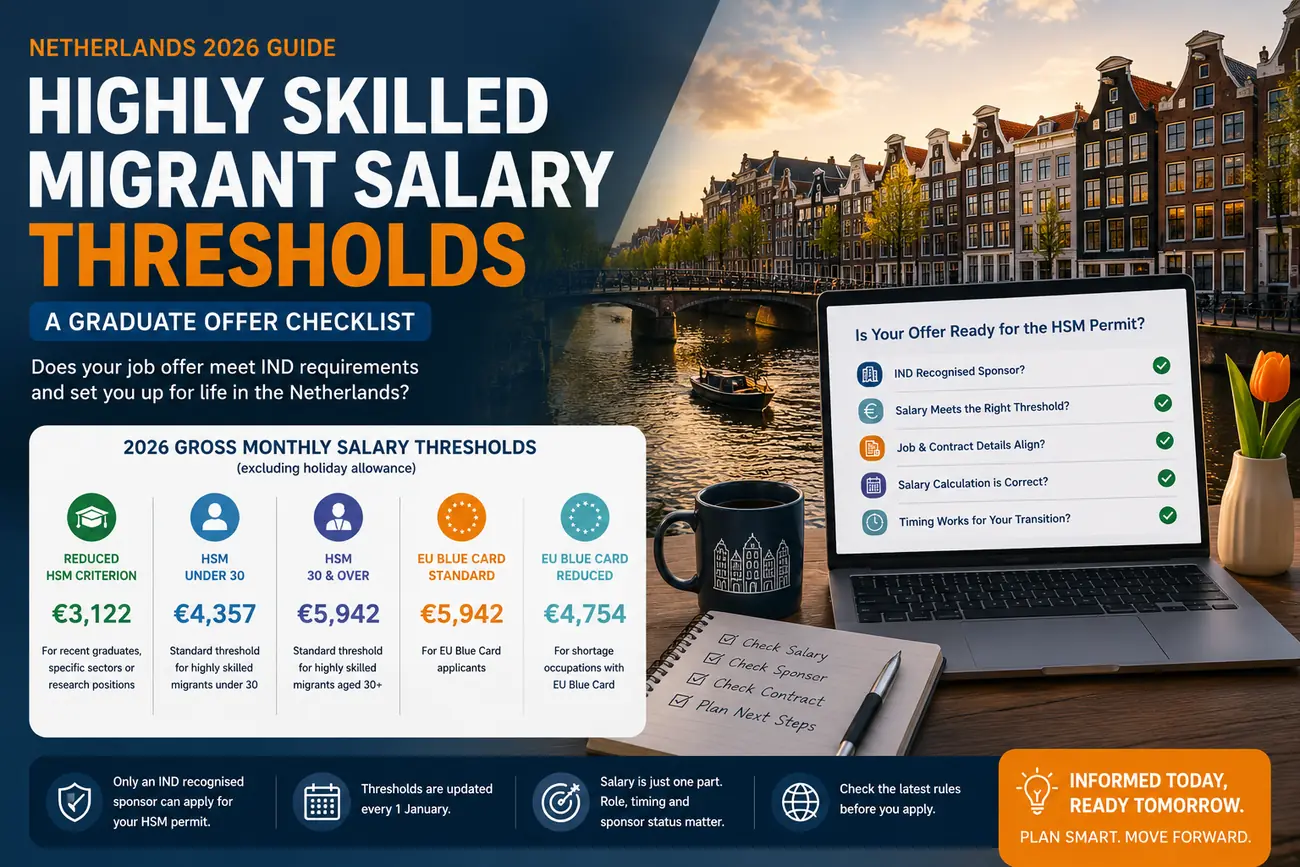
For 2026, IND lists these gross monthly amounts, excluding holiday allowance, for Highly Skilled Migrant and European Blue Card routes:
| Route or category | 2026 gross monthly amount shown by IND |
|---|---|
| Highly Skilled Migrant reduced salary criterion | €3,122 |
| Highly Skilled Migrant younger than 30 | €4,357 |
| Highly Skilled Migrant 30 or older | €5,942 |
| European Blue Card | €5,942 |
| Reduced salary criterion European Blue Card | €4,754 |
These are not casual targets. They are central to whether the route is workable.
IND also explains that reimbursements and fixed allowances can count only under conditions, while holiday allowance, payment in kind and uncertain non-regular pay elements do not count toward the salary criterion. That matters because some job adverts include benefits, bonuses or vague “package” language that may not help your permit case.
If a role is advertised at €2,900 gross per month and your route needs the reduced Highly Skilled Migrant criterion of €3,122, recognised-sponsor status will not fix the salary gap. If the role is close to the threshold, ask carefully and early.
The reduced salary criterion: why graduates misunderstand it
The reduced salary criterion is one reason the Dutch route can be attractive to recent graduates. But it has conditions.
IND says the reduced Highly Skilled Migrant salary criterion applies in three cases: when the permit is applied for during an orientation-year permit; when the person had an orientation-year permit and the Highly Skilled Migrant application is made within the relevant three-year window; or when the person has never had the orientation-year permit but meets the requirements and the application is made within the relevant three-year window.
That means you should not simply tell employers “I qualify for the lower salary”. You need to know why.
A better message is:
I am currently eligible for the reduced Highly Skilled Migrant salary criterion linked to the orientation-year route. I can share the relevant IND page and documents if the team would like to check the immigration requirements.
That is clearer than saying “I need sponsorship”. It shows you understand the route and reduces recruiter confusion.
How to use the Public Register Work properly
Do not use the recognised-sponsor list as a yes/no magic answer. Use it as a workflow.
Step 1: Search the exact legal entity
The trading name on a careers page may not match the legal entity in the IND register. Large groups may have several Dutch entities. Recruitment agencies and payroll entities can also complicate the picture.
When you find a vacancy, check:
- the employer name on the vacancy;
- the legal entity in the job description or footer;
- the Chamber of Commerce number if available;
- the entity listed in the IND Public Register Work;
- whether the contract would be with the listed sponsor or a different company.
If the entity does not match, do not assume the route is safe.
Step 2: Compare the job to the salary threshold
Many graduate jobs do not publish salary. When possible, use salary clues from the role level, sector, employer size, collective agreements, Glassdoor-type ranges, recruiter calls and comparable adverts.
Your goal is not to know the exact salary before applying. Your goal is to avoid spending days on roles that are obviously below the threshold.
Step 3: Read the vacancy for visa-language signals
Useful signals include:
- “recognised sponsor” language;
- “highly skilled migrant” language;
- “relocation support”;
- explicit openness to non-EU candidates;
- English as a working language;
- salary range close to the threshold;
- specialist or technical requirements matching your degree.
Weak signals include:
- “must already have permanent work rights”;
- “Dutch native speaker required” for roles where you do not have Dutch;
- short fixed-term contracts below the threshold;
- vague graduate traineeships with no salary information;
- outsourced roles where the contract entity is unclear.
Step 4: Ask a precise question
Do not ask “do you sponsor?” as your first message. It often creates confusion.
Ask something like:
I am currently authorised to work during my orientation year. For longer-term employment, would this vacancy be handled through your recognised-sponsor entity and the Highly Skilled Migrant route if salary and role requirements are met?
That question is specific. It also tells the employer you understand the difference between current work permission and long-term residence sponsorship.
Sponsor status does not solve weak job-market fit
The list can tempt graduates into applying only to famous companies. That is not always the smartest move.
A recognised sponsor may still reject you if:
- the role is too junior;
- the salary is below threshold;
- the team needs fluent Dutch;
- the employer sponsors only senior hires;
- the job is temporary or outsourced;
- your degree or experience does not match the role;
- the recruiter does not understand the orientation-year transition.
So use sponsor status as one layer, not the whole strategy. A smaller sponsor with a clearly matched technical role may be more useful than a large brand with a generic graduate programme.
A simple application scoring system
Before applying, score each role from 0 to 2 on these five checks.
| Factor | 0 | 1 | 2 |
|---|---|---|---|
| IND sponsor match | Not found | Group company found but entity unclear | Exact legal entity found |
| Salary confidence | Likely below threshold | Unknown or close | Clearly likely to meet threshold |
| Role fit | Generic or unrelated | Partial fit | Strong fit with degree or experience |
| Language fit | Dutch required | Mixed or unclear | English acceptable or Dutch level realistic |
| Route clarity | No visa signal | Recruiter may know route | Recognised sponsor / HSM / relocation language visible |
A role scoring 8 to 10 deserves careful tailoring. A role scoring 4 or below may still be worth trying, but it should not dominate your week.
This simple scoring system prevents emotional applications. It also helps you explain your search strategy to a careers adviser, mentor or recruiter.
Example: two jobs at the same company
Imagine a recognised sponsor has two vacancies.
| Vacancy | Sponsor status | Salary likelihood | Route risk |
|---|---|---|---|
| Junior customer support role | Company is recognised | Likely below HSM threshold | High |
| Data engineer role | Company is recognised | More likely to meet threshold | Lower, if your degree and experience fit |
Both jobs are at a recognised sponsor. Only one is likely to be a serious long-term route.
That is why “company on list” is not enough. You need company + entity + role + salary + timing.
How this links to the orientation year
GradSharp’s Netherlands Orientation Year Visa guide explains the zoekjaar as a 12-month conversion window. This article goes one step deeper: once you have that window, which employers deserve your time?
Use the first months of your orientation year to test the market broadly. But as the end date approaches, your search should become stricter.
A rough pattern looks like this:
| Stage | Search behaviour |
|---|---|
| Months 1 to 3 | Explore sectors, improve Dutch, test CV and interview response. |
| Months 4 to 8 | Prioritise recognised sponsors and roles near the threshold. |
| Months 9 to 12 | Focus on sponsor-backed, salary-realistic, high-conversion roles. |
Do not wait until month 10 to learn how the IND register works.
What to say to recruiters
You need a message that is accurate without scaring people away.
If you are currently on zoekjaar
I currently hold an orientation-year residence permit, so I am allowed to work in the Netherlands without a TWV during this period. For longer-term employment, I would need to move to a suitable residence route such as Highly Skilled Migrant if the role, salary and sponsor requirements are met.
If you are applying from outside the Netherlands
I am applying from outside the Netherlands and understand that long-term employment would require the correct Dutch work-residence route. I noticed that your organisation appears in the IND Public Register Work and would be happy to discuss the process if my profile fits the role.
If you are close to the salary threshold
The IND salary criterion is an important part of my planning. Could you confirm whether the salary range for this vacancy is expected to meet the relevant Highly Skilled Migrant threshold for my situation?
These messages are not magic. But they are clearer than “do you sponsor visa?” and show that you are not expecting the recruiter to explain the entire system.
Common mistakes
Avoid these mistakes:
- using the study sponsor register instead of the work register;
- checking the group name but not the legal entity;
- assuming every vacancy at a sponsor can support a permit;
- ignoring the salary threshold until after interview;
- treating the orientation year as extendable;
- waiting until the last months of zoekjaar to ask about the HSM route;
- applying only to famous brands;
- using UK-style “visa sponsorship” language without explaining the Dutch route;
- accepting a non-sponsor role without understanding your next residence step.
Test five employers against the register
If you are serious about the Netherlands, do this now.
- Download or open the IND Public Register Work.
- Pick 20 employers in your field and verify the exact entity names.
- Build a spreadsheet with employer, KvK number, vacancy link, salary clue, language requirement and route signal.
- Mark each vacancy red, amber or green using the scoring system above.
- Prepare one short recruiter message for your situation.
- Read the current IND salary page and save the figures relevant to your age and route.
- Revisit your target sectors if most roles are below threshold.
This is not glamorous work. But it is exactly the work that stops you wasting your orientation year on weak leads.
FAQ
Does being on the IND recognised sponsor list mean the company sponsors every job?
No. It means the organisation has been recognised by IND as a sponsor in that category. The specific role still needs to fit the route, salary and employer decision.
Which IND register should graduates use?
For work and Highly Skilled Migrant planning, use the IND Public Register Work. Do not rely on the study register when checking employer routes.
Can I work for a non-sponsor during my orientation year?
Yes, orientation-year holders can work freely and the employer does not need a TWV. But if you want to stay later through the Highly Skilled Migrant route, recognised-sponsor status becomes important.
What are the 2026 Highly Skilled Migrant salary amounts?
It depends on the category. IND lists the 2026 reduced Highly Skilled Migrant criterion as €3,122 gross per month without holiday allowance. The under-30 amount is €4,357 and the 30-or-over amount is €5,942. Check the live IND page before relying on these figures because required amounts change.
Does the reduced salary criterion always apply after graduation?
No. IND sets conditions. It can apply in orientation-year-related situations and within the relevant three-year window, but you should check the live IND rules for your case.
Should I mention my visa situation in the first application?
Usually, yes, but briefly. Lead with role fit, then state your current work authorisation and likely route in plain language.
Should I only apply to recognised sponsors?
Not always. If you are early in your zoekjaar, a non-sponsor role may still help you build Dutch work experience. If you need a near-term permit switch, recognised sponsors should move to the top of your list.
Source-checked notes
Checked on 11 June 2026.
- IND, Public register recognised sponsors: used for the definition and monthly update note.
- IND, Public Register Work: used to confirm this is the relevant register for work and Highly Skilled Migrant sponsors; overview last updated 8 May 2026 when checked.
- IND, Highly Skilled Migrant: used for the rule that only an employer recognised by the IND can apply for the permit and for general route requirements.
- IND, Required amounts income requirements and Fees and required amounts for 2026 known: used for 2026 salary criteria and salary-composition cautions.
- IND, Residence permit for orientation year: used for working-rights, one-year validity and non-extension points.
- Nuffic, Stay rates of international graduates: used for stay-rate context.
Related GradSharp reading
- For salary-threshold checks after identifying a sponsor, read Netherlands Highly Skilled Migrant Salary Thresholds 2026.
- For the post-study bridge before HSM sponsorship, read Netherlands Orientation Year Visa.