Netherlands Highly Skilled Migrant Salary Thresholds 2026: Offer Checklist for International Students Worldwide
A practical Netherlands Highly Skilled Migrant salary-threshold checklist for international students and graduates checking whether a Dutch job offer can support long-term work.
A Netherlands job offer can look safe and still fail the immigration test.
That is the uncomfortable bit many international students and graduates discover late. You may be planning a master’s in the Netherlands from India, Pakistan, Nigeria, Ghana, Kenya, Bangladesh, China, the Middle East or elsewhere. You may already be studying in Amsterdam, Eindhoven, Delft, Rotterdam, Groningen or Maastricht. You may be on the Dutch orientation year, often called zoekjaar, and trying to convert temporary access into a longer-term work route.
In all of those situations, the same question eventually appears:
Will a Dutch job offer actually meet the Highly Skilled Migrant salary threshold and sponsor requirements?
This article is for students and graduates worldwide who are considering the Netherlands as a study-to-work destination. It is not only for people already in the Netherlands. Use it before choosing a course, before assuming the orientation year will solve everything, before accepting a borderline offer, and before stopping applications elsewhere.
It is not legal advice. It is a decision checklist based on official IND guidance checked on 15 June 2026.
If you are still comparing routes, read GradSharp’s guide to the Netherlands Orientation Year Visa, the IND recognised sponsors job-search guide and the Germany EU Blue Card guide.
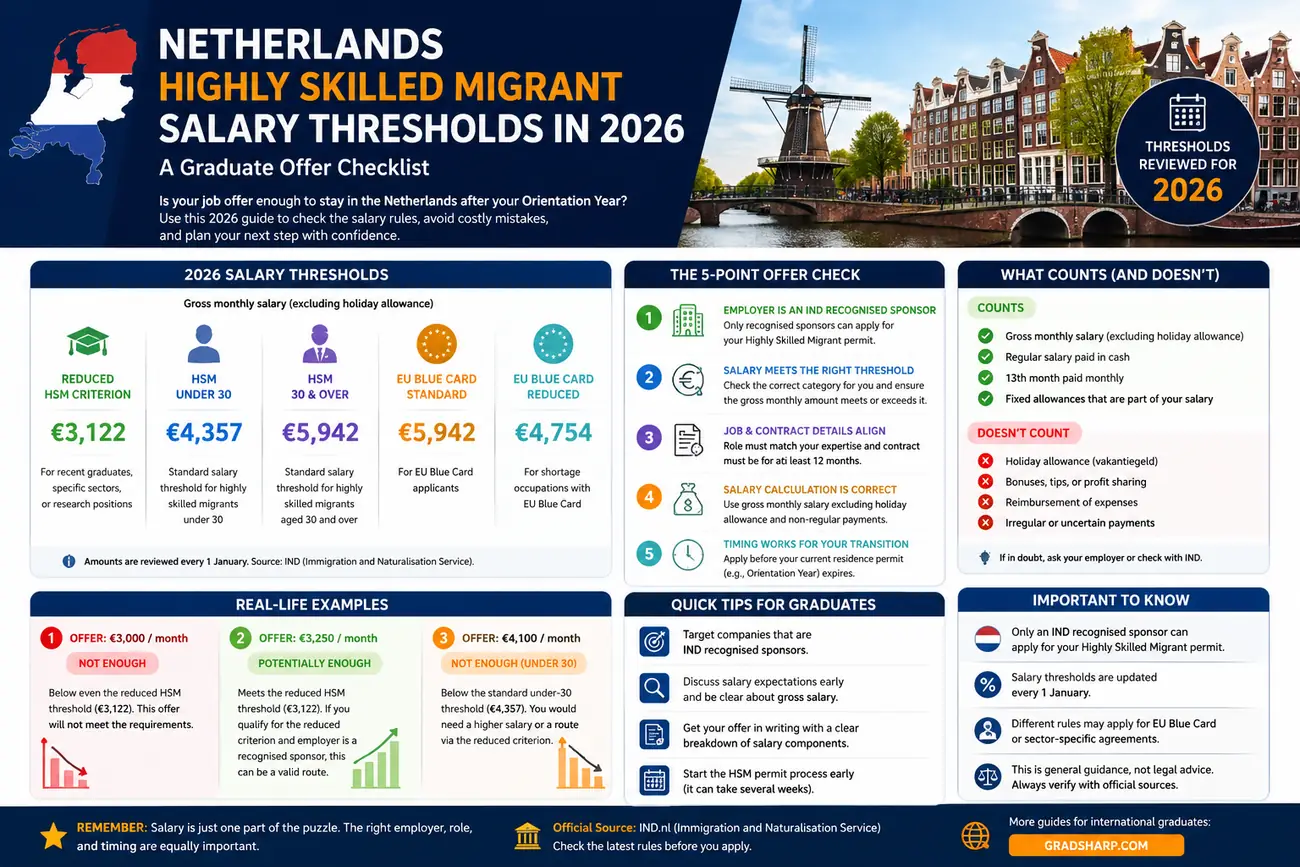
Test the offer against five conditions
For 2026, the Netherlands Highly Skilled Migrant salary check is not one number. It depends on your age, route, timing and whether you qualify for the reduced salary criterion after study or research.
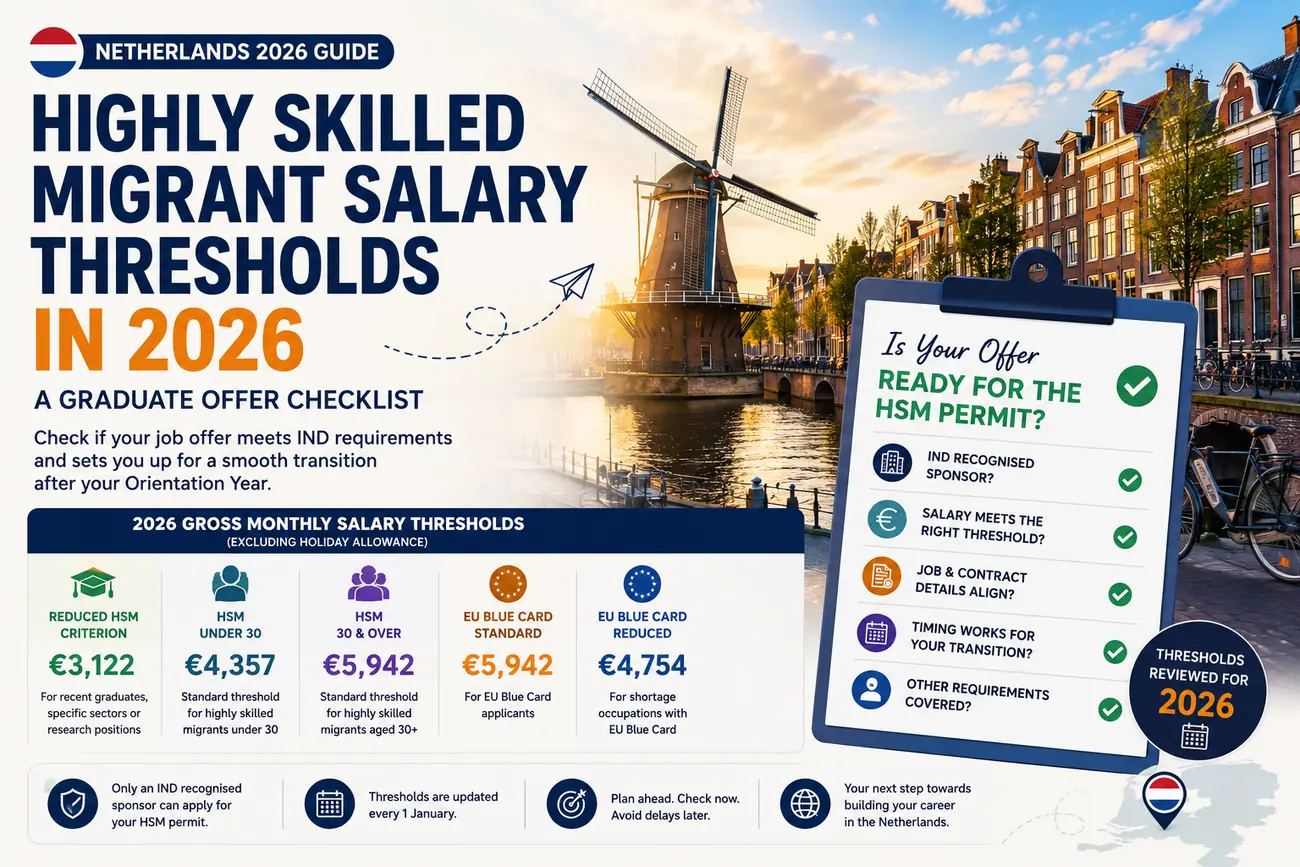
As of the IND’s 2026 figures, the key gross monthly salary thresholds without holiday pay are:
| Category | 2026 gross monthly amount without holiday pay |
|---|---|
| Highly Skilled Migrant, reduced salary criterion | €3,122 |
| Highly Skilled Migrant, younger than 30 | €4,357 |
| Highly Skilled Migrant, 30 or older | €5,942 |
| European Blue Card | €5,942 |
| European Blue Card, reduced salary criterion | €4,754 |
Source checked: IND required amounts and IND 2026 required-amount notice, checked 15 June 2026.
The reduced Highly Skilled Migrant salary criterion is the one many graduates care about most. It can apply when the Highly Skilled Migrant application is made during the orientation year, or within the relevant three-year period after graduation, doctoral defence or eligible research status, depending on your situation.
That lower threshold is why a €3,200 monthly graduate offer can be worth discussing with HR, while a €4,200 offer can still be a problem if you do not qualify for the reduced criterion and instead fall under the under-30 Highly Skilled Migrant threshold.
Why this matters before you choose the Netherlands
Students often compare the Netherlands with Germany, Ireland, the UK, Canada and Australia using broad labels such as “post-study work” or “visa sponsorship”. That is too vague.
For the Netherlands, the important pathway is usually:
study or eligible qualification → orientation year/zoekjaar → employer offer → Highly Skilled Migrant permit
The salary threshold sits near the end of that chain, but it should influence decisions much earlier. If your target sector rarely pays close to the reduced Highly Skilled Migrant threshold, a Dutch master’s may still be valuable academically, but the work-route risk is higher. If your field is software, engineering, data, finance, specialised life sciences or another salary-competitive area, the route may be more realistic — but only if the employer, role and pay package fit IND rules.
This is why overseas students should check likely Dutch graduate salaries before paying deposits, not only after graduation.
The mistake graduates make
Many international students and overseas applicants ask the wrong first question.
They ask: “Does this company sponsor visas?”
A better first question is:
“Can this specific employer, for this specific role, using this specific salary package, apply for the permit category I need?”
Those are different questions.
A company may be an IND recognised sponsor but still not sponsor every graduate role. A recruiter may say the company supports international hiring but not know which salary category applies to your case. A large Dutch employer may have several legal entities, only one of which appears in the IND Public Register Work. A job advert may say “relocation support” but mean help with housing, not residence-permit sponsorship.
You do not need to become an immigration lawyer. You do need to slow the decision down before you treat an offer as safe.
Step 1: Check which salary category applies to you
Start with your status and timing, not the job title.
If you are on the Netherlands orientation year for highly educated persons, the reduced Highly Skilled Migrant criterion may be the most relevant route. IND says the reduced criterion can apply when the Highly Skilled Migrant residence permit is applied for during the orientation year.
It may also apply if you previously had the orientation year and the Highly Skilled Migrant application is made within three years of your graduation date, doctoral defence date, or the date an eligible research permit expired.
There is also a third route: you may never have held the orientation year permit, but still meet the requirements for that residence purpose. In that case, the application must also be submitted within the relevant three-year period.
That detail matters because graduates sometimes assume the reduced salary rule is only available while the physical Zoekjaar card is still valid. The IND wording is more nuanced, but the timing still matters. Do not rely on a memory of what a friend did two years ago. Ask the employer’s HR or immigration contact which salary criterion they intend to use and why.
If you do not qualify for the reduced criterion, the under-30 or 30-plus salary threshold may apply instead. That is a much higher bar for many entry-level roles.
Step 2: Check the monthly salary, not the annual headline
Dutch job offers often show annual salary, monthly salary, holiday allowance, fixed allowance and bonus in different places. For the Highly Skilled Migrant threshold, you need to check the gross monthly amount that counts for IND purposes.
The IND 2026 table is expressed as a gross amount per month without holiday pay.
That sounds simple until you see an offer like this:
| Offer wording | What to check |
|---|---|
| “€40,000 per year including holiday allowance” | Convert carefully. The monthly base without holiday allowance may be lower than you think. |
| “€3,000 plus 8% holiday allowance” | Holiday allowance does not count towards the HSM salary criterion. |
| “€3,150 plus annual bonus” | The fixed monthly salary may work for reduced HSM, but bonus should not be treated as the reason it qualifies. |
| “€3,050 plus overtime” | Uncertain or non-regular pay elements are not a safe basis for the threshold. |
| “€3,122 base salary” | This is close to the reduced threshold; check exact timing, contract wording and current IND amount before relying on it. |
Do not use a salary calculator as your only check. Calculators are helpful for tax and take-home pay, but the immigration question is different: does the salary meet the IND criterion in the form IND counts?
Step 3: Know what pay elements count
This is where many borderline offers become risky.
IND says certain reimbursements and fixed allowances can count towards the salary criterion, but only under conditions. They must be in the contract, transferred to a bank account in the name of the highly skilled migrant or European Blue Card holder, and paid monthly. For example, a thirteenth month must be paid monthly in twelve equal amounts to count.
IND also lists pay elements that do not count. These include vacation allowance, payment in kind, and uncertain or non-regular pay elements such as overtime allowances, tips and payments from funds.
In plain English: if the employer says “don’t worry, your bonus usually pushes you over”, you should still worry.
For a graduate trying to convert from Zoekjaar, or an international applicant planning to use the Netherlands as a study-to-work route, the safer offer is boring:
- a clear gross monthly salary;
- written into the contract;
- paid every month;
- from the sponsoring employer;
- comfortably above the relevant threshold.
“Comfortably” matters because thresholds change every 1 January. If your application is near year-end, or if the employer delays the permit process, you need HR to check which amount will apply on the date of application or employment start.
Step 4: Check the sponsor and the legal entity
For the Highly Skilled Migrant route, IND says only an employer recognised by IND can apply for the permit. The employer must be listed in the public register of recognised sponsors.
This is not the same as “the company is famous” or “the company hires internationals”.
Check the exact legal name. Large groups may have Dutch subsidiaries with similar names. A job may be advertised by one group company while the contract comes from another. If the contract entity is not the recognised sponsor, ask HR to explain the setup before you assume it is fine.
A useful message is:
“Before I accept, could you confirm which legal entity would employ me, whether that entity is listed in the IND Public Register Work, and which salary criterion your immigration team expects to use?”
That is not rude. It is professional. A serious sponsor has answered this question before.
Step 5: Test the offer with scenarios
Use these examples as a structure, not as personal legal advice.
Scenario 1: €3,000 per month plus 8% holiday allowance
This is risky for the reduced Highly Skilled Migrant criterion because the IND amount is listed without holiday pay, and holiday allowance is not included in the salary criterion.
A graduate may see the annual total and feel close. For immigration purposes, close is not enough.
What to do: ask whether the base monthly salary can be increased above the reduced criterion without relying on holiday allowance.
Scenario 2: €3,200 per month from an IND recognised sponsor during Zoekjaar
This could be worth serious discussion if the reduced Highly Skilled Migrant criterion applies and the salary is fixed monthly gross pay without holiday allowance.
It is not automatically safe. You still need to confirm the sponsor entity, timing, contract, market-rate requirement and whether the employer is willing to submit the application.
What to do: ask HR to confirm the intended permit route in writing before you stop applying elsewhere.
Scenario 3: €4,200 per month, under 30, but no reduced criterion
This may look strong for a graduate job. But if the under-30 Highly Skilled Migrant threshold applies, €4,200 is below the 2026 amount of €4,357.
What to do: ask whether you qualify for the reduced criterion. If not, the employer may need to raise the offer or discuss another route.
Scenario 4: €4,800 per month with an employer not recognised as an IND sponsor
For a Highly Skilled Migrant application, the employer recognition issue is a problem. However, the European Blue Card may be worth discussing because IND says recognised sponsor status is mandatory for Highly Skilled Migrant applications but not for European Blue Card applications.
That does not mean the Blue Card is easier. The reduced European Blue Card salary criterion is higher than the reduced Highly Skilled Migrant criterion, and the Blue Card has its own qualification, contract and role requirements.
What to do: do not diagnose the route yourself. Ask whether the employer has handled European Blue Card applications and whether your degree, role and contract fit.
What matters more than graduates think
The salary definition
The amount in your head is often not the amount IND checks. Holiday allowance, bonus, overtime and benefits can make a package feel better than the immigration calculation allows.
The application date
IND says required amounts change every year on 1 January, and the relevant amount depends on the application situation. If you are close to a year boundary, do not rely on last year’s threshold or an old blog post.
The employer’s immigration competence
A sponsor-list match helps, but the practical question is whether HR knows how to handle your case. A company can be recognised and still have a slow or cautious process for junior roles.
The reduced criterion
For many graduates, this is the difference between a realistic first Dutch job and a salary level that only more experienced candidates can reach. But you need to know whether it applies to your case. Do not assume.
What matters less than graduates think
The job title
“Analyst”, “consultant”, “engineer” or “associate” does not tell you whether the offer qualifies. Salary, sponsor status, timing and contract details matter more.
The employer brand
A global brand is not a permit guarantee. A smaller Dutch employer with the right recognition, salary and HR process can be more useful than a famous employer that will not sponsor the role.
Vague sponsorship wording
“Visa support available” is not enough. You need the route, the entity and the salary category.
A practical offer-check worksheet
Before accepting a Netherlands graduate offer, fill this in.
| Check | Your answer |
|---|---|
| What is my current residence status? | |
| Am I on Zoekjaar, previously on Zoekjaar, or otherwise within the reduced-criterion window? | |
| Which salary threshold does HR say applies? | |
| What is the gross monthly salary without holiday pay? | |
| Does the amount rely on bonus, overtime, tips or payment in kind? | |
| Which legal entity will employ me? | |
| Is that entity in the IND Public Register Work? | |
| Will the employer submit the application, and when? | |
| Is the salary comfortably above the threshold, or just on the line? | |
| What is my backup plan if the permit route fails? |
If you cannot complete the worksheet, you are not ready to rely on the offer.
Run the five-point offer check
First, save the current IND required-amounts page and note today’s date. Do not screenshot random third-party tables as your evidence.
Second, check the employer’s exact legal name in the IND Public Register Work. If the advert, contract and register use different names, ask HR to clarify.
Third, calculate the gross monthly salary without holiday allowance. If the offer is annual, ask HR to confirm the monthly amount that counts for the permit application.
Fourth, ask this one question in writing:
“Could you confirm which residence-permit route and salary criterion you expect to use for my employment, and whether the salary in the contract meets the 2026 IND requirement without relying on holiday allowance or non-regular pay?”
Finally, keep applying until the answer is clear. An offer is encouraging. It is not secure until the immigration route is workable.
FAQ
Is the reduced Highly Skilled Migrant salary criterion only for people currently on Zoekjaar?
Not always. IND lists several situations where the reduced criterion can apply, including applications during the orientation year and applications within the relevant three-year period after graduation, doctoral defence or eligible research status. Your exact facts matter, so confirm with the employer and IND guidance before relying on it.
Does holiday allowance count towards the Highly Skilled Migrant threshold?
For this salary criterion, IND lists the required amounts as gross monthly amounts without holiday pay and says vacation allowance is not included in the salary criterion.
Can bonus or overtime help me reach the threshold?
Do not rely on uncertain or non-regular pay. IND says uncertain, non-regular pay elements such as overtime allowances, tips and payments from funds are not included.
Does every IND recognised sponsor hire international graduates?
No. Recognition means the organisation has IND sponsor status in the relevant category. It does not mean every role, department or graduate vacancy will be sponsored.
What if my salary is just below the threshold?
Ask whether the employer can raise the fixed monthly salary or whether another permit route is genuinely available. Do not assume the employer can “explain it” away.
Can I use this checklist before applying to study in the Netherlands?
Yes. In fact, that is the best time to use it. If your long-term goal is to work in the Netherlands after graduation, compare your course, target jobs and likely salary range against the Highly Skilled Migrant thresholds before you commit to a programme.
Is the European Blue Card better than the Highly Skilled Migrant route?
Not automatically. IND notes that recognised sponsor status is not mandatory for the European Blue Card, and the card can have EU mobility advantages. But the salary criterion is higher than the reduced Highly Skilled Migrant criterion, and the Blue Card has its own requirements. For many recent graduates, the Highly Skilled Migrant reduced criterion may be more realistic.
Source-checked notes
Checked on 15 June 2026.
- IND, Required amounts income requirements: 2026 Highly Skilled Migrant and European Blue Card salary thresholds; reduced criterion rules; what may and may not be included in the salary criterion.
- IND, Highly Skilled Migrant: recognised sponsor requirement, employment contract, income requirement, market-rate salary requirement and application process.
- IND, Public register recognised sponsors: recognised sponsor register and monthly updates.
- IND, Residence permit for orientation year: one-year validity, work permission and non-extension context.
- IND, European Blue Card residence permit: differences from the Highly Skilled Migrant route, including recognised sponsor requirement and mobility considerations.
- IND, Income requirements: independent, sustainable and sufficient income: general income terminology and sufficiency principle.
Future applicants should confirm the live IND pages before making immigration or employment decisions.