Netherlands Orientation Year Visa: What International Graduates Need to Know Before Relying on Zoekjaar
The Dutch orientation year visa gives international graduates time to work and job hunt, but it is not a sponsorship guarantee. Here is the realistic plan.
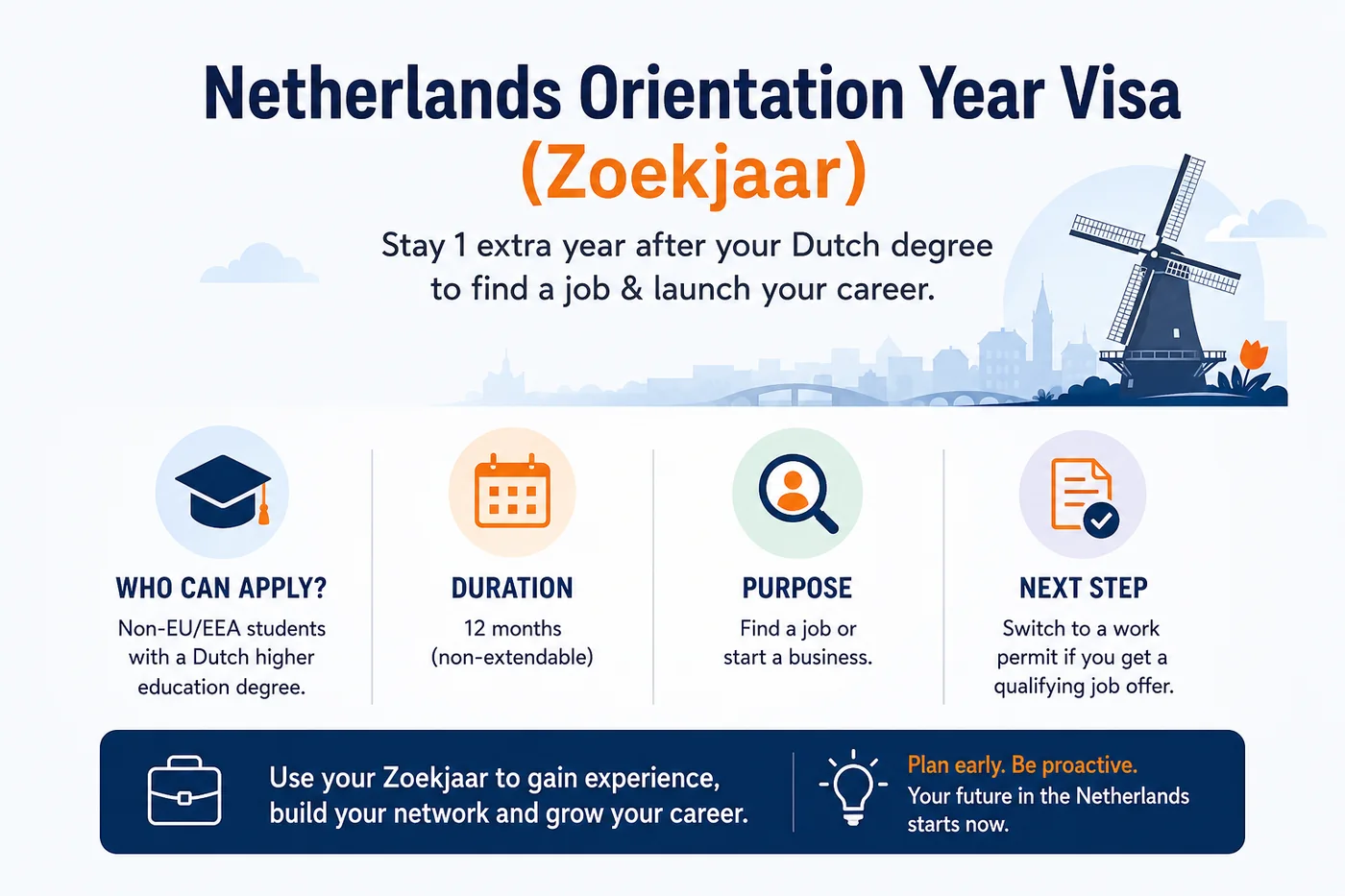
The Netherlands orientation year visa — often called the zoekjaar — is useful, but it is not magic.
It can give eligible non-EEA graduates one year in the Netherlands to work, freelance, intern, look for a job or start a business. During that year, your employer does not need a Dutch work permit for you. That is the good news.
The harder truth is that the orientation year does not guarantee a long-term job, does not make every Dutch employer comfortable hiring you, and does not remove the need to move into another residence route if you want to stay after the year ends.
For most international graduates, the real question is not: “Can I get the orientation year?” It is:
Can I use the year to move into a job that keeps me in the Netherlands legally after the zoekjaar ends?
That usually means understanding the highly skilled migrant route, recognised sponsors, salary thresholds, Dutch-language expectations, sector fit and timing. Treat the orientation year as a 12-month conversion window, not a year to drift.
For wider comparison, read GradSharp’s guides to international graduates in the UK and Ireland, UK vs Ireland for Indian students and Stamp 1G to Critical Skills Permit in Ireland.
What the orientation year does and does not solve
The orientation year is one of Europe’s more useful post-study options because it gives eligible graduates temporary freedom in the Dutch labour market.
The IND says the orientation year residence permit lets eligible graduates look for work after graduation, doctorate or research. It also says work is freely permitted during the permit and that a Dutch work permit, known as a TWV, is not required. The same IND guidance says the permit is valid for one year and cannot be extended. Source: IND, checked 29 May 2026.
That changes how you should think about it. The orientation year is not a final destination. It is a bridge.
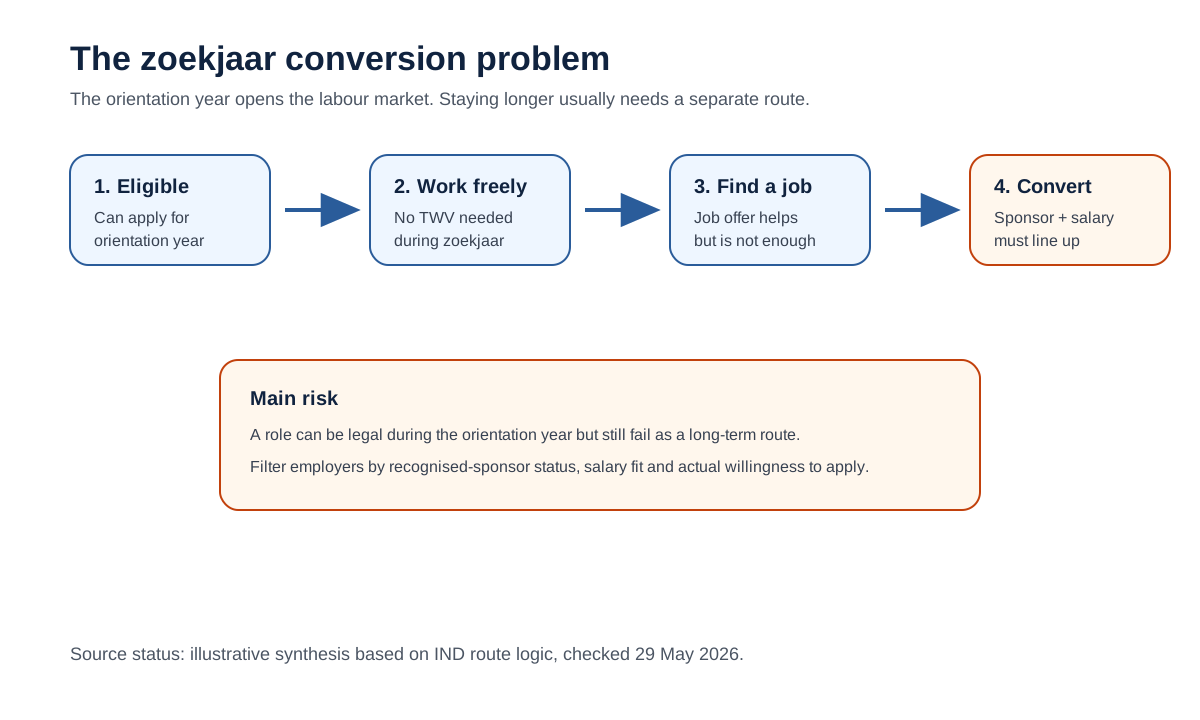
For many graduates, the next bridge is the highly skilled migrant residence permit. To use that route, the employer must be recognised by the IND as a sponsor, the salary must meet the required threshold, and the salary must be in line with the market rate for the role. Source: IND, checked 29 May 2026.
So the honest answer is this:
The zoekjaar helps you enter the Dutch labour market, but your long-term chance depends on whether you can turn that access into a sponsor-backed role before time runs out.
Who the orientation year is for
The orientation year is for highly educated migrants who want time to find work or start a company in the Netherlands after study or research. Government.nl says it covers foreign students who studied in the Netherlands, graduates from top universities outside the Netherlands, and foreign scientific researchers; it also says graduates can apply within three years of graduating. Source: Government.nl, checked 29 May 2026.
IND gives the detailed eligibility rules, including Dutch study, certain master’s, doctoral or post-master’s programmes at designated foreign institutions, and recent scientific research. Source: IND, checked 29 May 2026. Nuffic summarises the route similarly for non-EEA graduates and researchers. Source: Nuffic, checked 29 May 2026.
If you studied outside the Netherlands, check the exact IND criteria for your institution, degree level, ranking evidence and timing. Do not rely on agency adverts, old university pages or social media summaries.
What the orientation year lets you do
During the orientation year, your work access is broad. IND says you may work freely in the Netherlands, do an internship, work as an independent entrepreneur, work as a self-employed person or freelance. Your employer does not need a TWV work permit. Source: IND, checked 29 May 2026.
That means you can apply without immediately asking the employer to sponsor you. It can also help you gain Dutch work experience, build local references and prove that you understand the market.
But do not confuse work access now with permission to stay later. A small company can hire you during your orientation year even if it has no recognised-sponsor status. That may be useful, but if the company cannot support your next residence route, you may still have a problem at the end of the year.
The key question is: will this role help me convert, or is it only helping me survive the zoekjaar? Both can be valid, but you should know which one you are taking.
What the orientation year does not do
The orientation year does not remove employer hesitation.
Some employers may still avoid applicants who need future sponsorship, even if they can work freely for the first year. Some recruiters may not understand the zoekjaar. Some roles may be too junior or too low-paid to support a later highly skilled migrant application. Some employers may like your profile but have no internal process for sponsoring non-EU workers.
This is why “I have full work rights for one year” is not enough as an application strategy.
A stronger message is:
“I currently have unrestricted work permission under the orientation year permit. For longer-term employment, I am targeting roles that can transition into the highly skilled migrant route if salary and sponsor requirements are met.”
The second limitation is time. One year feels shorter once graduate schemes have closed and recruiters ask whether you can work beyond your permit expiry date.
The third limitation is sector fit. English-speaking roles exist, especially in international companies, tech, engineering, finance, logistics, data, research and some start-up environments. But Dutch can still matter in client-facing work, public sector roles, healthcare, education, law, HR and smaller firms. Study in NL says technical and education degrees can improve employment chances, and that learning Dutch greatly enhances labour-market opportunities. Source: Study in NL, checked 29 May 2026.
The real endgame: highly skilled migrant status
For many international graduates who want to remain in the Netherlands, the most relevant next route is the highly skilled migrant permit.
IND guidance says only an employer recognised by the IND can apply for your highly skilled migrant permit. The employer must be listed in the public register of recognised sponsors, and you must meet the income requirements. Source: IND, checked 29 May 2026.
This is the detail many students miss.
Being hired by “a good company” is not the same as being hired by a recognised sponsor. Being hired by a start-up is not the same as being hired by a sponsor. Being hired into an English-speaking role is not the same as meeting the salary threshold.
The IND public register can be used to check whether an organisation has been recognised as a sponsor, and IND says the register is updated once a month. Source: IND recognised sponsor register, checked 29 May 2026.
Use the register as a filter, not a promise. Sponsor status does not mean every role will be sponsored, every team will say yes or every graduate salary will qualify.
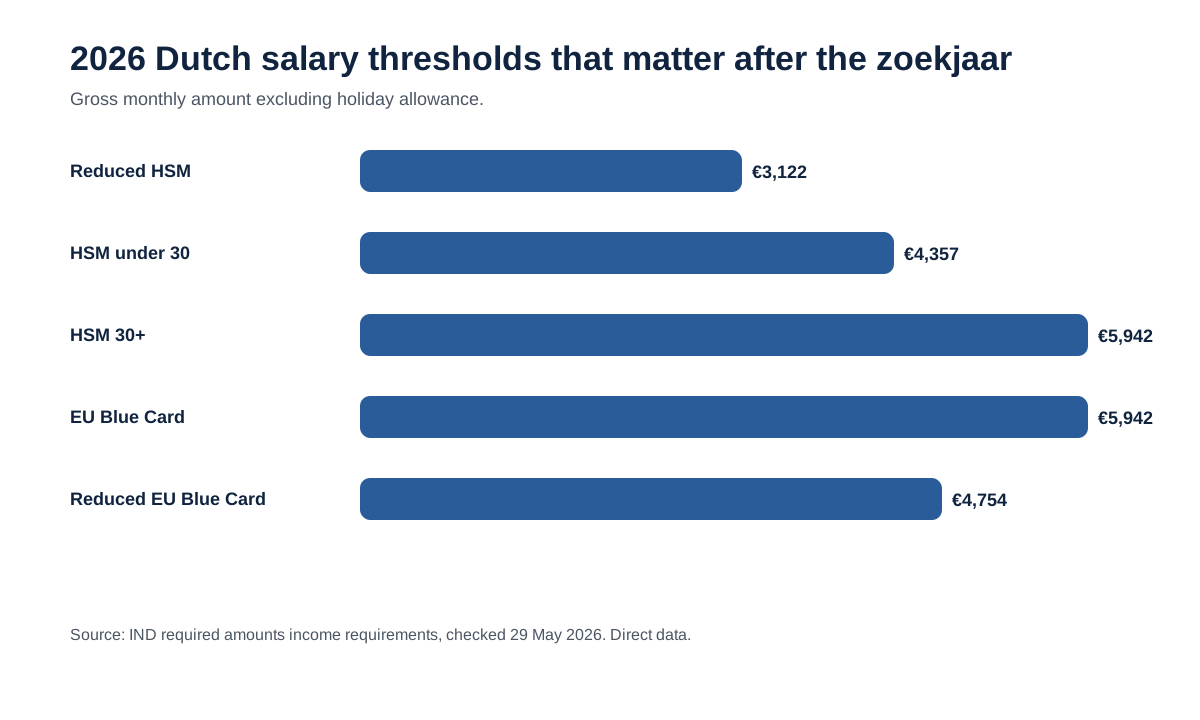
IND’s 2026 required amounts list the reduced salary criterion for highly skilled migrants at €3,122 gross per month excluding holiday allowance, the under-30 threshold at €4,357, and the 30-and-over threshold at €5,942. The European Blue Card threshold is €5,942, with a reduced criterion of €4,754. Source: IND required amounts 2026, checked 29 May 2026.
The reduced criterion is why the orientation year is strategically important. But you still need a role that pays enough, an employer that can apply, and a salary that is market-conform for the job. Source: IND, checked 29 May 2026.
How to use the orientation year properly
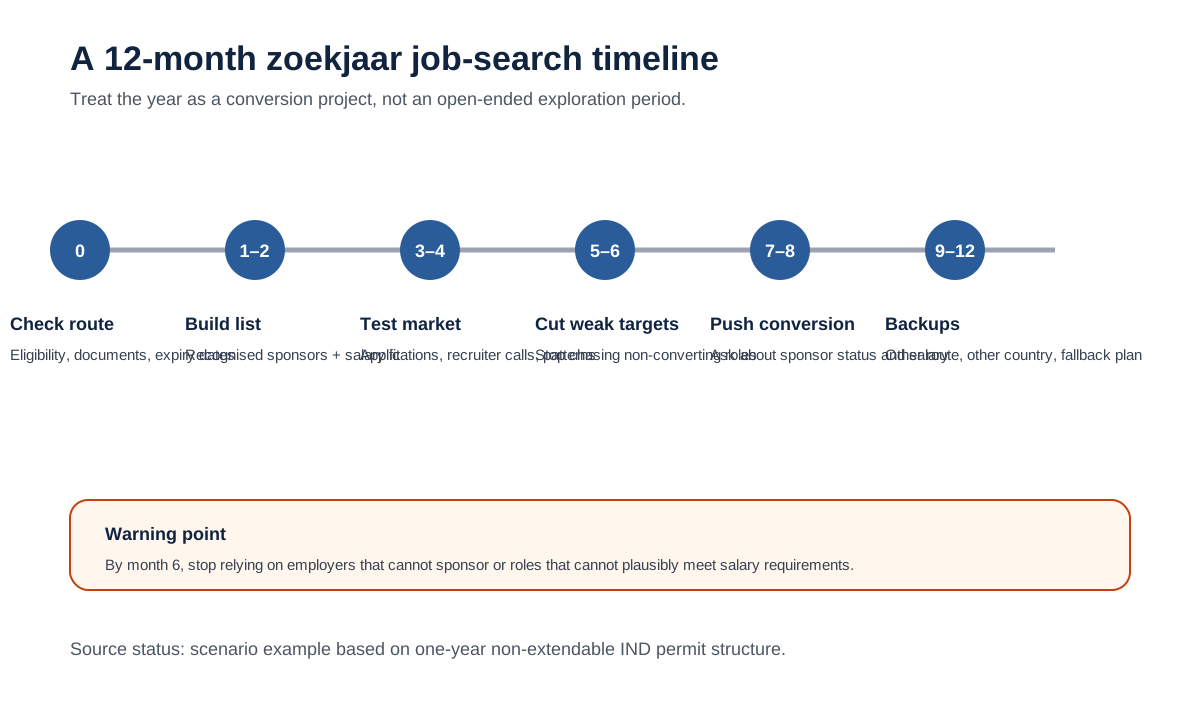
The best use of the zoekjaar is not to “try the Dutch market.” It is to run a focused conversion campaign.
Divide employers into three groups.
Group 1: strong conversion targets. These are employers that are already recognised sponsors, hire international talent, advertise English-speaking professional roles, and offer salaries that could plausibly meet the relevant threshold.
Group 2: useful experience, weak conversion. These employers may hire you during the orientation year but are unlikely to sponsor later. They can pay rent and build references, but they should not consume your whole year unless they create a route to a sponsor-ready role.
Group 3: dead ends. These roles neither build relevant experience nor create a route to long-term residence. If a job leaves you six months later with no relevant experience, no salary progression and no sponsor conversation, it has quietly cost you your most important asset: time.
What employers are really deciding
When a Dutch employer looks at an international graduate on the orientation year, they are usually asking five practical questions: can this person work now, will they still be able to work later, are we a recognised sponsor, does the role pay enough, and is the extra immigration administration worth it?
Your job is not to apologise for needing a route. Your job is to reduce uncertainty.
Weak version:
“I have a zoekjaar visa and need sponsorship later.”
Stronger version:
“I currently have unrestricted work permission under the Dutch orientation year permit. For a longer-term role, I would need to transition to an eligible residence route, usually through a recognised sponsor if the role and salary meet IND requirements.”
Sponsor status, timing and regional breadth drive conversion
Recognised-sponsor status matters more than employer brand. A well-known employer may still not sponsor a particular graduate role. A less famous employer may already be on the IND register and have experience with highly skilled migrant applications.
Salary design matters. IND’s salary thresholds are gross monthly amounts excluding holiday allowance. Do not casually compare the threshold to a total package without understanding what is counted. Source: IND required amounts 2026, checked 29 May 2026.
Dutch matters, even when it is not formally required. Study in NL says learning Dutch greatly enhances labour-market opportunities. Dutch can expand your options beyond international bubbles, especially in client-facing roles, public-facing roles, HR, law, local sales and smaller employers.
Geography matters. Amsterdam is important, but it is not the whole country. Nuffic’s stay-rate dashboard says almost four in ten international graduates who work in the Netherlands five years after graduation are employed in the Greater Amsterdam labour-market region. Source: Nuffic stay-rate dashboard, checked 29 May 2026.
Depending on your sector, Eindhoven, Delft, Rotterdam, Utrecht, The Hague, Leiden or Groningen may be more realistic.
The visa label and Amsterdam fixation add less
The visa name matters less than the conversion plan. “Zoekjaar” sounds like a job-search visa, but job searching is not the whole task. The task is conversion.
Applying to every English-speaking role is not a strategy. Volume matters, but unfocused volume wastes time. A role can be English-speaking and still be too low-paid, too temporary, too unrelated or too weak for sponsorship.
Track why roles fail: Dutch required, no recognised sponsor, salary too low, no visa support, sector mismatch, or rejection after visa discussion. Patterns tell you whether to change language strategy, sector or employer list.
University prestige alone matters less than work evidence. A Dutch degree can help, and some universities have strong employer links. But prestige does not replace internships, projects, technical skills, language, communication, salary fit and whether the team can justify the immigration process.
Is the Netherlands a good destination for international graduates?
It can be, especially for graduates with technical, analytical, engineering, data, research or internationally portable business skills.
Nuffic’s stay-rate data says almost 26% of international students who studied in the Netherlands still live there five years after graduation, and that most of them are in paid employment by then. The same summary says education and engineering graduates are the most likely to stay. Source: Nuffic stay rates, checked 29 May 2026.
Nuffic also reported that in 2025 there were 16,120 graduates with an orientation year permit, up from 14,530 in 2024 and 12,940 in 2023. China was the most common country of origin, followed by India, Iran, Türkiye and Indonesia. Source: Nuffic orientation year permits, checked 29 May 2026.
But stay rates are not individual guarantees. They do not tell you that your degree, city, language level, work experience or sector will work.
The better question is:
Am I in the kind of profile that Dutch employers can realistically absorb?
A data engineering graduate with internships, projects, English-speaking target employers and basic Dutch may have a very different outlook from a general management graduate with no Dutch, no internships and no clear sector.
Common mistakes
Waiting until after graduation to understand the route. Your route affects internships, thesis projects, networking and language learning. Learn it before you graduate.
Treating all jobs as equal. A role that builds Dutch professional experience in your target sector is stronger than a job that only pays rent. A role at a recognised sponsor is stronger than a similar role at an employer with no sponsorship route.
Not checking the employer early enough. Once there is genuine interest, ask professionally: “Before we go further, I want to check whether the company is able to support highly skilled migrant applications for eligible roles, if the salary and contract meet IND requirements.”
Ignoring Dutch completely. You may not need Dutch for your first role, but ignoring it entirely can shrink your labour market and signal that you are not serious about staying.
Having no exit plan. A good orientation-year strategy includes a backup: another Dutch route, another country, further study only if the academic and financial case is strong, or returning home with Dutch experience.
A practical 48-hour plan
First, read the live IND orientation year page and confirm your eligibility, timing and documents. Source: IND, checked 29 May 2026.
Second, read the IND highly skilled migrant page and understand the recognised-sponsor and income requirements. Source: IND, checked 29 May 2026.
Third, build a spreadsheet with four columns: employer, recognised-sponsor status, role type and likely salary range.
Fourth, rewrite the top third of your CV for the Dutch market. Lead with the work you can do: data analysis, mechanical design, GMP documentation, financial modelling, UX research, software engineering, logistics planning, lab work or policy analysis.
Fifth, choose 30 target employers where your skills, language level, salary path and residence route have at least a plausible fit.
FAQ
Can I work during the Netherlands orientation year?
Yes. IND states that orientation year permit holders may work freely in the Netherlands, do an internship, work as an independent entrepreneur, be self-employed or freelance. Employers do not need a TWV work permit for this work permission. Source: IND, checked 29 May 2026.
Can the orientation year be extended?
No. IND states that the orientation year residence permit is valid for one year and cannot be extended. Source: IND, checked 29 May 2026.
Use the orientation year as a conversion runway
The Netherlands orientation year is valuable because it gives you breathing room.
But breathing room is not the same as a plan.
Use the zoekjaar to prove your employability quickly, target employers that can support your next step, learn enough Dutch to widen your options, and check salary and sponsor fit before you get emotionally attached to a role.
If you are still studying, start now. If you are already on the orientation year, stop treating the year as a countdown and start treating it as a conversion project.
The graduates who win are not always the ones with the most applications. They are the ones who understand the route early enough to avoid wasting their best months.