Indian Graduate Jobs in the UK and Ireland: A 2026 Reality Check
A practical 2026 guide for Indian graduates comparing UK and Ireland post-study work routes, sponsorship, salary thresholds and realistic employer targets.
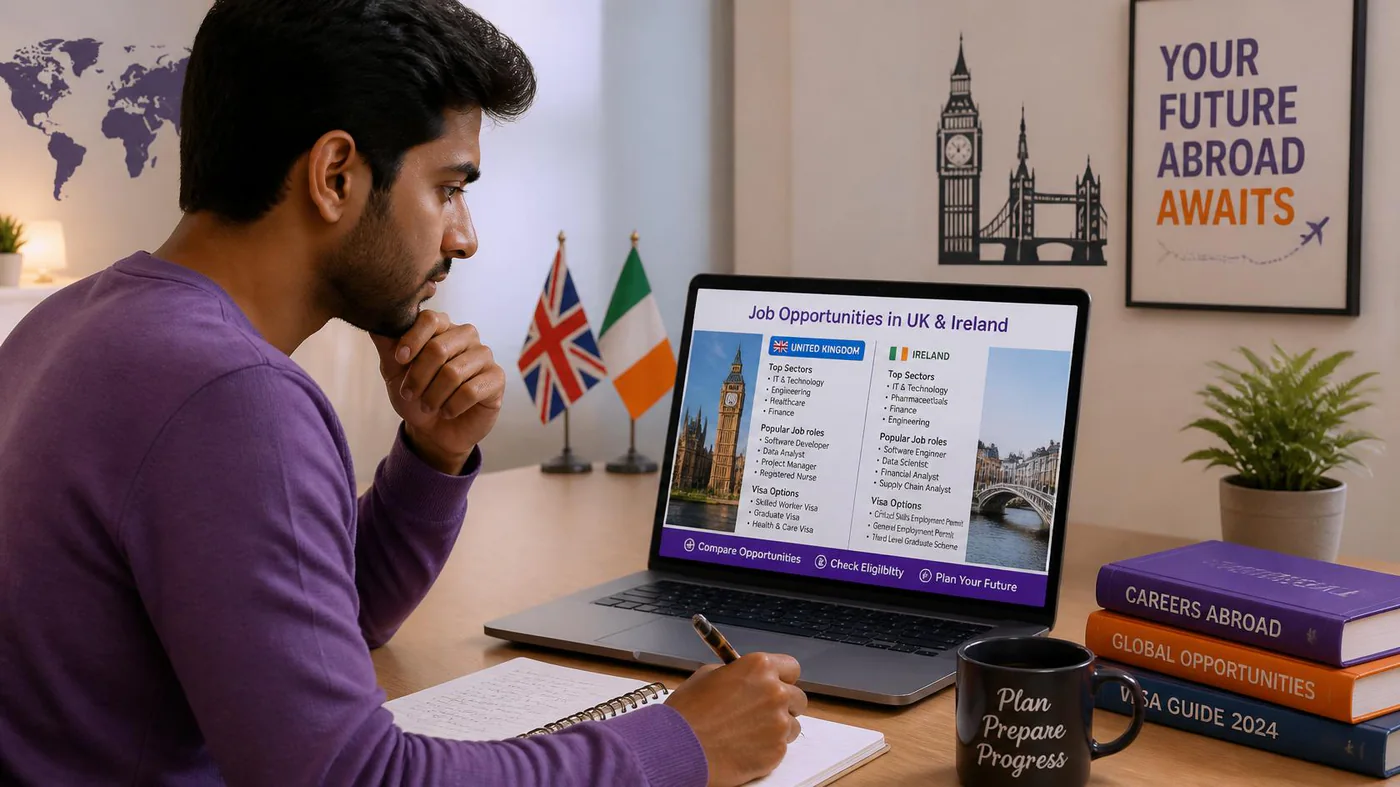
For Indian master’s students, the UK and Ireland still offer serious graduate opportunities. But the route is tighter than it used to be. Post-study work time, salary thresholds and employer sponsorship now matter as much as the degree itself.
The old advice was simple: get a UK or Irish master’s, use the post-study window, then find a sponsor. In 2026, that is too vague. You need to know which employers sponsor, which sectors clear salary thresholds, and when applications actually open.
This is a practical reality check for Indian graduates looking at the UK and Ireland.
Quick decision map
Before choosing a country or sending applications, sort your target route by sector:
| Applicant profile | UK usually offers | Ireland usually offers | Main risk to check |
|---|---|---|---|
| Finance, investment, consulting or large banking | More total schemes and London volume. | Smaller market, with selected professional-services and financial-services routes. | Deadlines, sponsorship policy and salary fit. |
| Software, cloud, data or cyber | Large sponsor-capable employers plus a deep startup market. | Concentrated multinational and European headquarters roles. | Whether the role clears the long-term work route after post-study permission. |
| Pharma, biopharma, medtech or engineering | Strong employers, but more dispersed by region and sector. | Particularly relevant clusters around Cork, Dublin, Galway and Limerick. | Permit fit, salary, employer history and location. |
| General business, marketing or operations | More vacancies, but sponsorship can be less predictable. | Smaller market and more selective sponsorship outside shortage-style roles. | Whether the employer can support you beyond temporary post-study work. |
The starting point
Indian students remain one of the largest international student groups in both the UK and Ireland. The UK has far more total volume. Ireland is smaller, but its technology, pharma, medtech and European headquarters market can be attractive for the right candidate.
The key difference is not just country. It is sector.
A software, data, biopharma or engineering graduate may find Ireland more practical than expected. A finance, consulting or large-bank candidate may still find more total opportunity in the UK.
The UK route in 2026
The UK Graduate visa lets eligible graduates work after finishing a UK degree without employer sponsorship for that temporary route. It should still be treated as a bridge because longer-term routes have separate requirements.
The long-term route is usually Skilled Worker sponsorship. That means the employer, role and salary must all meet the rules. A job offer is not automatically enough.
The main issue for many Indian graduates is the salary threshold. Some graduate roles clear it easily. Others do not. The new entrant rate can help for some graduates, especially those switching from Student or Graduate permission, but it is time-limited and depends on the role.
This is why employer targeting matters from day one.
UK employers that are more realistic
Big 4 professional services
Deloitte, EY, KPMG and PwC can be realistic for Indian graduates, especially where the role connects to audit, tax, consulting, technology or a recognised professional qualification route.
But sponsorship is not automatic. You still need to meet the academic and application standard, and the role must work under the relevant visa rules.
Technology employers
Amazon, Microsoft, Google, Meta, Apple, IBM, Arm, Booking.com, Darktrace and larger fintech employers can be strong targets for software, cloud, data, product and security candidates.
For these roles, project evidence matters. A strong GitHub portfolio, internship, technical test performance or product example can do more than another generic certificate.
Banks and financial institutions
HSBC, Barclays, JPMorgan, Goldman Sachs, Morgan Stanley, Citi, BlackRock and similar employers can sponsor for finance, technology, analytics and quantitative routes.
The deadlines are early. Many applications open in summer and close in autumn for the following year’s intake.
Indian-origin IT services firms
TCS, Infosys, Wipro, Cognizant and HCLTech have established UK operations and experience with sponsorship. They may be practical targets for technology, delivery, consulting and business analyst roles.
Clinical healthcare routes
For doctors, nurses, pharmacists, radiographers and some allied health professionals, healthcare routes can be clearer than general business routes. Do not confuse clinical sponsorship with general NHS management roles. They are different.
UK routes that are harder
Some routes are less reliable for Indian graduates who need long-term sponsorship:
- Civil Service Fast Stream and roles with nationality restrictions
- most domestic SMEs
- many charities
- many marketing and PR graduate schemes
- retail and hospitality management schemes
- general public-sector commercial roles
These employers may be useful for short-term Graduate Route experience, but do not build your whole long-term plan around them unless sponsorship has been confirmed.
Ireland as an alternative
Ireland is a smaller market, but it can be practical for Indian graduates in the right fields.
Indian master’s graduates from Irish institutions may be eligible for Stamp 1G after completing an NFQ Level 9 programme. Immigration Service Delivery sets the qualification, duration and renewal conditions. That permission can provide a runway before a longer-term employment permit route, but the maximum period is not a guarantee of a job or permit.
Ireland’s strongest international graduate sectors include:
- software and cloud
- data and analytics
- pharma and biopharma
- medtech
- engineering
- financial services
- accounting and professional services
Employers to research include Google, Meta, Microsoft, Apple, LinkedIn, Stripe, Salesforce, Workday, Pfizer, AbbVie, Johnson & Johnson and Medtronic. Irish employers such as AIB, Bank of Ireland and ESB also recruit graduates, but sponsorship can be more selective outside Critical Skills-type roles.
UK versus Ireland for Indian graduates
The UK offers more universities, more graduate schemes, a larger finance market and more consulting volume. Ireland offers a smaller but concentrated employer base, especially in technology, pharma, biopharma and medtech.
The better country depends on your target sector.
If you want investment banking, consulting or large-scale finance, the UK often has more volume. If you want technology, cloud, data, pharma or medtech, Ireland may be more competitive than it looks on paper.
Housing matters too. Dublin is expensive and supply is tight. London is also expensive but has a larger rental market. Model the real cost, not just the tuition fee.
What actually works
Apply during the course, not after it
Graduate recruitment cycles move early. If you wait until results are released, you may already have missed the strongest routes.
Create your employer list before arrival or during the first month of the programme.
Build a sponsor-first employer list
For the UK, check the current Register of Licensed Sponsors, then confirm that the specific vacancy is open to applicants who need sponsorship. For Ireland, check the live employment-permit rules and ask about the employing entity rather than assuming a multinational brand sponsors every role.
Match your CV to the sector
For technology, show projects and technical proof. For finance, show modelling, markets, accounting, Excel and commercial awareness. For consulting, show structured thinking and measurable leadership. For pharma and medtech, show lab, regulatory, quality, data or engineering evidence.
Use internships and placements seriously
A placement, internship or part-time role with a sponsor-friendly employer can be more valuable than another certificate. If your course offers a placement option, treat it as part of the immigration strategy, not just course decoration.
Understand the salary threshold before accepting an offer
A role can be good experience but still fail the long-term visa route. Ask early and politely about sponsorship policy. Do not wait until the end of your post-study permission.
Common mistakes
The most common mistakes Indian graduates make are avoidable:
- applying only after graduation
- applying to employers that do not sponsor
- treating the post-study route as a long holiday from visa pressure
- relying only on university brand
- collecting certificates without project evidence
- ignoring deadlines for finance, consulting and Big 4 schemes
- assuming Ireland is too small to be worth considering
The better approach is early targeting, realistic sectors and a CV built around evidence.
FAQ
Is the UK still worth it for Indian students?
It can be, especially for finance, consulting, technology, analytics and high-salary sectors. But the margin for error is smaller. You need a sponsor-aware plan before you arrive.
Is Ireland easier than the UK?
Not automatically. Ireland is smaller and housing is difficult. But for technology, pharma, medtech and some data roles, it can be a practical alternative.
Do Indian graduates need employer sponsorship after post-study work?
For long-term stay, normally yes. The post-study route gives temporary work permission. A longer-term route usually needs Skilled Worker sponsorship in the UK or an employment permit route in Ireland.
Which employers should Indian graduates target?
In the UK, start with large technology firms, banks, Big 4, Indian-origin IT services firms and clinical healthcare routes where relevant. In Ireland, start with technology, pharma, medtech, data, engineering and financial services employers.
Should I choose the UK or Ireland for 2026 or 2027?
Choose based on sector, cost, post-study runway, salary threshold and realistic employer list. Do not choose only because one country sounds bigger or more familiar.
Build a UK-Ireland employer tracker
Make a one-page spreadsheet with four columns: employer, country, sponsorship route, application deadline.
Add 20 employers before you submit another application. If you cannot identify the sponsorship route, mark the employer as uncertain and do not rely on it as your main plan.
For Indian graduates, the strongest UK or Ireland strategy is not more applications. It is better-targeted applications.
Sources and references
This article is based on UK Government immigration rule updates, Home Office study and sponsorship data, HESA student statistics, Higher Education Authority Ireland statistics, Irish Third Level Graduate Programme guidance, employment permit threshold guidance, and Migration Advisory Committee analysis summarised in the supplied editorial brief.
Related GradSharp reading
- For a direct UK-versus-Ireland comparison for Indian students, read UK vs Ireland for Indian Students: Graduate Jobs After Study.
- For the wider international graduate targeting framework, use International Graduates: Where the UK and Ireland Actually Hire.