UK Global Talent Visa in 2026: The Route That Bypasses Sponsorship — and Who Actually Qualifies
A practical guide to the UK Global Talent Visa for international graduates, researchers, digital technology workers and creative applicants, with honest eligibility checks.
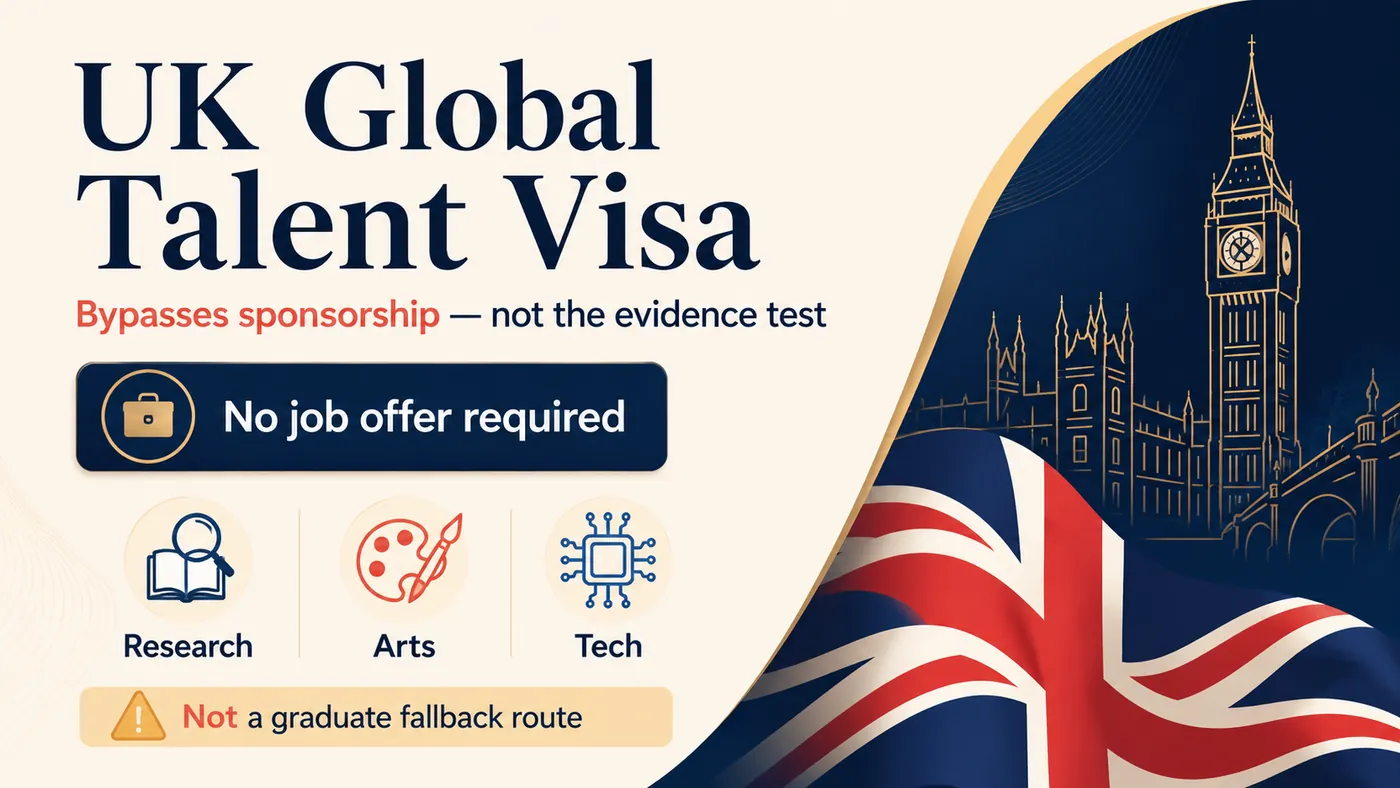
The UK Global Talent Visa is one of the few UK work routes that can remove employer sponsorship from the centre of your immigration plan.
That makes it sound attractive to international graduates who are tired of hearing the same answer: find a sponsor, meet the salary threshold, hope the employer is willing, and move from the Graduate visa to Skilled Worker.
But the Global Talent route is not an easier Graduate visa. It is not a backup route for ordinary job searching. It is an endorsement-led route for people who can already show recognised achievement or strong promise in academia or research, arts and culture, or digital technology.
For most recent graduates, the honest answer is uncomfortable: Global Talent is something to understand and possibly build towards, not something to rely on immediately after university.
For a smaller group, such as strong PhD researchers, published academics, recognised creative practitioners, founders, senior technologists or unusually visible digital contributors, it can become one of the most flexible UK immigration routes available.
If you are comparing your wider UK options, read this alongside GradSharp’s guide to international graduates in the UK and Ireland, the UK Graduate Route 18-month comparison and the UK final-year job search timeline.
Who this route is really for
The UK Global Talent Visa is not a graduate job-search route.
It is a recognition route.
You may be a realistic candidate if you can show evidence of leadership, exceptional promise or recognised achievement in one of the eligible fields. You are unlikely to be a realistic candidate if your evidence is mainly a degree, coursework, a few internships or a general first graduate job.
The route matters because it is not built around a sponsoring employer. GOV.UK’s Global Talent overview says applicants can apply to work in the UK as a leader or potential leader in academia or research, arts and culture, or digital technology, and that applicants usually need an endorsement unless they have won an eligible prestigious prize. The rules and endorsing arrangements can change, so check the live route before applying.
What the Global Talent Visa actually is
GOV.UK says the Global Talent visa is for people aged 18 or over who are leaders or potential leaders in one of three broad fields:
| Field | What this usually means in practice | Why graduates misunderstand it |
|---|---|---|
| Academia or research | Research track record, academic appointment, fellowship, grant, publication strength or recognised promise | A taught master’s alone is usually not enough |
| Arts and culture | Significant creative work, recognition, awards, exhibitions, performances or industry evidence | Talent must be evidenced, not just self-declared |
| Digital technology | Product, technical, founder, engineering, open-source or sector impact evidence | A tech job title alone is not the same as endorsement evidence |
There are two broad ways into the route.
First, some applicants can apply directly if they have won an eligible prestigious prize listed under the official rules. This is rare and should not be assumed.
Second, most applicants need endorsement. GOV.UK says applicants who have not won an eligible prestigious prize need endorsement to prove that they are a leader or potential leader in their field. Source: GOV.UK Global Talent visa overview, checked 4 June 2026.
That endorsement stage is the real filter. The visa application comes after the evidence question.
Exceptional Talent vs Exceptional Promise
The words sound similar, but they point to different levels of evidence.
Exceptional Talent is for applicants who are already recognised as leaders in their field.
Exceptional Promise is for earlier-career applicants who can show strong potential to become leaders.
This distinction matters for graduates. A recent PhD researcher with publications, citations, awards, research funding or a strong host environment may be closer to an Exceptional Promise argument than a taught master’s graduate with a strong dissertation but no external recognition.
The mistake is treating Exceptional Promise as a low bar. It is not. It still requires evidence that credible people or institutions outside your own claim recognise your work.
A safer test is this:
If you removed your degree certificate from the application, what independent evidence would still prove your talent or promise?
If the answer is weak, the route is probably premature.
How it differs from Graduate Route and Skilled Worker
Most international graduates in the UK think in two routes.
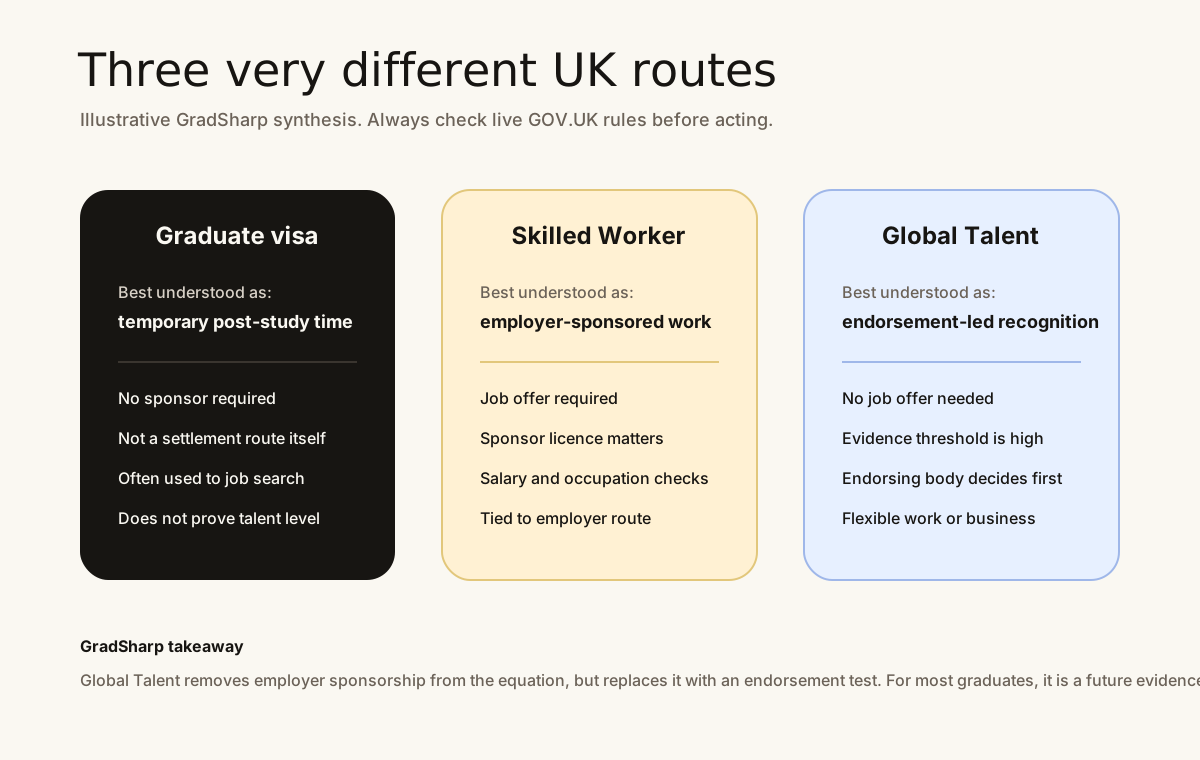
The Graduate visa gives temporary post-study work permission. It gives time, but it does not itself guarantee long-term permission or sponsorship.
The Skilled Worker route depends on an eligible job, employer sponsorship and the relevant salary and occupation rules.
Global Talent is different because it is not primarily about the job offer. It is about your evidence profile.
| Route | Main question | Main risk |
|---|---|---|
| Graduate visa | Do I qualify after UK study? | Time runs out before a long-term route is secured |
| Skilled Worker | Will an employer sponsor this role at the right level? | Employer, salary and occupation constraints |
| Global Talent | Can I prove recognised talent or promise? | Evidence may not meet endorsement standards |
That is why the Global Talent route is powerful but rare. It removes one problem, employer sponsorship, but replaces it with another: proving that your work is already strong enough for an endorsement or eligible-prize route.
Who is unlikely to qualify straight after graduation
You are usually unlikely to be ready if your profile is mainly:
- a bachelor’s degree or taught master’s;
- normal coursework or dissertation output;
- general internships;
- a first graduate job;
- a portfolio with no external recognition;
- a startup idea without traction;
- GitHub activity with no adoption, users or recognised contribution;
- good job performance inside one employer but no wider field evidence.
This does not mean your profile is weak. It means the Global Talent route is testing a different question.
A good graduate application says: I am employable.
A Global Talent application needs to say: my field already has evidence that I am unusually strong, promising or recognised.
Those are not the same claim.
Who should take a closer look
You should investigate the route more seriously if you have evidence such as:
- peer-reviewed publications, citations or research awards;
- a strong PhD or postdoctoral profile;
- a research fellowship, grant or recognised academic appointment;
- significant open-source contributions used by others;
- a digital product with measurable users, revenue, growth or adoption;
- recognised technical leadership beyond normal employment;
- awards, media coverage or industry recognition;
- exhibitions, performances, commissions or critical recognition in arts and culture;
- recommendation letters from credible senior people who can speak to your impact.
The point is not to collect documents randomly. The point is to build a coherent evidence story: field, contribution, recognition, trajectory and why the UK route fits.
The endorsement stage is where most weak applications fail
The endorsement process asks whether your evidence meets the relevant field standard.
For academia and research, the evidence may relate to research output, appointments, fellowships, grants, peer recognition or endorsement through the relevant academic route.
For digital technology, the evidence is usually about product, technical or commercial impact. A job title such as software engineer, analyst or product manager is not enough by itself.
For arts and culture, the evidence usually needs to show recognised creative work rather than personal ambition.
A common weak application says: I am talented and want to work in the UK.
A stronger application says: here is the field, here is my contribution, here is independent recognition, here is evidence of impact, and here is why the route fits the work I am already doing.
What the visa gives you if you qualify
GOV.UK says Global Talent visa holders can live and work in the UK for up to five years at a time. It also says there is no total limit on how long someone can stay, provided they extend when the visa expires and continue to meet the requirements. Source: GOV.UK Global Talent visa overview and extension guidance, checked 4 June 2026.
GOV.UK also states that applicants may be able to settle in the UK after three or five years, depending on field and how they apply. Source: GOV.UK Global Talent and indefinite leave to remain guidance, checked 4 June 2026.
That flexibility is why the route matters. For the right candidate, it can support changing jobs, building a company, working across projects or pursuing research without being tied to one sponsoring employer in the same way as a Skilled Worker plan.
But the flexibility comes after the evidence test. You do not get flexibility because you want it. You get it because you qualify.
What documents should you expect to prepare?
Documents vary by field and route, so always check the current official guidance for your category.
A serious applicant may need to prepare:
| Evidence area | Examples |
|---|---|
| Identity and immigration documents | Passport, current immigration status, application details |
| Career record | CV, role history, academic or professional record |
| Endorsement evidence | Field-specific evidence required by the relevant endorsing route |
| Recognition | Awards, publications, media, peer recognition, public proof of impact |
| Recommendation letters | Letters from credible people who can speak to your contribution |
| Impact evidence | Users, revenue, adoption, citations, performances, exhibitions, grants or technical contribution |
The checklist is not the hard part. The quality of the evidence is the hard part.
Two applicants can submit similar categories of documents and receive different outcomes because the substance is different.
What graduates should do in the next 48 hours
If you are a recent graduate or current student, do not start by filling forms.
Start with an evidence audit.
1. Choose the correct field
Ask whether your evidence belongs mainly to academia and research, digital technology, or arts and culture.
If you cannot place your evidence clearly, you are probably not ready.
2. Separate employment from recognition
Write two lists:
- jobs, degrees and projects you have completed;
- external recognition, measurable impact or field contribution.
Global Talent depends more on the second list.
3. Check whether this is immediate or future-facing
For many graduates, the realistic answer is: not now, but maybe later.
That is still useful. It tells you what to build: publications, public technical work, product traction, creative recognition, grants, awards, strong references or field-specific evidence.
4. Compare against your real route options
If your evidence is not strong enough yet, your practical route may still be:
- Graduate visa to gain time;
- Skilled Worker sponsorship through a realistic employer;
- further research training or a PhD;
- building a stronger public portfolio before reconsidering Global Talent.
5. Do not rely on social media success stories
A viral post saying someone got Global Talent does not tell you whether your evidence fits the rules. Use official guidance and, if needed, qualified immigration advice.
Common mistakes
Avoid these mistakes:
- treating Global Talent as an advanced Graduate visa;
- applying with only degree evidence;
- assuming a tech job automatically qualifies as digital technology talent;
- confusing good employment with external recognition;
- collecting recommendation letters before understanding the evidence standard;
- assuming Exceptional Promise means a low threshold;
- ignoring live GOV.UK guidance because someone online described last year’s process.
FAQ
Can I apply for the UK Global Talent Visa straight after a master’s?
Yes, but only if you already meet the evidence standard. For most taught master’s graduates, that will be rare.
Do I need a job offer?
The route is not built around a job offer in the way Skilled Worker is. Most applicants need endorsement or an eligible prestigious prize route instead.
Is Global Talent easier than Skilled Worker sponsorship?
No. It removes the sponsoring-employer problem, but it adds a high evidence and endorsement problem.
Can digital technology workers qualify?
Yes, digital technology is one of the eligible fields. But the evidence usually needs to show impact, innovation, technical contribution, product traction or recognition beyond an ordinary job title.
Is it useful for international graduates?
Yes, but often as a future strategy rather than an immediate route. It can help ambitious researchers, technologists and creatives understand what evidence to build over the next few years.
Source-checked notes
This article was checked against GOV.UK Global Talent visa overview, extension and settlement guidance on 4 June 2026. It is general information, not legal advice.
Immigration rules, endorsing-body arrangements, fees and settlement requirements can change. Always confirm on live GOV.UK pages before acting.