UK Graduate Route Cut to 18 Months: Compare Ireland Stamp 1G and US OPT Before You Choose
The UK Graduate Route falls to 18 months from 2027. Compare the UK, Ireland and US for post-study work, sponsorship and Indian student strategy.
The question is no longer just “does the UK give me two years after graduation?”
For many international students choosing between the UK, Ireland and the United States, the better question is: how much realistic time do I have to turn a degree into sponsored work?
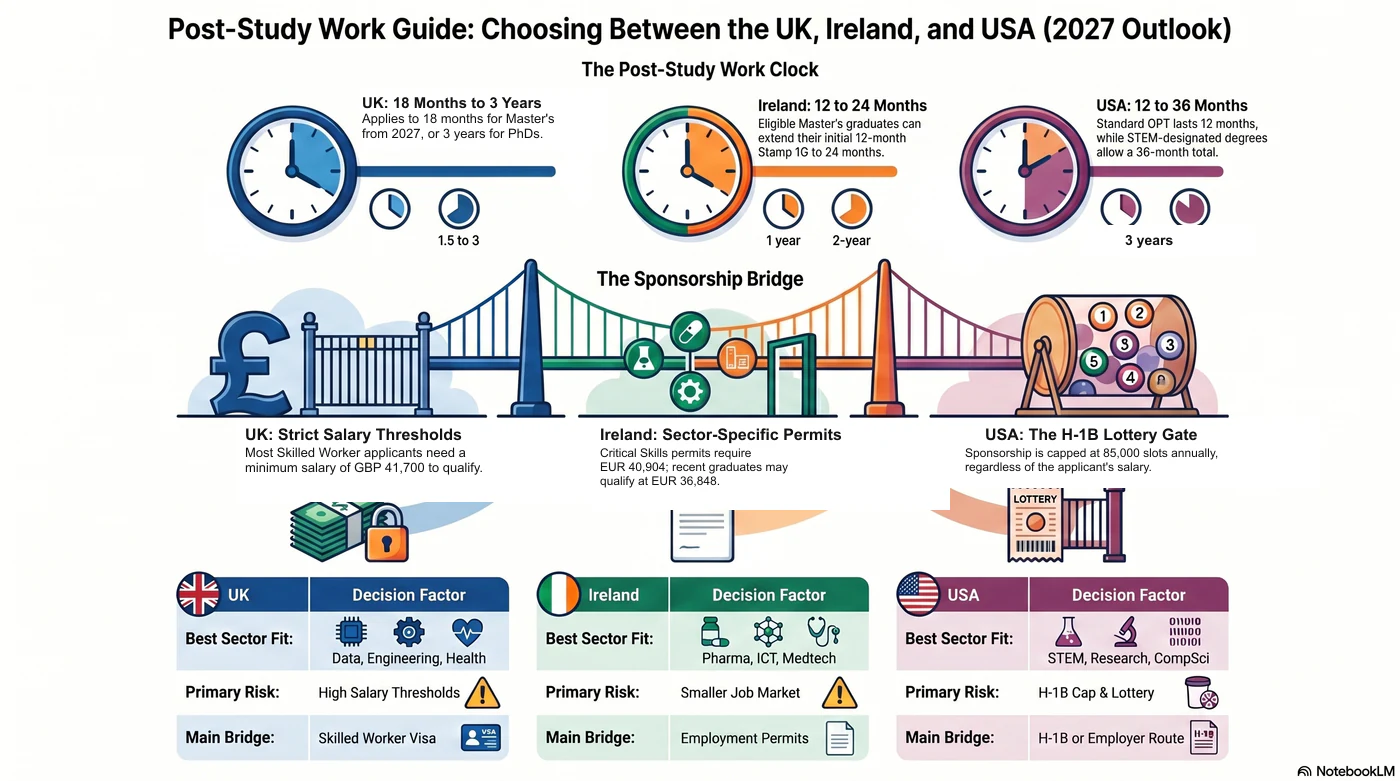
The honest answer is uncomfortable. The UK is still a serious graduate destination, but the Graduate Route is becoming a shorter runway for most non-doctoral applicants from 2027. Ireland can still give many master’s graduates a comparable 24-month search window through Stamp 1G, but the market is smaller and more sector-specific. The US can give STEM graduates the longest work clock through OPT and STEM OPT, but the H-1B sponsorship step is the most uncertain of the three.
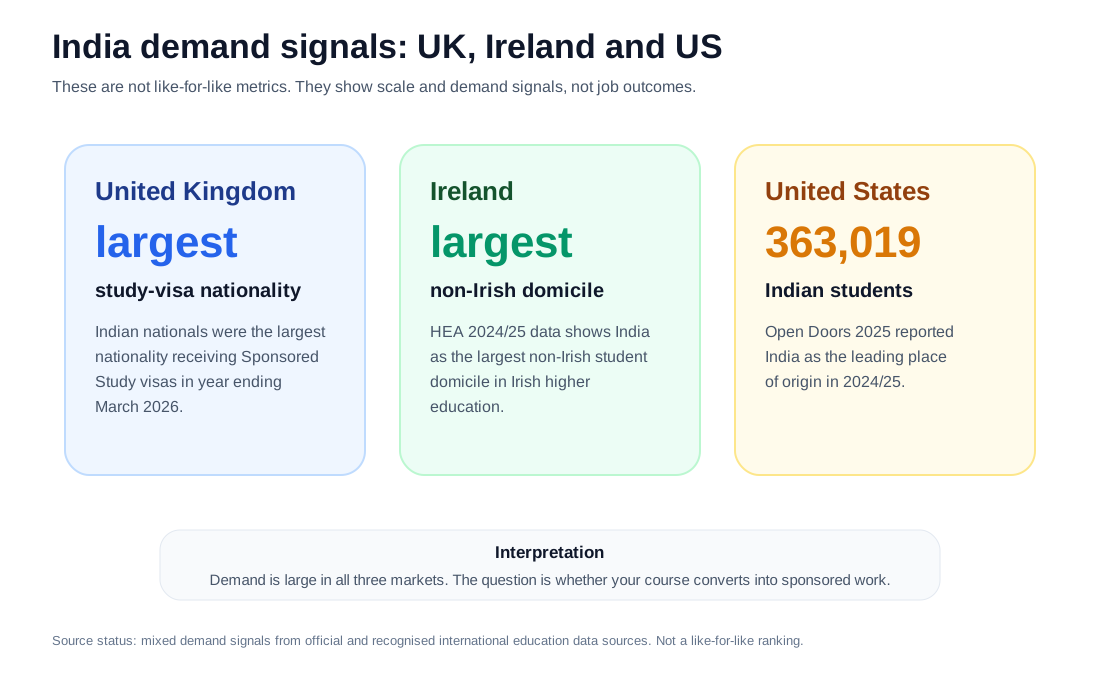
For Indian students in particular, this is a big decision. India is the largest source country for international students in the US, and Indian nationals were also the largest nationality receiving UK Sponsored Study visas in the year ending March 2026. Ireland’s 2024/25 higher education data also shows India as the largest non-Irish student domicile. That means the UK–Ireland–US comparison is not theoretical. It is the decision many students are making right now.
For related GradSharp guidance, read the country-choice article on UK vs Ireland for Indian students, the broader guide to Indian graduate jobs in the UK and Ireland, and the Ireland-specific guide to Stamp 1G to Critical Skills Permit.
Compare the post-study clocks before choosing
Choose the UK if your target roles are in sectors where graduate salaries and employers can realistically support Skilled Worker sponsorship: technology, engineering, data, some finance roles, regulated healthcare and selected professional services roles. But if you will apply for the Graduate Route on or after 1 January 2027, build your plan around 18 months, not two years.
Choose Ireland if you are targeting a sector where Ireland is structurally strong, especially technology, pharma, medtech, engineering, finance, funds, data or regulated business services. Stamp 1G can still give many Level 9 master’s graduates a 12-month permission plus a possible further 12 months, but the job market is smaller than the UK and Dublin costs are high.
Choose the US if you are in a strong STEM field, can secure field-related employment early, and understand that OPT is not the same as long-term sponsorship. STEM OPT can give up to 36 months of practical training, but H-1B remains capped, employer-dependent and policy-sensitive.
What changed: the UK clock is getting shorter
The UK Graduate Route has been one of the main reasons international students considered the UK. It gave eligible graduates time after study to work, search and build UK experience without needing immediate employer sponsorship.
The key change is timing.
GOV.UK says the Graduate visa lasts:
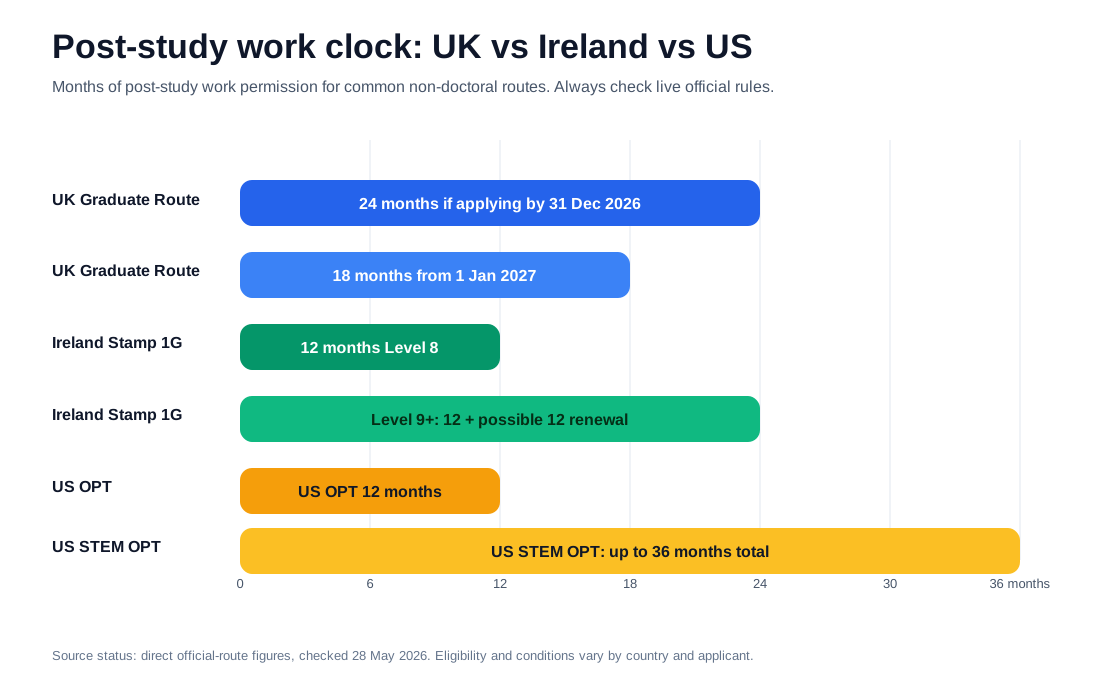
- 2 years if you apply on or before 31 December 2026
- 18 months if you apply on or after 1 January 2027
- 3 years for PhD or other doctoral qualifications
That may not sound dramatic. But for a one-year master’s student, six months can be the difference between having two recruitment cycles and having one compressed window.
For example, many UK graduate schemes open in autumn and can assess candidates months before graduation. If you finish your course, spend several months recovering from dissertation pressure, and only then start applying seriously, an 18-month Graduate Route can disappear quickly.
This does not mean the UK is a bad choice. It means the UK now rewards earlier, sharper planning.
The post-study route is only the first half of the decision
Many students compare countries by post-study work time only. That is too simple.
The better comparison is:
How long do I have, and what must happen before that time ends?
A post-study route is useful only if it helps you reach the next step. For most international graduates, that next step is employer sponsorship or an employment permit.
UK: easier open work, harder salary threshold
The UK Graduate Route gives flexibility at first. You can usually work in most jobs during the Graduate visa period. The pressure comes later, when you need a Skilled Worker route or another long-term permission.
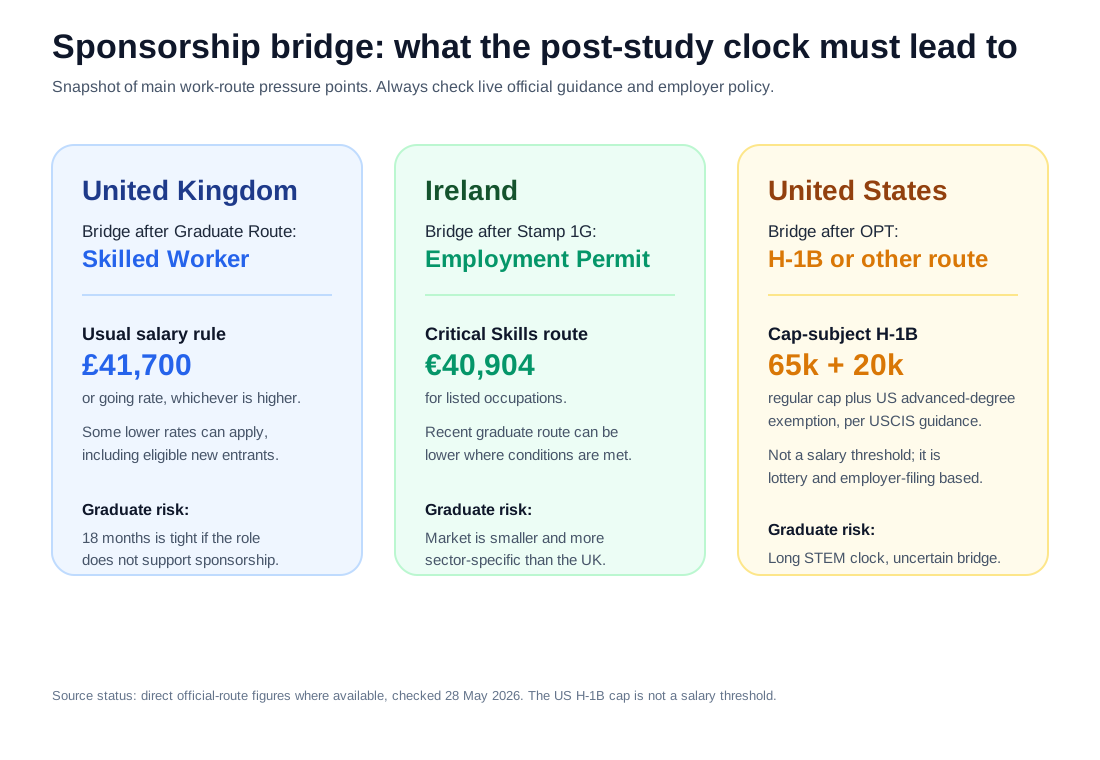
As of 28 May 2026, GOV.UK says the usual Skilled Worker salary requirement is the higher of £41,700 per year or the going rate for the occupation. Some applicants can qualify at lower salary levels, including certain recent graduates and people under 26, but GOV.UK still lists £33,400 as an example lower minimum for some eligible cases.
This is the main risk for graduates. A job can be legal during the Graduate Route and still not convert easily into Skilled Worker sponsorship.
Ireland: smaller market, clearer permit logic in shortage sectors
Ireland’s Stamp 1G is different. It is explicitly connected to seeking graduate-level employment and, where appropriate, applying for an employment permit or research hosting agreement.
Irish Immigration Service Delivery says Level 8 graduates may receive 12 months, while Level 9 or above graduates can receive 12 months initially and may apply for a further 12 months if they meet the conditions.
Ireland’s permit logic is more occupation-and-salary focused. Department of Enterprise guidance lists salary thresholds including:
- Critical Skills Employment Permit: €40,904
- Recent-graduate lower threshold where conditions apply: €36,848
- Higher-remuneration route: €68,911
Ireland can be attractive for graduates in tech, data, pharma, medtech, engineering, finance and regulated business services. But because the market is smaller, you cannot rely on volume. You need a targeted employer list.
US: longest clock for STEM, hardest sponsorship lottery
The US can look attractive because OPT gives international students practical training connected to their field of study. Standard post-completion OPT can provide up to 12 months, and eligible STEM graduates can apply for a 24-month STEM OPT extension. That creates a potential 36-month work clock for eligible STEM graduates.
But it comes with conditions. OPT employment must relate to the student’s field of study. STEM OPT has extra employer and training-plan requirements, including Form I-983 and employer participation rules. The route is also not a direct permanent solution.
The H-1B step is the major uncertainty. USCIS has long described the cap-subject H-1B system as including a 65,000 regular cap plus a 20,000 US advanced-degree exemption. Because H-1B rules, employer filing costs and implementation details are policy-sensitive and can change, students should not rely on second-hand summaries. They should check live USCIS and Department of State guidance and ask employers exactly what kind of H-1B filing they are willing to support.
For a STEM student, the US may offer the best time window. For a non-STEM student, the US can feel much tighter.
Why Indian students should pay attention
This comparison matters especially for Indian students because demand is large in all three markets, but the risk profile is different.
In the US, Open Doors 2025 reported 363,019 Indian international students in 2024/25, making India the leading place of origin. It also reported 294,253 international students on OPT, up 21% from the prior year, and said 57% of international students across academic levels pursued STEM fields.
In the UK, Home Office statistics for the year ending March 2026 show Indian nationals as the largest nationality receiving Sponsored Study visas, with 98,014 grants and 18% of the total. Indian nationals were also the second-largest nationality for work visas in that same statistics release.
In Ireland, HEA Key Facts and Figures 2024/25 show that India is the largest non-Irish domicile among higher education enrolments. The exact number depends on how the published HEA categories are read, so this article treats it as a demand signal rather than a direct outcome measure.
The important point is not “where are the most Indian students?” The important point is: where does your specific course and sector convert into sponsored work most realistically?
A country can have a large Indian student population and still be difficult for your role. A smaller market can still be better if your skill set matches its shortage areas.
Country-by-country decision frame
If you are choosing the UK
The UK still has scale. It has more graduate schemes than Ireland, more regional job markets, a deeper finance and consulting market, and a wide spread of employers across technology, engineering, healthcare, public services, retail, logistics and professional services.
The 18-month Graduate Route matters most if your target role is not clearly sponsorship-friendly. General business, marketing, early career admin, low-paid charity roles and many smaller employers may be weak conversion routes unless the salary and occupation fit.
For Indian master’s students, timing matters. Many UK graduate schemes recruit almost a year before the start date. If you only begin serious applications after dissertation submission, you may have already missed a full cycle.
The UK can still be strong if:
- your target role is sponsor-friendly;
- the salary can realistically meet Skilled Worker rules;
- your employer has sponsorship experience;
- you apply during the main graduate cycle;
- you use the Graduate Route as a conversion window, not a waiting room.
If you are choosing Ireland
Ireland’s main advantage is not size. It is concentration.
For graduates in software, data, cyber security, pharma, biopharma, medtech, engineering, funds, accounting, finance and regulated business operations, Ireland can be a serious option. Its labour market is smaller than the UK, but some sectors are highly international.
Stamp 1G can still give many Level 9 graduates a useful runway: 12 months initially, with a possible further 12 months where conditions are met. But students should not assume renewal is automatic. Irish Immigration guidance says Level 9 or above graduates seeking a further period must satisfy immigration authorities that they have taken appropriate steps to access suitable graduate-level employment.
Ireland can be strong if:
- your course maps to a shortage or permit-relevant occupation;
- you are willing to consider Cork, Galway, Limerick, Waterford or other locations beyond Dublin;
- you build a permit-aware employer list;
- you understand Critical Skills and General Employment Permit logic early;
- you do not rely only on famous tech names.
If you are choosing the US
The US is the most attractive of the three for some STEM students because the work clock can be long. A student with a strong STEM degree, good projects, internship potential, employer network and a realistic H-1B strategy may find the US worth the risk.
But longer time does not remove H-1B risk. The H-1B cap, employer willingness, filing costs, policy changes and lottery dynamics all matter.
The US can be strong if:
- your programme is genuinely STEM-aligned;
- your job will directly relate to your field;
- your employer participates correctly in STEM OPT if needed;
- you understand H-1B timing and backup options;
- you can absorb uncertainty.
The US may be weaker if your programme is non-STEM, you do not have a strong employer network, or your target sector does not sponsor regularly.
Salary, employer route and course evidence decide more
1. Salary thresholds beat university prestige
A famous university name helps, but sponsorship usually depends on the job, salary, employer and occupation. A strong university with weak role fit is not enough.
2. Employer behaviour beats official eligibility
A route can be legally possible but practically unavailable if the employer does not sponsor, does not understand the process, or does not want to support entry-level candidates.
3. Application timing beats “I’ll apply after graduation”
The students who wait until after results often lose the strongest graduate recruitment window. This is especially risky in the UK after the Graduate Route reduction.
4. Course title matters less than job evidence
Data analytics, business analytics, management, finance and computer science programmes vary widely. Employers care about what you can prove: projects, tools, internships, placements, portfolios, technical evidence and communication.
The easiest-country question obscures the real decision
“Which country is easiest?”
There is no universally easiest country. The UK may be easier for one finance graduate and harder for another marketing graduate. Ireland may be better for a pharma graduate and worse for a general management graduate. The US may be strongest for a STEM graduate and weakest for a non-STEM graduate who needs fast H-1B sponsorship.
“Which country has more jobs?”
Volume helps, but only if your target employers can sponsor or support the next route. The UK has more jobs than Ireland, but not every job converts. The US has huge scale, but H-1B uncertainty is real.
“Can I just switch later?”
Switching country after study is possible for some people, but expensive and complex. Better to choose a course and country with the next permission step already in view.
A practical scoring table
| Factor | UK | Ireland | US |
|---|---|---|---|
| Non-doctoral post-study work clock for new applicants after 1 Jan 2027 | 18 months | 12 months, often up to 24 months for eligible master’s graduates | 12 months OPT; up to 36 months for eligible STEM graduates |
| Main sponsorship bridge | Skilled Worker | Critical Skills or General Employment Permit | H-1B or other employer route |
| Best fit sectors | Tech, engineering, finance, consulting, healthcare, professional services | Tech, pharma, medtech, data, finance, funds, engineering | STEM, tech, engineering, research, data |
| Main risk | Shorter conversion window and salary threshold | Smaller market and housing pressure | H-1B cap and employer filing uncertainty |
| Best applicant profile | Early applicant with sponsor-friendly role target | Targeted applicant in permit-relevant sector | STEM applicant with employer network and backup plan |
Compare one realistic country plan
Step 1: Pick three target job families. Do not compare countries in general. Compare them for your target roles.
Examples:
- software engineer
- data analyst
- financial analyst
- audit trainee
- regulatory affairs assistant
- process engineer
- supply chain analyst
- marketing executive
Step 2: Check whether those jobs are sponsorship-friendly in each country. For the UK, check occupation eligibility, going rates and sponsor behaviour. For Ireland, check whether the role fits Critical Skills or General Employment Permit logic and whether the salary is realistic. For the US, check whether the role relates to your field and whether employers in that sector sponsor H-1B regularly.
Step 3: Build a 30-employer list for each serious country. If you cannot name 30 plausible employers, that is a warning sign.
Step 4: Ask universities harder questions. Do not ask only about rankings. Ask:
- Which employers hired graduates from this course last year?
- What were the job titles?
- Did those roles lead to Skilled Worker, employment permit, H-1B or another route?
- What salary bands did graduates enter?
- Does the careers service support international-student sponsorship questions?
Step 5: Decide your risk appetite. The US may offer longer time for STEM graduates but higher sponsorship uncertainty. The UK offers scale but a shorter route from 2027. Ireland offers a focused market but fewer total roles. Your right answer depends on your field and risk tolerance.
The bottom line
For Indian and other international students choosing between the UK, Ireland and the US, the winning question is:
Which country gives my specific course the most realistic path from study to sponsored work?
The UK remains serious, but the 18-month Graduate Route changes the planning clock. Ireland remains attractive in selected sectors, especially for Level 9 graduates who use Stamp 1G properly. The US remains powerful for STEM graduates, but H-1B uncertainty cannot be ignored.
Do not choose by country brand alone. Choose by role, employer, salary, sponsorship route, timing and backup plan.
FAQ
Is the UK Graduate Route still two years?
It depends when you apply. GOV.UK says the Graduate visa lasts two years if you apply on or before 31 December 2026, and 18 months if you apply on or after 1 January 2027. Doctoral graduates still get three years under the current GOV.UK wording checked on 28 May 2026.
Does Ireland Stamp 1G give international graduates two years?
For Level 8 graduates, Stamp 1G is usually 12 months. For Level 9 or above graduates, it is usually 12 months initially, with a possible further 12 months where conditions are met. Students should not assume renewal is automatic.
Is US OPT better than the UK Graduate Route?
For eligible STEM graduates, the US can offer a longer work clock because standard OPT can be followed by a 24-month STEM OPT extension. But the longer clock does not remove the H-1B risk. For non-STEM graduates, the US work clock can be much shorter.
Is Ireland easier than the UK for sponsorship?
Not automatically. Ireland has clearer permit logic in some shortage sectors, but the market is smaller. The UK has more employers and roles, but the salary and sponsorship threshold can be difficult for some graduate jobs.
Should Indian students avoid the UK after the Graduate Route cut?
No. Indian students should avoid weak UK plans, not the UK itself. The UK can still work well for students targeting sponsor-friendly sectors and employers. But students starting courses that complete in 2027 or later should plan around the 18-month route unless official timing says otherwise.
Which country is best for a data analytics master’s?
It depends on the course quality, projects, internship access and employer network. The UK has more overall roles. Ireland has strong tech and EMEA operations clusters. The US can be attractive if the programme is STEM-designated and you can secure field-related employment.
Sources checked
This article was reviewed against official and recognised public sources on 28 May 2026. Immigration and employment rules change, so readers should check live guidance before making decisions.
- GOV.UK: Graduate visa
- GOV.UK: Skilled Worker visa salary requirements
- Irish Immigration Service Delivery: Third Level Graduate Programme
- Irish Immigration Service Delivery: Immigration permission stamps
- Ireland Department of Enterprise, Tourism and Employment: Critical Skills Employment Permit
- Ireland Department of Enterprise, Tourism and Employment: General Employment Permit
- USCIS: Optional Practical Training for F-1 students
- USCIS: STEM OPT extension
- USCIS: H-1B cap season
- UK Home Office: immigration system statistics, year ending March 2026 — study
- UK Home Office: immigration system statistics, year ending March 2026 — work
- Higher Education Authority: Key Facts and Figures 2024/25
- IIE Open Doors 2025: International Students