Germany EU Blue Card for International Graduates in 2026: Salary Thresholds, Shortage Roles and the New-Graduate Route
Germany's EU Blue Card can work for recent graduates, but only if the job offer, salary and qualification checks line up. Here is what to verify before applying.
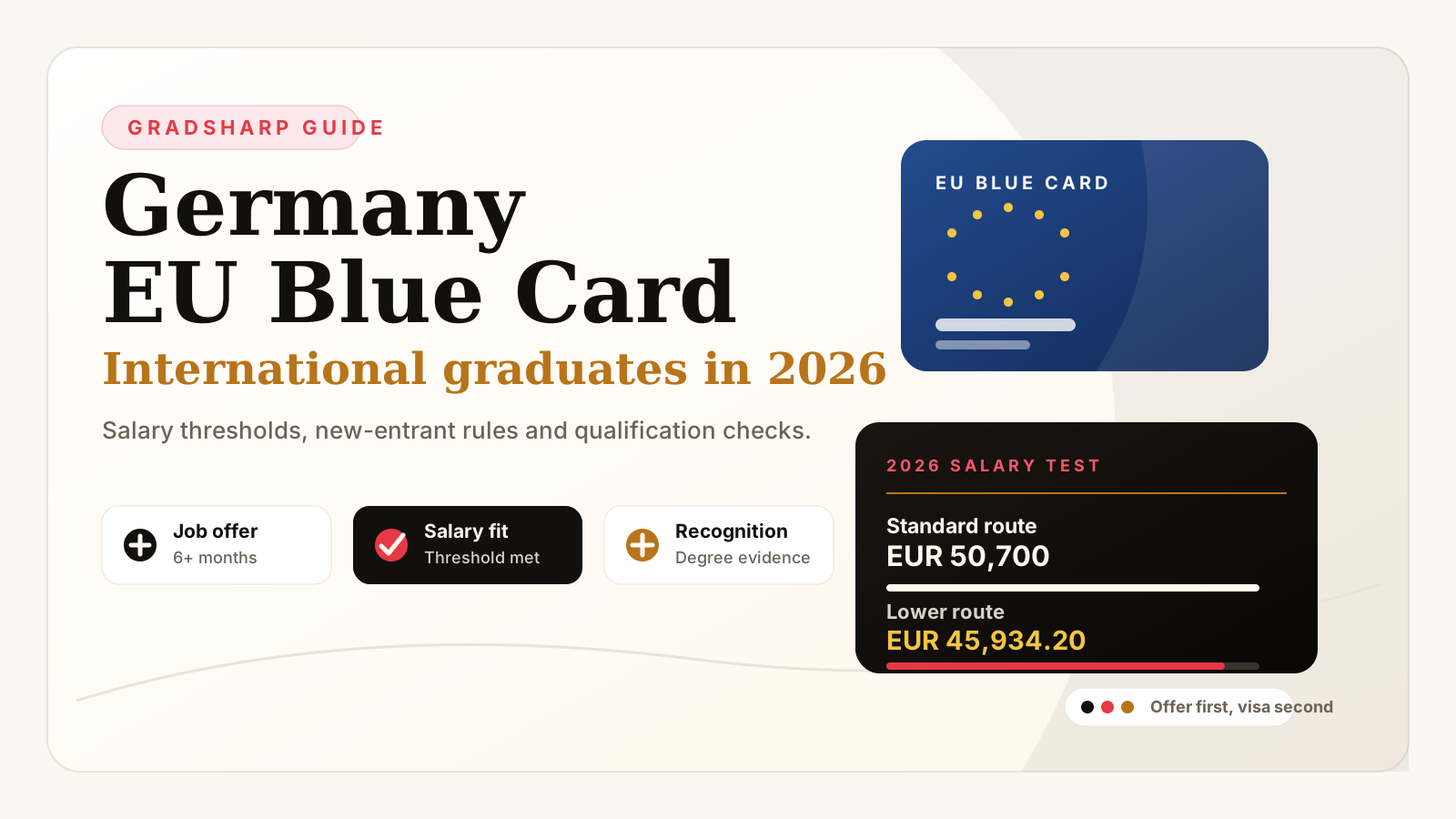
Germany is attractive to international graduates because the EU Blue Card looks more structured than many work-route systems. But it is not a general job-search visa, and it does not mean every entry-level job can support a long-term plan. It works only when the job offer, salary, qualification and role fit line up.
The honest answer: the Germany EU Blue Card can be realistic for some international graduates in 2026, especially in technical, engineering, IT, health, STEM and other higher-paid roles. The detail many applicants miss is that Germany’s lower Blue Card salary threshold is not limited to shortage occupations. It can also apply to new entrants to the labour market if the applicant obtained their last degree or equivalent qualification less than three years ago.
This article is careers guidance, not legal advice. It uses official German and EU sources checked on 10 June 2026.
The Blue Card route at a glance
The EU Blue Card is strongest if you already have, or can realistically get, a German job offer that:
- lasts at least six months;
- matches your academic degree or eligible qualification;
- reaches the 2026 salary threshold;
- has an employer willing to provide the required employment documents;
- fits any recognition or licence requirements for your profession.
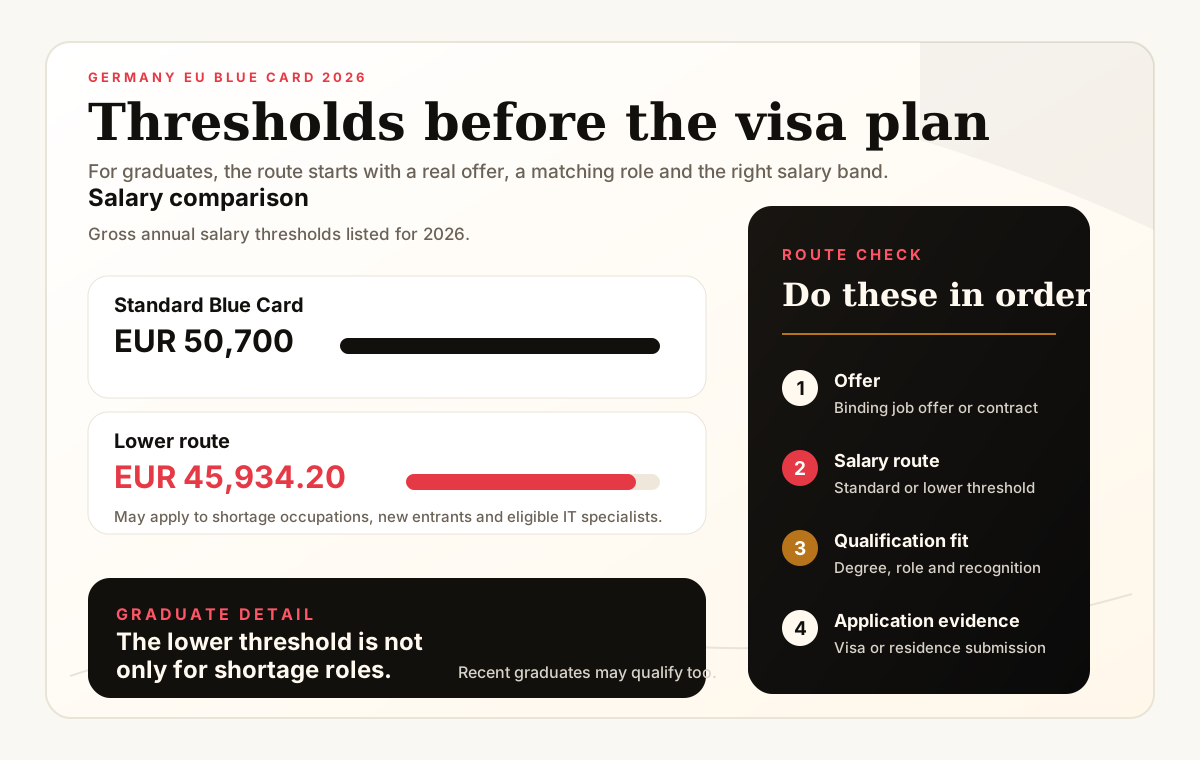
For 2026, Germany lists a standard gross annual salary threshold of €50,700. A lower threshold of €45,934.20 can apply to shortage occupations and to new labour-market entrants whose last degree was obtained less than three years ago. Eligible IT specialists without a university degree may also qualify if they meet the experience conditions. These figures are stated on the official Make it in Germany EU Blue Card page.
The real graduate question is not “does Germany have a Blue Card?” It is “can the jobs I am targeting reach the threshold quickly enough, and can I prove my qualification is acceptable?”
What the Germany EU Blue Card actually is
The EU Blue Card is a residence title for highly qualified non-EU nationals who want to live and work in an EU country. For Germany, the European Commission says applicants generally need a work contract or binding job offer for highly qualified employment, a duration of at least six months, the relevant salary threshold, health insurance, and proof of qualifications or professional requirements where relevant. See the European Commission’s EU Blue Card Germany page.
For graduates, the simplest way to think about it is this:
| Question | Why it matters |
|---|---|
| Do you have a real German job offer? | The Blue Card is not a job-search route. |
| Does the job match your qualification? | A random role above the threshold may not be enough. |
| Does the salary reach the correct threshold? | Gross annual pay is central to eligibility. |
| Is your degree recognised or comparable? | You may need anabin evidence or a ZAB Statement of Comparability. |
| Is the profession regulated? | Health, teaching and some other roles may need a licence or recognition. |
This is why applicants waste time searching only “visa sponsorship Germany”. The better search is role-first: data engineer, mechanical engineer, pharmacist, physician, regulatory affairs associate, product analyst, automation engineer, or whatever your qualification supports.
The 2026 salary thresholds
For 2026, Make it in Germany lists the following EU Blue Card salary thresholds:
| Route | Gross annual salary threshold for 2026 | Extra note |
|---|---|---|
| Standard EU Blue Card | €50,700 | For jobs meeting the general Blue Card salary level. |
| Shortage occupations | €45,934.20 | Federal Employment Agency approval is required. |
| New labour-market entrants | €45,934.20 | Applies if your last degree or equivalent qualification was obtained less than three years ago; approval is required where relevant. |
| IT specialists without a degree | €45,934.20 | Requires a specific IT job offer and at least three years of relevant professional experience at graduate level. |
These thresholds are gross annual figures. They are not take-home pay. They also do not remove the need for qualification, job-fit and recognition checks.
For many recent graduates, the new-entrant route is the most important detail. It means the lower threshold can potentially apply beyond the shortage-occupation list, but only if the degree timing and approval conditions are met. That does not make every graduate job eligible. It means the offer has a lower salary hurdle than the standard route if the applicant qualifies as a new entrant.
Why the new-graduate route matters
A recent international graduate may not immediately reach the standard threshold in every sector. The difference between €50,700 and €45,934.20 can be decisive in early-career roles.
But do not treat the lower threshold as a guarantee. It still needs a real German job offer, employment of at least six months, a job that matches your qualification, evidence that your degree or equivalent qualification is acceptable, and any professional licence or recognition if the profession is regulated.
The safer way to use this information is to build a realistic target list. Ask:
- Which German employers hire entry-level international graduates in my field?
- What salary range do those roles actually offer?
- Are those roles close to €45,934.20 or €50,700?
- Does my degree clearly match the role?
- Would my degree be considered comparable in Germany?
If your target roles are usually €35,000 to €40,000, the Blue Card is probably not your immediate route, even if Germany remains a good long-term market.
Shortage occupations are useful, but not the whole story
Make it in Germany lists several shortage-occupation groups for the lower threshold. These include, among others, certain managers, ICT service managers, STEM professionals, architects and spatial or transport planners, medical doctors, veterinarians, dentists, pharmacists, academic and comparable nursing or midwifery professionals, and school or out-of-school teachers and educators.
This list matters because it gives some applicants a lower salary route. But the job still needs to match your qualification and meet the relevant conditions.
Do not assume that a broad field label is enough. A graduate with a business degree applying for a generic administrative role is not in the same position as a graduate with a computer science degree applying for a software engineering role or a pharmacist applying for a regulated pharmacy role.
The match between qualification, role and salary is the real test.
Degree recognition and anabin: the check students leave too late
Many applicants focus on the salary threshold and forget the qualification check.
Make it in Germany explains that, for foreign academic qualifications, applicants may use the anabin database to check whether their university degree is comparable to a German degree. If the degree cannot be found or does not have the right status, the applicant may need a Statement of Comparability from the Central Office for Foreign Education, known as ZAB. See Make it in Germany’s page on foreign academic qualifications.
Before applying for jobs seriously, check:
| Check | Why it matters |
|---|---|
| Institution status | Your university must be recognised appropriately. |
| Degree status | Your qualification should be comparable to a German qualification. |
| Role match | The job should fit the qualification you are relying on. |
| Regulated profession status | Some professions require formal recognition or licence to practise. |
| ZAB requirement | If anabin is unclear, you may need a Statement of Comparability. |
This is boring paperwork, but it affects real employability. A recruiter may like your profile, but the immigration process still needs evidence.
Why “sponsorship” is the wrong way to search
In the UK, international graduates often talk about “sponsorship”. In Germany, that language can be misleading.
The better question is whether the employer is willing to hire you into a role that satisfies the Blue Card or another work-residence route. The employer may need to provide documents and complete employment-related steps, but the route is not identical to UK-style sponsorship.
A better German job-search filter is:
- role is skilled and degree-matched;
- salary is close to or above the relevant threshold;
- employer is familiar with international hiring;
- job advert is realistic about language expectations;
- role is in a sector where Germany has demand;
- employer can provide contract details for the visa process.
This is more useful than searching only “visa sponsorship Germany graduate job”.
The sectors where graduates should look first
The Blue Card is salary-sensitive, so sector choice matters.
| Sector | Why it may fit | Watch-out |
|---|---|---|
| IT and software | Many roles are degree-matched and salary-competitive. | Entry-level salaries vary; German language may still matter in some firms. |
| Engineering | Germany has a large industrial base and technical demand. | Recognition, German language and location can matter. |
| Health and pharmacy | Listed shortage areas can support the lower threshold. | Regulated professions require licence or recognition steps. |
| Data, AI and analytics | Roles can cross threshold faster than general business roles. | Job titles can be vague; check salary and degree match. |
| Manufacturing and automation | Strong fit for mechanical, electrical, process and industrial engineers. | Smaller firms may be less familiar with international hiring. |
| Scientific and technical roles | STEM is directly relevant to shortage pathways. | Research roles may have different contract structures. |
This does not mean humanities, business or social science graduates have no route. It means the Blue Card may be harder if the first job does not meet the salary and qualification-fit test.
Blue Card vs other Germany routes
Germany has more than one work-related route. The Blue Card is only one option.
| Route | Best for | Main issue |
|---|---|---|
| EU Blue Card | Higher-qualified workers with a salary-threshold job offer. | Salary and qualification fit are strict. |
| Work visa for qualified professionals | Skilled workers with recognised qualifications and suitable employment. | Conditions differ from the Blue Card. |
| Opportunity Card | Job-search route based on points and recognised qualifications or equivalents. | It is not the same as a guaranteed work route. |
| Study-to-work pathway | Students who build German language, internships and local experience. | Course choice must connect to real roles. |
If the Blue Card salary threshold is out of reach, that does not automatically mean Germany is impossible. It means you need to compare the correct route instead of forcing your plan into the Blue Card.
If you are comparing European routes, also read GradSharp’s guide to the Netherlands Orientation Year Visa. If you are comparing non-EU options, see the UK Graduate Route comparison and the Canada PGWP guide.
Check one German offer against the route
If Germany is on your list, do this before sending dozens of applications.
1. Check your degree in anabin or plan for ZAB
Do not wait until an employer is interested. Check whether your institution and degree are listed clearly. If not, read the ZAB process early.
2. Build a salary-aware role list
Pick 10 to 20 German job adverts in your field and record the role title, location, required degree, salary range if visible, language requirement, seniority and whether the employer looks internationally active.
If most roles are far below the threshold, adjust your plan.
3. Decide whether you are a new labour-market entrant
If your last degree or equivalent qualification was obtained less than three years ago, the lower threshold may be relevant. Check the official Make it in Germany guidance and do not rely on old blog posts.
4. Separate regulated and non-regulated roles
If you are in medicine, pharmacy, nursing, teaching or another regulated field, visa eligibility and professional licence are separate problems. You need both.
5. Improve German strategically
Some international roles operate in English, especially in tech. But German can widen your job market, help with interviews and improve long-term settlement. Do not assume English-only roles are enough in every sector.
Common mistakes
Avoid these mistakes:
- assuming the Blue Card is a job-search visa;
- applying for low-paid roles and hoping the visa will work later;
- ignoring the new-entrant lower threshold;
- assuming all shortage roles have easy hiring;
- checking salary but not degree comparability;
- ignoring anabin or ZAB until the last minute;
- applying for regulated professions without checking licence requirements;
- using UK-style “sponsorship” thinking for the German market;
- treating Germany as English-only outside international tech or research environments.
FAQ
Can a recent graduate get the Germany EU Blue Card?
Yes, if the job offer, salary, qualification and visa conditions are met. Recent graduates may benefit from the lower new labour-market entrant salary threshold if their last degree or equivalent qualification was obtained less than three years ago.
What is the Germany EU Blue Card salary threshold in 2026?
Make it in Germany lists €50,700 as the standard gross annual salary threshold for 2026. It lists €45,934.20 for shortage occupations and new entrants to the labour market, with Federal Employment Agency approval required where relevant.
Is the lower salary threshold only for shortage occupations?
No. Make it in Germany states that the lower threshold also applies to new entrants to the labour market if the last degree or equivalent qualification was obtained less than three years ago. That is one of the most important details for recent graduates.
Do I need German for the EU Blue Card?
The Blue Card route itself is mainly about qualification, job offer and salary. But German can matter heavily for job access, interviews, regulated professions, workplace integration and settlement.
Can IT specialists get a Blue Card without a university degree?
Yes, under specific conditions. Make it in Germany says IT specialists without formal qualifications may be able to obtain the lower-threshold Blue Card if they have a specific IT job offer and at least three years of relevant professional experience at university graduate level.
Is Germany easier than the UK or Canada?
It depends on your field. Germany can be clearer if you have a degree-matched offer at the right salary, especially in STEM or technical sectors. It can be harder if you need German, professional recognition or if your target roles are below the Blue Card threshold.
Source-checked notes
Checked on 10 June 2026.
- Salary thresholds, shortage occupations, new-entrant rule, IT-experience route and job-offer conditions: Make it in Germany, EU Blue Card.
- anabin and ZAB evidence: Make it in Germany, Foreign academic qualifications.
- Validity and processing context: European Commission, EU Blue Card Germany.
- Settlement route: Make it in Germany, Settlement permit.