Canada’s PGWP Is Not Automatic: What International Students Must Check Before Paying a Deposit
A practical 2026 PGWP guide for international students choosing a Canadian course: DLI checks, CIP codes, language rules and job-market risk.
Canada can still be a serious option for international students. But the old shortcut - “study in Canada, then get a work permit” - is too loose for 2026.
The real question is not whether Canada has a Post-Graduation Work Permit. It does. The real question is whether your exact institution, programme, credential, study pattern and application timing keep you eligible.
That distinction matters. IRCC says graduating from a designated learning institution does not automatically make you eligible for a PGWP, and students must check which schools have eligible programmes on the DLI list. IRCC PGWP about page
This article is not legal advice. Use it as a practical decision frame before paying a deposit, accepting an offer or assuming a Canadian course will lead to post-study work.
If you are comparing Canada with other post-study work options, read this alongside GradSharp’s UK Graduate Route 18-month comparison and Netherlands Orientation Year guide. The rules are different, but the decision problem is similar: do not choose a course first and check the work route later.
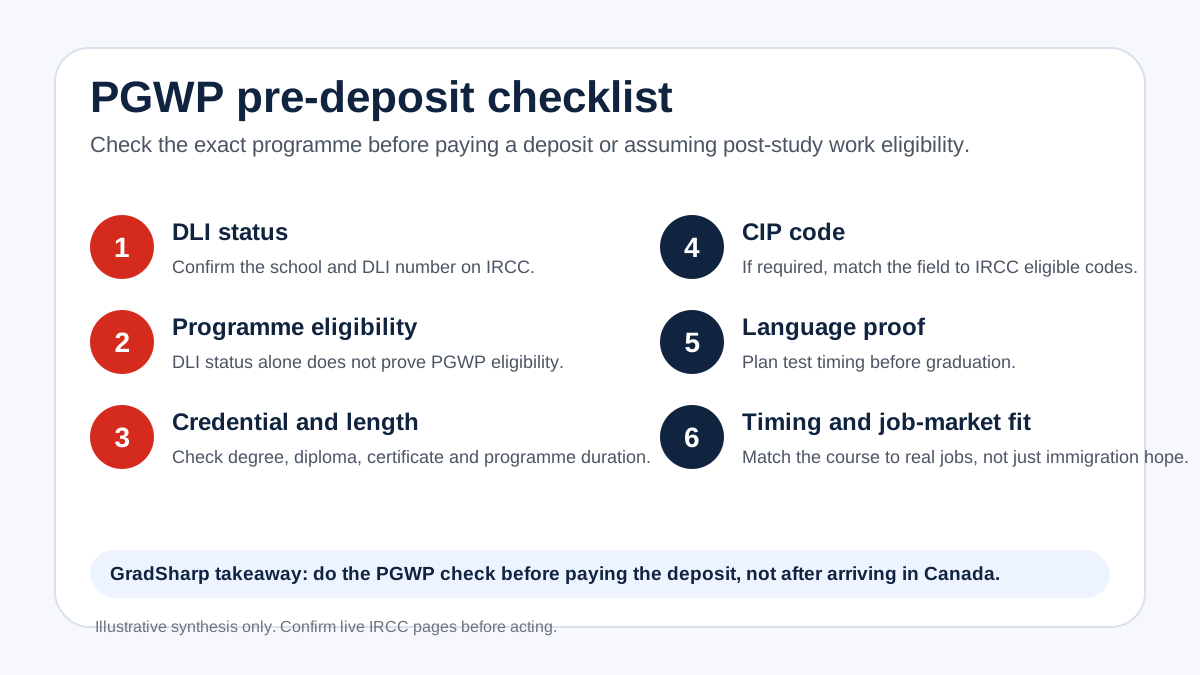
The PGWP eligibility check in one minute
If you are choosing a Canadian course in 2026, treat PGWP as a checklist, not a promise.
A Canadian bachelor’s, master’s or doctoral degree at a PGWP-eligible public DLI is usually a cleaner route than a short, unclear or private-partnership programme. But even then, you still need to meet the current IRCC rules on programme length, full-time study, timing, language proof and application status.
For non-degree, college, polytechnic and some other programmes, the risk is more case-specific. You may need to prove that your field of study is eligible, often through the programme’s CIP code, and you should not rely on agent marketing or a university logo alone. IRCC says not all programmes offered by a DLI are eligible for PGWP, and the DLI list tells students to check the details of eligible programmes. IRCC DLI list
The honest answer: Canada is still worth considering, but it is no longer a country where students can safely choose a course first and check work-permit consequences later.
What changed about Canada’s PGWP in 2026?
The PGWP still matters because it lets eligible graduates from Canadian institutions gain Canadian work experience after study. But the policy environment is tighter than it was a few years ago.
IRCC says that, from 1 November 2024, PGWP eligibility requirements changed and most PGWP applicants now need to give proof of language results when they apply. IRCC PGWP about page
Canada has also continued to control international student numbers. For 2026, IRCC expects to issue up to 408,000 study permits, including 155,000 for newly arriving international students and 253,000 extensions for current and returning students. IRCC describes this as 7% lower than the 2025 issuance target and 16% lower than the 2024 issuance target. IRCC 2026 study permit cap notice
That does not mean Canada is “closed”. It means applicants need to be more selective. A stronger decision in 2026 is not “Which college gave me an offer fastest?” It is “Which programme gives me the clearest study, work and employability pathway?”
The PGWP checks that matter before you choose a course
The safest time to check PGWP risk is before paying a deposit. After you arrive, the expensive decisions have already been made.
| Check | What to ask before paying | Why it matters |
|---|---|---|
| DLI status | What is the institution’s DLI number? | You need a letter of acceptance from a DLI for a study permit, but DLI status alone is not enough for PGWP. |
| Programme-level PGWP eligibility | Is this exact programme PGWP eligible? | IRCC says not all programmes offered by a DLI are eligible for PGWP. |
| Credential type | Is it a bachelor’s, master’s, doctoral degree, diploma, certificate or other credential? | Degree and non-degree routes face different language and field-of-study rules. |
| Programme length | Is it at least 8 months, or 900 hours in Quebec? | IRCC’s general PGWP eligibility requires a PGWP-eligible programme of at least 8 months, or 900 hours in Quebec. |
| Field of study | Does the programme have a 6-digit CIP code, and is it eligible if required? | Some applicants must meet a field-of-study requirement linked to eligible CIP codes. |
| Language proof | What language test will you use, and when will you take it? | Most PGWP applicants applying from 1 November 2024 need proof of English or French language ability. |
| Study mode | How much of the programme is in person in Canada? | For students whose lock-in date is on or after 1 September 2024, IRCC says at least 50% of the programme must be completed in class within Canada, and time studied outside Canada is deducted from PGWP length. |
| PAL/TAL | Do you need a provincial or territorial attestation letter? | Many study-permit applicants need a PAL or TAL, although public-DLI master’s and doctoral students are exempt from 1 January 2026. |
| Application timing | When will your completion letter and transcript be issued? | You usually have up to 180 days after graduation to apply for a PGWP. |
The point is not to panic. The point is to stop treating “Canada” as one route. Two students can both be going to Canada and face completely different PGWP risk.
How long could your PGWP be?
This is where many students get misled. The answer is not always “three years”.
IRCC says PGWP length depends on the level and duration of your study programme, as well as passport expiry. If your passport expires earlier than the period you would otherwise qualify for, your PGWP may be shortened. IRCC PGWP about page
Use this as a rough planning frame, then check the exact IRCC guidance for your case:
| Study pattern | Possible PGWP planning issue |
|---|---|
| Programme shorter than 8 months | Usually not PGWP eligible under general rules. |
| One programme of at least 8 months but less than 2 years | PGWP length may match programme length. |
| Master’s degree programme of at least 8 months | May qualify for up to 3 years, subject to current IRCC rules and passport validity. |
| Programme of 2 years or more | May qualify for up to 3 years, subject to current IRCC rules and passport validity. |
| Two eligible programmes | Combined study may affect length, if rules are met. |
The important word is eligible. A long programme at the wrong institution, or a programme that fails a field-of-study rule, can still create problems.
DLI status is not enough
A designated learning institution is a school approved by a provincial or territorial government to host international students. But students often overread that status.
DLI status helps with the study permit question. It does not automatically answer the PGWP question.
IRCC’s DLI list has specific columns that indicate whether a school offers PGWP-eligible programmes. It also warns students to check the details because not all programmes at a DLI are PGWP eligible. IRCC DLI list
Before paying a deposit, ask the institution for:
- its DLI number;
- whether the exact programme is PGWP eligible;
- the credential awarded;
- the programme length;
- the delivery mode;
- the field-of-study/CIP code, if relevant;
- any written page where the institution confirms programme-level eligibility.
Do not rely only on screenshots, agent promises or generic statements such as “our college is a DLI”.
Field-of-study risk: the CIP code question
For some students, programme choice now matters more directly.
IRCC says that, depending on when you applied for your study permit and your programme type, you may need to meet a field-of-study requirement. It also says that eligible fields of study are linked to occupations in long-term shortage areas and are grouped under categories such as agriculture and agri-food, education, health care and social services, science/technology/engineering/mathematics, trade and transport. IRCC PGWP field-of-study page
IRCC also states that eligible fields will not be added or removed in 2026. IRCC PGWP field-of-study page
The field-of-study check usually points to the programme’s Classification of Instructional Programs code, often called a CIP code.
This is why broad course labels can be dangerous. “Business”, “technology”, “health” or “management” may sound employable, but the official code and credential classification matter more than the marketing name.
Ask the school:
What is the 6-digit CIP code for this programme, and does that code meet the current PGWP field-of-study requirement for my situation?
If the answer is vague, slow down.
Language proof is now part of the plan
Students often think about English or French test scores only at the admission or study-permit stage. For PGWP, that is no longer enough.
IRCC says most applicants applying for PGWP from 1 November 2024 need to include proof of language ability when they apply. It also lists different Canadian Language Benchmark or Niveaux de compétence linguistique canadiens levels depending on programme type. IRCC PGWP about page
At the time checked for this article, IRCC listed:
| Programme type | Language level shown by IRCC |
|---|---|
| University bachelor’s, master’s or doctoral degree | CLB/NCLC 7 |
| Other university programmes | CLB/NCLC 7 |
| College, polytechnic or other non-university programmes | CLB/NCLC 5 |
Do not treat this as a last-minute formality. If you are planning a Canadian programme, plan the language test timeline before graduation.
The job-market check students avoid
PGWP eligibility is only one half of the decision. Employability is the other half.
A PGWP gives you permission to work; it does not guarantee a job, permanent residence or a smooth transition to a longer-term immigration route.
Statistics Canada’s Labour Force Survey for May 2026 reported that employment increased by 88,000 in May and the national unemployment rate fell to 6.6%. That monthly improvement is useful context, but it does not remove the planning risk for graduates: youth unemployment was still 13.4%, and Statistics Canada said youth have faced more difficult labour-market conditions in recent years. Statistics Canada Labour Force Survey, May 2026
That does not mean students should avoid Canada. It means course choice should be labour-market aware.
Before choosing a programme, ask:
- What jobs does this programme realistically lead to?
- Are those jobs available in the province where I plan to live?
- Do employers usually require Canadian licensing or local experience?
- Is the role connected to longer-term immigration options?
- What salary range and competition should I expect?
- How soon after graduation do I need to secure skilled work?
A programme can be PGWP eligible and still be a poor employment decision.
For a wider comparison of work-route risk, GradSharp’s international graduate hiring guide for the UK and Ireland is useful because it separates the legal right to stay from the harder problem of finding employers who actually hire international graduates.
Safer programme-choice signals
No programme can guarantee your future. But some signals are safer than others.
Stronger signals include:
- the institution and exact programme are PGWP eligible;
- the credential is clear and recognised;
- the programme length supports a realistic PGWP length;
- the field of study is eligible if your case requires it;
- the curriculum connects to shortage areas or regulated demand;
- co-op or work-integrated learning is credible and documented;
- alumni outcomes are specific rather than promotional;
- the city or province has realistic jobs in the field;
- your prior education or work experience connects to the programme.
Weaker signals include:
- “Canada is easy after study” marketing;
- vague claims about permanent residence;
- no clear CIP code;
- unclear programme-level PGWP status;
- private partnership arrangements you do not understand;
- a course chosen only because it is cheap or fast;
- job outcomes described only in broad motivational language.
Before you pay a Canadian deposit
If you are considering Canada, do this before paying a deposit.
1. Find the institution on the DLI list
Use the official IRCC DLI list and confirm the DLI number, province and PGWP programme column. Save a screenshot or PDF for your records, but rely on the live page when making decisions.
2. Ask for programme-level PGWP confirmation
Email admissions and ask them to confirm whether the exact programme is PGWP eligible. Do not ask only “are you a DLI?” Ask about the programme.
3. Ask for the CIP code
If your case may require a field-of-study check, ask for the programme’s 6-digit CIP code and compare it with IRCC’s eligible fields.
4. Build a timing plan
Write down:
- study permit application timing;
- PAL/TAL requirement;
- course start date;
- expected completion date;
- language test timing;
- passport expiry;
- PGWP application window.
5. Check the job market before the course brochure
Search actual jobs, not just course pages. Look at role titles, province, licensing, salary, experience requirements and whether the course genuinely helps.
Common mistakes
Avoid these mistakes:
- assuming any DLI programme leads to PGWP;
- choosing the cheapest programme without checking eligibility;
- ignoring field-of-study/CIP code rules;
- leaving language proof until after graduation;
- forgetting passport expiry can shorten a permit;
- assuming PGWP means permanent residence;
- choosing a course with weak employment links;
- trusting agent marketing without official confirmation.
FAQ
Is PGWP automatic after studying in Canada?
No. IRCC says graduating from a DLI does not automatically make you eligible for a PGWP. You need to meet the current PGWP eligibility rules.
Is every DLI programme PGWP eligible?
No. IRCC’s DLI list tells students to check details because not all programmes offered by a DLI are PGWP eligible.
Do I need a language test for PGWP?
Most PGWP applicants applying from 1 November 2024 need to provide language results. The level depends on programme type. Check the current IRCC table before applying.
Does field of study matter for PGWP?
It can. Depending on when you applied for your study permit and the type of programme, you may need to meet a field-of-study requirement. IRCC links eligible fields to specific CIP codes.
Is a master’s degree safer for PGWP?
A Canadian master’s degree at a PGWP-eligible public DLI can be a cleaner route, but you still need to check length, institution, language requirements, timing and passport validity.
Can I work while studying in Canada?
IRCC has rules on working off campus while studying. Check the current work-off-campus page before planning income or hours. IRCC work off campus page
Does PGWP guarantee permanent residence?
No. PGWP can help you gain Canadian work experience, but permanent residence depends on separate federal or provincial rules, job outcomes, language, occupation, points and timing.
Source-checked notes
This article was originally reviewed against IRCC PGWP eligibility, DLI, field-of-study, language-results, PAL/TAL and study-permit cap pages, plus Statistics Canada Labour Force Survey May 2026, on 8 June 2026. It was refreshed on 9 June 2026 to correct the Labour Force Survey paragraph and add clearer internal pathway links.
Immigration rules, fees, work rights, eligible fields and labour-market conditions can change. Always confirm live official pages before paying a deposit, applying for a study permit or relying on PGWP eligibility.