American Students Studying in Europe: The Degree, Cost and Career Checks Before You Apply
A practical checklist for US students considering a European degree, covering FAFSA, cost, recognition, visas, language and career outcomes.
Europe can look like the obvious answer when US college prices feel impossible.
Shorter degrees. Lower advertised tuition. English-taught courses. Cities that sound more interesting than another campus tour.
But the real question is not whether Europe sounds exciting. It is whether a specific European degree works for your funding, your career plan, your visa position and your return-to-US options.
American students often compare countries first. They should compare constraints first.
Start with five decision gates
A European degree can be a smart move when the programme is recognised, financially workable, career-relevant and tied to a realistic plan after graduation.
It becomes risky when the decision is built around vague claims like “Europe is cheaper”, “everyone speaks English”, or “I can just stay and work afterwards”.
| Question | Honest answer |
|---|---|
| Can Americans study for a full degree in Europe? | Yes, but admissions, visas, funding and recognition vary by country and university. |
| Is Europe always cheaper than the US? | No. Tuition may be lower, but housing, travel, health insurance, exchange rates and lost aid can change the answer. |
| Can FAFSA be used? | Sometimes. It depends on whether the foreign school and exact programme are eligible for US federal student loans. |
| Is an English-taught degree enough? | Not always. Internships, part-time work and local graduate jobs may still need the local language. |
| Can you work in Europe after graduation? | Sometimes. Post-study rules differ by country and may depend on salary, sponsor status, job type or timing. |
Related GradSharp reading: use the European bachelor’s versus US college guide if the decision is undergraduate, the FAFSA foreign-school checklist before relying on federal loans, and the 529 plans and European universities guide before withdrawing tax-advantaged funds.
Study abroad and full-degree study are different decisions
A semester in Florence through your US college is not the same as enrolling directly in a three-year bachelor’s degree in the Netherlands or a one-year master’s in Ireland.
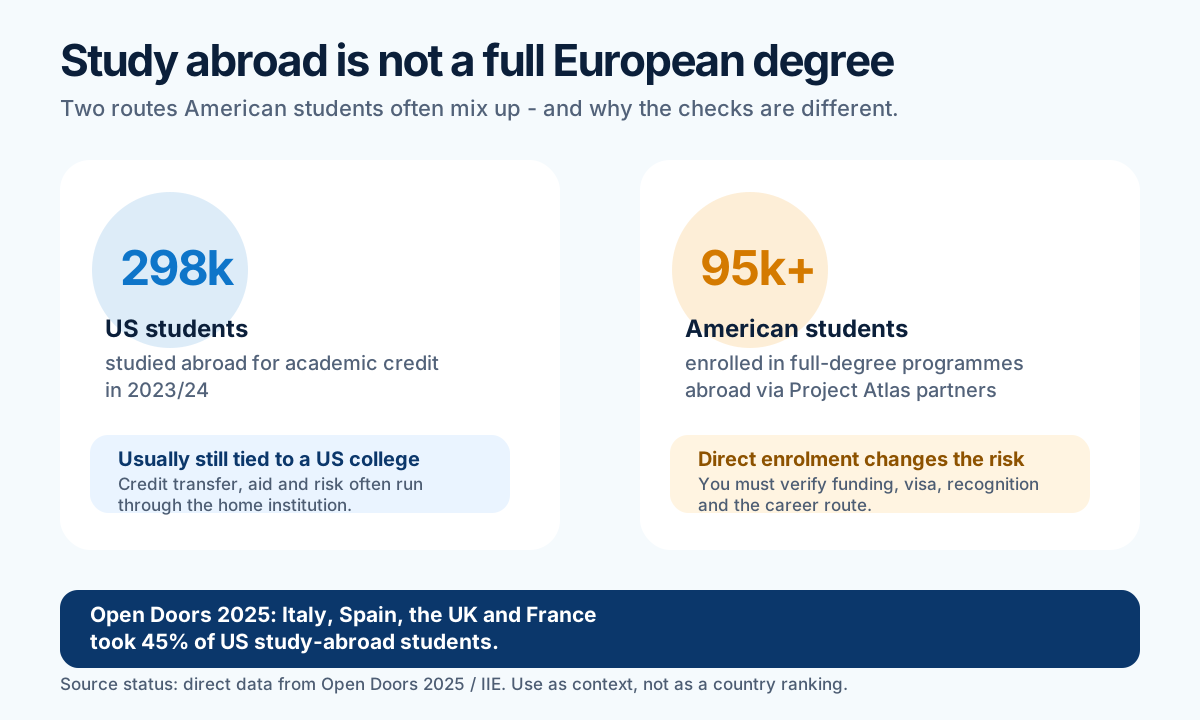
Open Doors 2025 reports that 298,180 US students studied abroad for academic credit in 2023/24, while Project Atlas partners reported more than 95,000 American students enrolled in full-degree programmes abroad. Those are related trends, but they are different pathways.
Study abroad usually keeps you attached to a US institution. A full European degree puts funding, visa, degree recognition and graduate employment into another system.
If you are applying directly to a European university, you are the one checking whether the programme works.
College in Europe for American students: what changes?
The phrase “college in Europe” can mean several different things. Before comparing prices or rankings, name the route.
| Route | What changes first | Main family check |
|---|---|---|
| Full European bachelor’s degree | The student is enrolled in a foreign higher-education system, often in a more specialised programme from year one. | Degree recognition, funding eligibility, housing, visa route and return-to-US options. |
| European master’s degree | The course may be shorter and more compressed than a US programme. | Whether the qualification, timeline and post-study route support the next career step. |
| US college study abroad semester | The student usually remains enrolled at the US home institution. | Credit transfer, US billing, financial aid handling and extra travel or programme costs. |
| Summer or provider-led programme | The sponsor, credit route and billing may vary. | Whether the course is academic credit, travel, enrichment or a bridge into a recognised degree. |
This distinction matters for FAFSA, 529 plans, visas and degree recognition. A semester abroad is usually a supported extension of a US degree. A full European degree is a different academic and financial commitment.
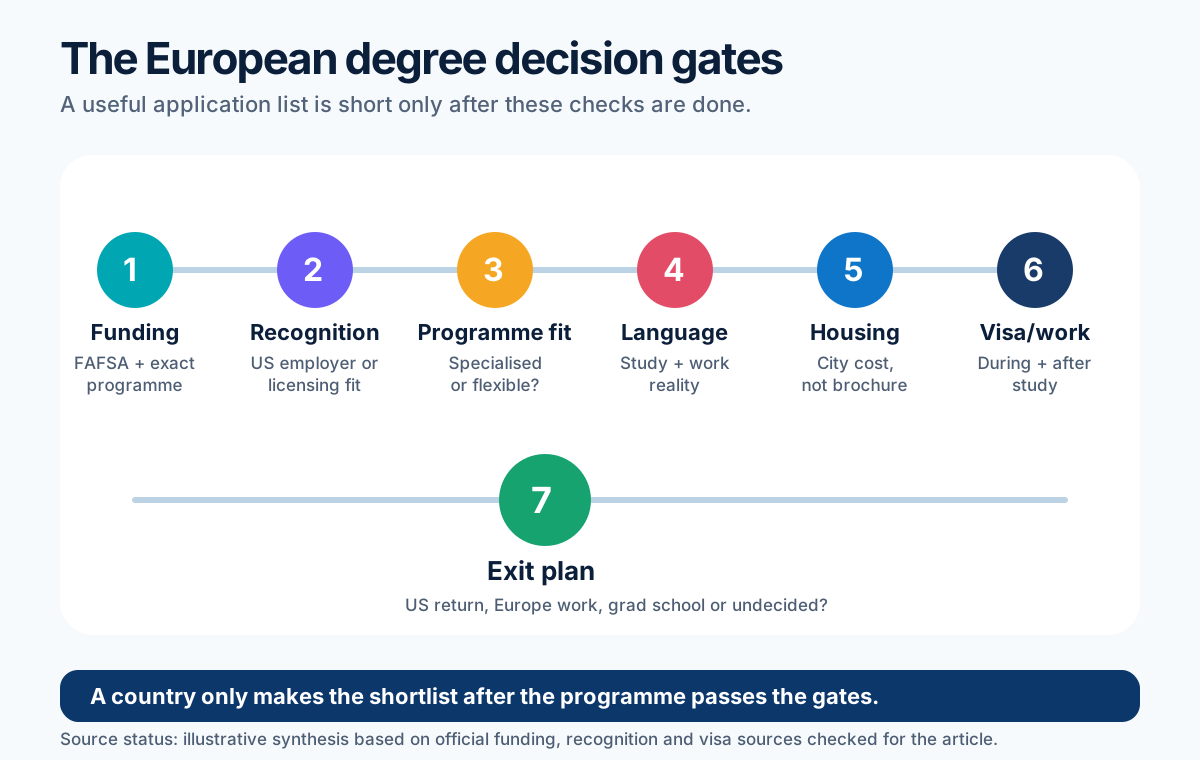
The seven checks before you apply
Do these before you pay application fees or deposits.
| Check | What you are trying to prove |
|---|---|
| Funding | Can you pay for this exact programme without assuming grants or loans that may not apply? |
| Recognition | Will the degree make sense to US graduate schools, employers or licensing bodies if you return? |
| Programme fit | Is it a broad US-style college experience, or a specialised European degree from year one? |
| Language | Can you study, intern, work and live with the language level you will have? |
| Housing | Is the city financially realistic, not just the tuition? |
| Visa/work rules | What can you do during study and after graduation? |
| Exit plan | Are you aiming to return to the US, work in Europe, apply to graduate school, or keep options open? |
Check 1: FAFSA does not automatically follow you abroad
This is the first financial gate.
US Federal Student Aid says students may borrow federal student loans for attendance at some eligible foreign institutions, but only when the student, institution and programme meet the rules. It also distinguishes between “eligible” foreign schools and “deferment only” schools. At a deferment-only school, you may be able to defer repayment on existing federal loans, but you cannot take out new federal loans for that institution.
Federal Student Aid also says students attending foreign schools are not eligible for federal grant programmes such as Pell or TEACH Grants.
That changes the cost conversation.
Before you apply, search the current US federal foreign-school list and then email the university:
“Is this exact programme eligible for US federal student loans, or is the institution deferment-only? Are there any restrictions for my degree level or delivery mode?”
Do not assume that because one programme at a university is eligible, all programmes are.
Check 2: compare total cost, not tuition headlines
College Board reports that average published tuition and fees for full-time US undergraduates in 2025/26 are $11,950 at public four-year in-state institutions, $31,880 at public four-year out-of-state institutions and $45,000 at private nonprofit four-year institutions.
That makes Europe attractive. It should. But the comparison still needs a full cost sheet.
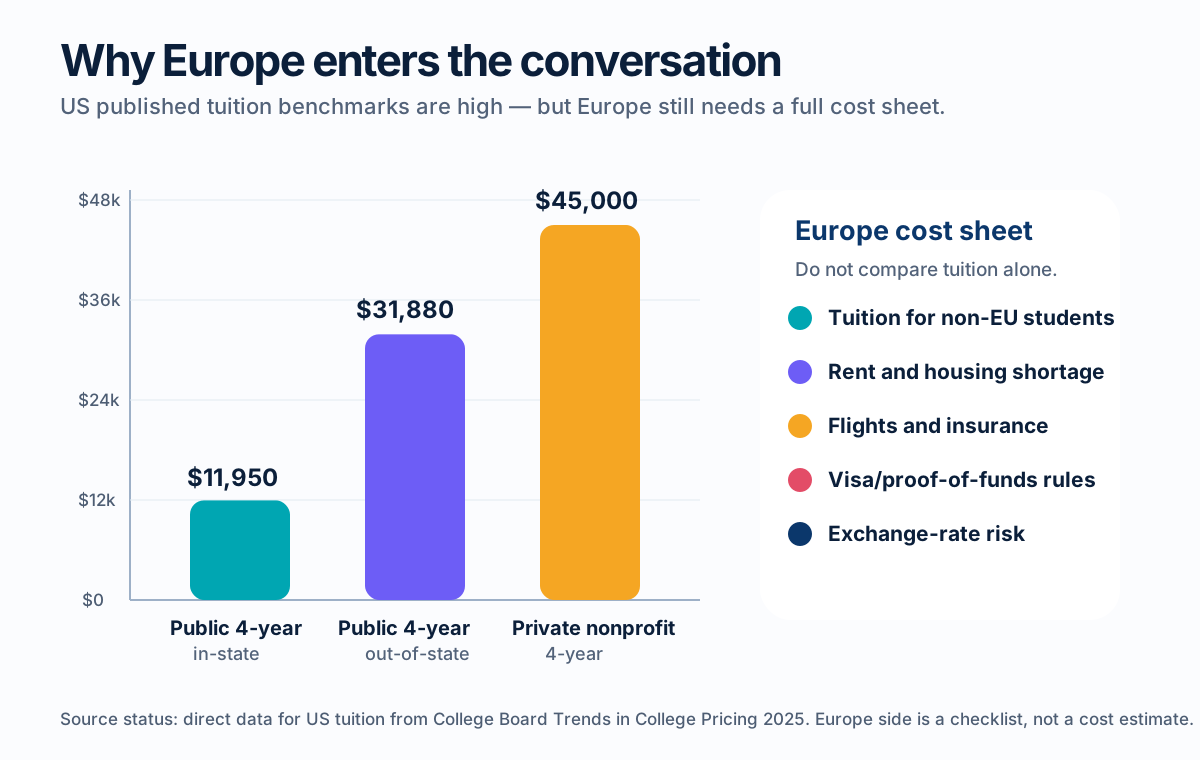
For each European programme, build a one-year cost line:
| Cost item | Why it matters |
|---|---|
| Tuition | May differ for non-EU students and may rise by year. |
| Rent | Housing shortages can erase tuition savings in cities such as Amsterdam, Dublin, Paris or parts of Germany. |
| Flights | Two international trips a year can be a real budget line. |
| Health insurance | Rules vary by country and student status. |
| Visa/residence permit | Fees and proof-of-funds rules change. |
| Exchange rate | A “cheap” euro cost can move against you. |
A safer test is this:
Would this still look sensible if rent is 20% higher than expected and federal grants do not apply?
If not, the plan is too fragile.
Check 3: make the degree recognisable before you need it recognised
The European Commission’s Study in Europe project covers study opportunities in 33 European countries, and its higher-education guidance notes that each country has its own nationally governed system within the European Higher Education Area.
That helps compatibility inside Europe. It does not mean every US employer, graduate school or licensing board will instantly understand your degree.
The US Department of Education says recognition depends on the context. For further study, the competent authority is the institution you apply to. For employment, it is the employer. For licensed professions, it is usually the relevant state licensing board. Credential evaluations may be required.
This matters most for regulated or pathway-sensitive fields: nursing, medicine, psychology, teaching, law, architecture, accounting, engineering licensure, pre-med or graduate-school prerequisites.
Use this sentence test:
“This is a [three-year bachelor’s / one-year master’s] from a recognised university in [country], with coursework in [field], evidence of [skills], and a transcript that can be evaluated if needed.”
If you cannot explain it in plain English, keep researching.
Check 4: English-taught does not mean English-only life
Many European universities offer English-taught bachelor’s and master’s degrees. That helps American students access programmes that would otherwise be closed.
But English-taught is not English-only.
You may be able to attend lectures in English while still needing Dutch, German, French, Spanish, Italian, Danish or Swedish for housing, healthcare, part-time jobs, internships and local networking.
| Situation | Main risk |
|---|---|
| English-taught degree in an English-speaking country | Lower language risk, but tuition and housing may be higher. |
| English-taught STEM/technical degree in a non-English-speaking country | Often more workable, but internships still vary. |
| English-taught business, policy or people-facing degree in a non-English-speaking country | Higher job-market language risk. |
| Degree partly taught in the local language | Only sensible if your language level is already strong. |
Check 5: post-study work routes are country decisions, not “Europe” decisions
There is no single “Europe post-study visa”.
The UK Graduate visa lasts 2 years if you apply on or before 31 December 2026, but 18 months if you apply on or after 1 January 2027; PhD and doctoral graduates have a 3-year route. The Netherlands orientation year is valid for 1 year, allows free work during that period and cannot be extended. Germany gives graduates of German higher-education courses up to 18 months to look for a job, provided conditions such as livelihood support are met.
The real question is:
“What does this country let me do after graduation, and what must happen before that permission runs out?”
Check whether the post-study period is automatic or conditional, whether you can work freely, whether the next step needs a salary threshold, and whether an employer must sponsor or recognise you.
Country examples, not rankings
Do not start with “best country”. Start with the problem you are solving.
| Country | Why Americans consider it | Main caution |
|---|---|---|
| Ireland | English-speaking, one-year master’s options, strong US company presence | Housing pressure and competitive graduate market |
| Netherlands | English-taught programmes and an orientation-year route | Housing plus salary/sponsor checks after graduation |
| Germany | Strong STEM appeal and post-study job-search route | Language and degree-recognition checks still matter |
| France | Strong business, arts, politics and international relations options | French may affect internships and work more than expected |
| UK | Familiar language, strong university brands and one-year master’s options | High international fees and changing Graduate Route timing |
This is an editorial comparison, not a ranking. The right country depends on degree level, budget, language ability and what you want after graduation.
What matters more and less than students think
What matters more: the exact programme, the funding route, local job language, housing, and whether the degree still works if you return to the US.
What matters less: the “Europe is cheaper” headline, one global ranking table, a beautiful city, the word “international”, and one viral student story.
A plan is stronger when it still works after boring questions are answered.
Three realistic student scenarios
The US high-school senior considering a bachelor’s in the Netherlands
Check housing, federal-loan eligibility, whether the bachelor’s is specialised from year one, and whether your long-term plan depends on the Dutch orientation year and Highly Skilled Migrant salary rules.
The US graduate considering a one-year master’s in Ireland or the UK
The speed is attractive. The risk is compression. You may need to apply for graduate jobs almost as soon as the course starts. Check housing, post-study permission and employer timelines before assuming the degree buys you a long runway.
The engineering student drawn to Germany
Germany can be strong for technical fields. But even if lectures are in English, German may affect part-time work, internships, networking and long-term career mobility.
Common mistakes
- Applying first and checking funding later.
- Assuming a three-year European bachelor’s is always treated like a four-year US degree.
- Ignoring regulated professions.
- Choosing a country because tuition looks low.
- Treating post-study work permission as a job guarantee.
- Failing to ask the university whether this exact programme qualifies for US federal loans.
Build your Europe decision file this week
Pick three countries, not ten.
For each country, choose one realistic programme and fill this out:
| Question | Your answer |
|---|---|
| Exact university and programme name | |
| Degree level and length | |
| Teaching language | |
| Total first-year cost estimate | |
| Foreign-school federal aid status | |
| Housing risk | |
| Post-study route | |
| Return-to-US recognition risk | |
| Local language needed for internships/jobs |
Then send three emails:
- Admissions: “Is this exact programme eligible for US federal student loans?”
- International office: “What visa and proof-of-funds requirements should US applicants check before applying?”
- Programme team or careers office: “Where do recent international graduates from this programme typically work or study next?”
Your goal is not to decide in 48 hours. It is to remove the fantasy version of the decision.
FAQ
Is studying in Europe cheaper for American students?
Sometimes, but not automatically. Lower tuition can be offset by housing, travel, exchange rates, health insurance, visa costs and lost US grants. Compare total annual cost, not tuition alone.
Can American students use FAFSA in Europe?
Some US students can use federal student loans at eligible foreign institutions and eligible programmes. Federal Student Aid distinguishes eligible foreign schools from deferment-only schools, and students at foreign schools are not eligible for federal grants such as Pell or TEACH Grants.
Is college in Europe for American students the same as study abroad?
No. Study abroad usually keeps the student enrolled at a US home institution for a semester or year. A full European degree means the student is directly enrolled abroad, so funding, visa, housing, recognition and career checks become much more important.
Is a European bachelor’s degree recognised in the US?
There is no single US answer. Recognition depends on the employer, graduate school or state licensing board. The US Department of Education advises applicants to contact the relevant authority and use credential evaluation services where required.
Can Americans stay in Europe after graduation?
Often there are options, but they differ by country. Some routes give time to look for work; others require salary, sponsorship or job-match conditions. Check the official immigration page for the country before applying.
Is a European master’s better than a US master’s?
It depends on your field, funding and career target. A European master’s may be shorter and internationally valuable, but a US master’s may offer stronger local recruiting, assistantships, licensure alignment or employer familiarity.
Related GradSharp reading
- If the Netherlands is on your shortlist, read Netherlands Orientation Year Visa: What International Graduates Need to Know Before Relying on Zoekjaar before you assume one post-study year solves the job-search problem.
- If Germany is on your shortlist, use Germany EU Blue Card for International Graduates in 2026 to understand salary, qualification and job-fit checks.
- If you are comparing English-speaking routes, use UK Graduate Route Cut to 18 Months: Compare Ireland Stamp 1G and US OPT Before You Choose as the post-study work companion.
Source-checked notes
Checked on 21 June 2026.
- Open Doors 2025 / IIE: US study-abroad numbers and Project Atlas full-degree abroad context.
- European Commission Study in Europe: European study-opportunity context and higher-education systems across 33 countries.
- US Federal Student Aid Foreign School FAQs: eligible foreign schools, deferment-only status, Direct Loan availability and grant restrictions.
- US Department of Education: recognition of foreign qualifications for study, work and licensed professions.
- College Board Trends in College Pricing 2025: US published tuition and fee benchmarks for 2025/26.
- GOV.UK Graduate visa, IND Netherlands orientation year and BAMF Germany graduate job-search guidance: examples of country-specific post-study rules.
Future applicants should confirm live university, funding and immigration pages before making decisions. This article is general education and careers guidance, not financial, legal or immigration advice.