Will a European Bachelor's Degree Be Recognised in the US?
A practical recognition checklist for American students considering a European bachelor's degree, covering graduate school, employers, licensing boards and credential evaluation.

A European bachelor’s degree can be a serious academic choice for an American student. It can also create a recognition problem later if the family assumes that “recognised university” means every US graduate school, employer or licensing board will treat the degree the same way.
The honest answer is: a European bachelor’s degree may be recognised in the US, but recognition depends on who is evaluating it and what you need it for.
That is the part many families miss. The question is not only whether the university is real or respected. The question is whether the degree works for the student’s next step: US graduate school, employment, state licensing, federal hiring, professional certification or a return to Europe.
If you are still deciding whether Europe is the right route at all, start with the broader American students studying in Europe checklist. If the funding question is the blocker, use the FAFSA foreign-school guide and the 529 plans and European universities guide before assuming US money follows the student cleanly.
The short answer
There is no single US office that stamps every foreign bachelor’s degree as accepted or rejected.
The US Department of Education says foreign qualification recognition in the United States depends on the purpose. Education institutions decide for further study. Employers decide for employment. State-level licensing authorities decide for licensed professions. Federal immigration authorities decide for immigration purposes. The Department also states that it does not evaluate foreign degrees itself. US Department of Education
That means a European bachelor’s can be enough for one use and still need extra checks for another.
| Future use | Who usually decides | What the student should check |
|---|---|---|
| US master’s or PhD admission | The graduate school | Whether a three-year or 180 ECTS degree satisfies admission rules. |
| Ordinary private-sector job | The employer | Whether the degree title, institution and transcript are understandable for the role. |
| Regulated profession | State licensing board or professional body | Whether the coursework, supervised experience and degree level meet local rules. |
| Credential evaluation | Evaluation agency chosen by the receiver | Whether a course-by-course or document-by-document report is required. |
| Federal or public-sector role | The hiring agency or relevant rule set | Whether foreign education must be evaluated in a specific way. |
So the practical question is not “is a European degree recognised?” It is “recognised by whom, for what decision, and with what evidence?”
Recognition is not one central stamp
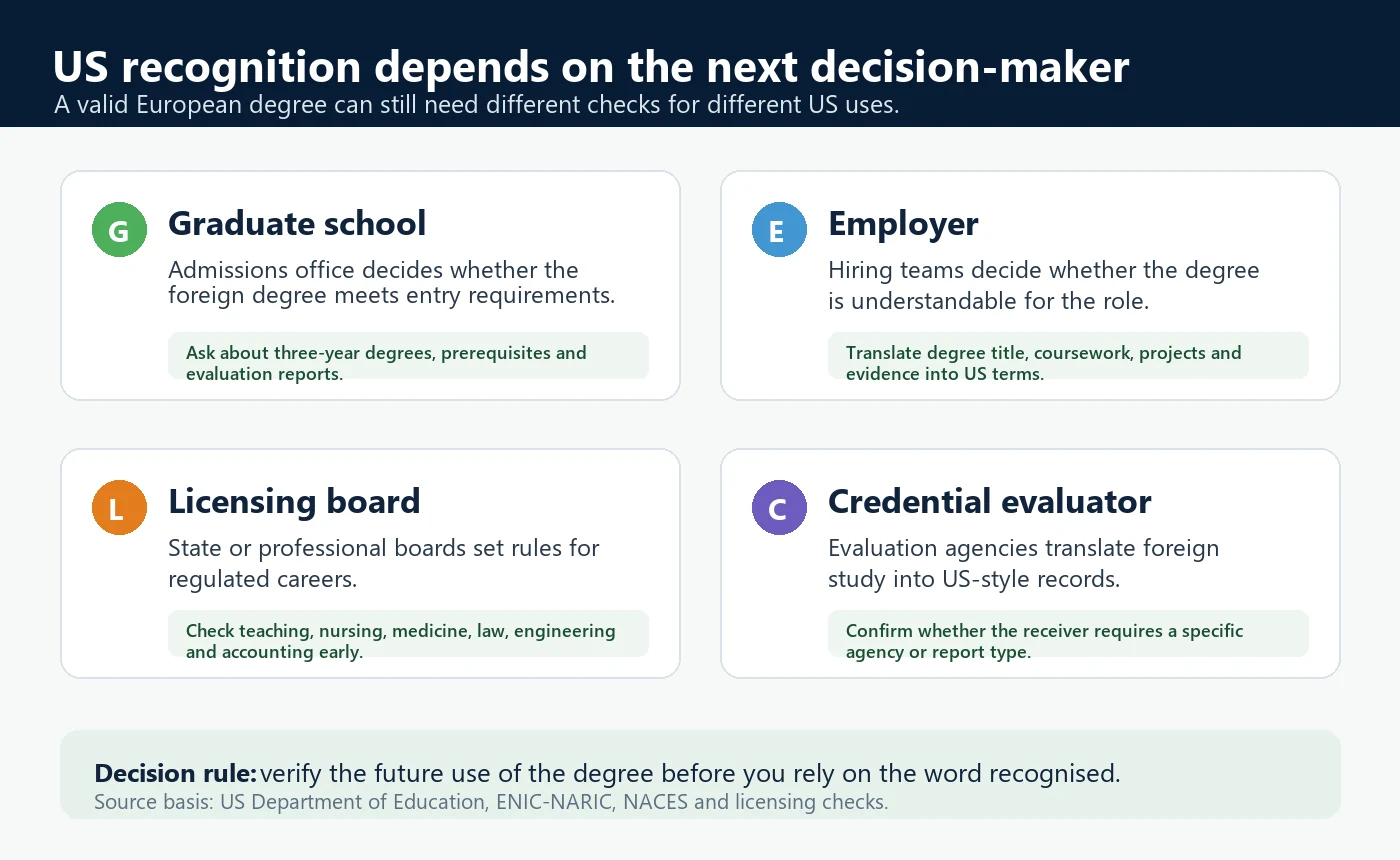
A family can reduce risk by separating four decisions.
First, the university awarding the degree should be properly recognised in its own country. That is the baseline.
Second, the programme should be a real degree at the level the student thinks they are buying. In Europe, bachelor’s degrees often sit in the first cycle of higher education and may be 180 or 240 ECTS credits depending on country and programme.
Third, the US receiver must be willing to use that degree for the purpose the student needs. A graduate school, employer, state board or agency may each ask different questions.
Fourth, someone may require a credential evaluation. That evaluation does not make a weak choice strong. It translates the foreign record into terms the receiver can use.
Families often collapse those four questions into one vague phrase: “Will it count?” That is too loose to be useful.
Three-year degrees are the common confusion
Many European bachelor’s degrees are three years long. Some are four. Under the European Credit Transfer and Accumulation System, a full academic year is usually 60 ECTS credits, and first-cycle bachelor’s degrees commonly involve 180 or 240 ECTS credits. European Commission: ECTS
For American families, the risk is not that “three years” automatically means “not valid.” That would be too simplistic.
The real risk is that a US graduate programme, professional pathway or employer may be used to seeing four-year US bachelor’s degrees and may ask whether the foreign degree is equivalent for its own policy. Some receivers may accept a three-year European bachelor’s. Some may require a credential evaluation. Some may look for missing prerequisites. Some may require additional coursework.
That is why the student should not wait until senior year to ask.
If the goal is a US master’s, pick three realistic US graduate programmes now and read their international-admission pages. If the goal is medical school, teaching, nursing, law, psychology, accounting or engineering licensure, check the relevant board or professional pathway before applying abroad.
Employers usually need translation, not a speech about prestige
For many private-sector jobs, the degree itself is only one signal. Employers also look at skills, projects, internships, work authorisation, communication and whether the application makes sense for the role.
That helps students with European degrees, because a well-explained degree can travel better than a vague one.
Do not write:
Bachelor of Arts, University of X, Europe.
Write something closer to:
Bachelor of Science in International Business, University of X, Netherlands. Three-year European bachelor’s degree; coursework included finance, data analysis, supply chains and a capstone project on market-entry strategy.
The second version gives a US reader context. It does not rely on the employer knowing the institution already.
Students should keep:
- official transcript;
- diploma or degree certificate;
- course descriptions or syllabus links;
- ECTS credit information;
- grading-scale explanation;
- capstone/project evidence;
- internship or work-experience proof;
- contact details for the registrar or records office.
This is especially important for students returning to the US after several years abroad. The degree should be understandable without the student needing to explain the whole European Higher Education Area in an interview.
Regulated professions are the danger zone
The highest-risk question is not “will employers like it?” It is “will a board let me use it?”
Regulated professions can include teaching, nursing, medicine, law, architecture, counselling, psychology, social work, accounting and engineering licensure. The exact list depends on state and occupation.
For these paths, a European bachelor’s may be academically serious and still fail to satisfy a US requirement because of missing prerequisites, clinical hours, supervised practice, local exams, accreditation rules or degree-level expectations.
Examples:
| Student goal | Why recognition is harder |
|---|---|
| US medical school | Prerequisite coursework, lab work, advising, clinical exposure and transcript evaluation may matter. |
| Teaching in a US state | State certification rules may require specific education coursework, supervised teaching and exams. |
| Nursing or allied health | Clinical placement and board eligibility rules can be strict and state-specific. |
| Law | A foreign undergraduate degree is not the same as qualifying for US legal practice. |
| Engineering licensure | Boards may look at programme accreditation, coursework and experience routes. |
The safer rule: if a career requires a licence, check the licence path before choosing the foreign degree.
Credential evaluation: what it can and cannot do
Credential evaluation services review foreign academic records and produce reports for US institutions, employers or boards. NACES lists member agencies that provide evaluation services, but the receiver usually decides which agency or report type it will accept. NACES member agencies
There are two common traps.
The first is assuming any evaluation report will work. Some universities or boards require a specific evaluator. Some require a course-by-course report rather than a basic document report.
The second is assuming evaluation equals acceptance. A report can explain the foreign credential. It does not force a graduate school, employer or licensing board to accept it.
Before paying for an evaluation, ask the receiver:
- Do you require a credential evaluation for this foreign bachelor’s degree?
- Which evaluation agencies do you accept?
- Do you need a document-by-document or course-by-course report?
- Do you require official records sent directly from the university?
- Do you have a policy for three-year European bachelor’s degrees?
The answers matter more than the student’s guess.
How to check the European side first
Before asking a US receiver to evaluate a degree, confirm the European qualification is clear.
Use official university and national sources to verify:
- exact degree title;
- degree level;
- language of instruction;
- standard duration;
- ECTS credit total;
- whether the institution is recognised in its country;
- whether the programme is academic, applied, professional or vocational;
- transcript and diploma supplement availability;
- whether the university can issue documents in English.
ENIC-NARIC centres provide information on recognition of academic and professional qualifications across Europe and related countries. They are useful for understanding recognition systems, but they do not replace the policy of a US graduate school, employer or licensing board. ENIC-NARIC
If a university cannot clearly explain the degree level, credit structure and records it provides, that is a warning sign.
The family checklist before paying a deposit
Use this before accepting an offer.
| Check | What good evidence looks like |
|---|---|
| Institution recognition | Official national or university information confirms the institution and degree status. |
| Degree structure | The programme page states duration, degree title and credit load. |
| US graduate-school fit | At least two realistic US graduate programmes confirm whether the degree type can be considered. |
| Licensing risk | Any regulated career path has been checked with the relevant board or pathway. |
| Credential evaluation | The likely receiver says whether an evaluation is needed and which agencies are accepted. |
| Records access | The university can provide transcript, diploma supplement, grading scale and course descriptions. |
| Backup plan | The student knows what happens if they return to the US immediately after graduation. |
Do not let the word “international” do too much work. The practical proof is whether the degree can be evaluated, explained and used for the student’s likely next step.
Example decisions
A politics student who wants a US master’s later: The European bachelor’s may work well, but the student should check US graduate programme policies for international credentials, three-year degrees and prerequisite expectations.
A business student aiming for private-sector roles: The degree may be fine if the student builds internships, projects and a clear US-style resume story. The risk is usually less about formal recognition and more about explaining the degree clearly.
A student considering medicine or nursing: This is high risk. The family should check the full professional pathway before choosing a European undergraduate degree. A strong overseas degree does not automatically solve US prerequisite or licensing requirements.
A student who wants to stay in Europe: US recognition still matters as a backup, but the immediate issue may be country-specific work permission, local language and employer sponsorship. Use the Netherlands orientation year guide or Germany EU Blue Card guide if those countries are on the shortlist.
What to ask before you apply
Send these questions before the deposit deadline, not after graduation.
To the European university:
Is this a recognised bachelor’s degree in your national system? How many ECTS credits does it carry, and can you provide an English transcript, diploma supplement and grading-scale explanation?
To a US graduate school:
Do you consider applicants with three-year European bachelor’s degrees in this field? Do you require a credential evaluation or specific prerequisite coursework?
To a licensing board or professional pathway:
Would this foreign bachelor’s degree satisfy any part of the education requirement, or would additional US coursework, exams or supervised experience be required?
To an employer or careers adviser:
How should this degree be described on a US resume so the level, subject, coursework and practical evidence are clear?
The answers may not be perfect. They will still be better than guessing.
FAQ
Is a European bachelor’s degree recognised in the US?
Sometimes. Recognition depends on the receiving institution, employer, licensing board or agency. There is no single US government stamp that accepts every foreign bachelor’s degree for every purpose.
Is a three-year European bachelor’s degree equal to a US four-year degree?
Not automatically. Many European bachelor’s degrees are legitimate first-cycle qualifications, often based on 180 or 240 ECTS credits, but US receivers decide how to evaluate them for admission, hiring or licensing.
Do I need a credential evaluation for a European degree?
You might. Some US graduate schools, employers or licensing boards require one. Ask the receiver which agency and report type it accepts before paying for an evaluation.
Will US employers understand a European bachelor’s degree?
Some will, especially in international or graduate-level hiring contexts. Others may need clearer explanation. Students should translate the degree title, credit structure, coursework, projects and evidence into plain US hiring language.
Is recognition the same as accreditation?
No. Accreditation or official recognition in the country where the university operates is the starting point. US recognition is about whether a particular US receiver accepts or evaluates the foreign credential for a specific purpose.
Should American students avoid European bachelor’s degrees?
No. The point is not to avoid them. The point is to verify the future use case before relying on a degree that may be shorter, more specialised or less familiar to US readers.
Related GradSharp reading
- Use European Bachelor’s vs US College: What American Families Misread Before Applying if you are still comparing the academic structure.
- Use American Students Studying in Europe: The Degree, Cost and Career Checks Before You Apply for the broader funding, housing, language and post-study planning checklist.
- Use Can Americans Use FAFSA for a Degree in Europe? before assuming federal loans can support the route.
- Use 529 Plans and European Universities before using tax-advantaged savings for a foreign degree.
Source-checked notes
Checked on 2026-07-16 against the US Department of Education’s recognition of foreign qualifications guidance, ENIC-NARIC recognition resources, NACES member-agency information and European Commission ECTS/higher-education guidance.
This article is general education and careers guidance. It is not legal, tax, immigration, admissions or licensing advice. Students should verify live requirements with the receiving graduate school, employer, licensing board, credential evaluator and university before relying on a European degree for a US outcome.