Is France Actually Cheap for American Students? Public Fees, Private Schools and the Paris Trap
A source-checked cost guide for US families comparing France: public university fees, private school prices, Paris housing and funding risk.

A parent sees the number and almost laughs.
A French public university fee can look tiny next to a US college bill. The spreadsheet opens. The family starts saying things like, “Maybe France is the affordable route.” Then another tab appears: Paris rent. A private school invoice. A flight home for winter break. A housing deposit. A visa proof-of-funds requirement. A line item for “we have no idea yet.”
That is where this article starts: not with the fantasy that France is cheap, and not with the cynical reply that it is secretly expensive. The truth is more useful.
France can be a genuinely good-value option for American students. It can also become a surprisingly high-cost plan if the family confuses public university fees with the whole bill.
This guide is deliberately cost-focused. If you need the wider France application, visa and career checklist, use US Students in France. For the broader European-degree decision, start with American Students Studying in Europe. Families using US federal loans should also read the FAFSA foreign-school checklist before treating any European degree as funded, and families comparing undergraduate routes should use European Bachelor’s vs US College.
The honest answer in one paragraph
France is cheapest for an American student when the programme is at a public institution, the student is charged a confirmed public fee, housing is realistic, and the budget does not depend on finding work immediately. It stops being cheap when the actual programme is private, the city is Paris, the family assumes an exemption that is not in writing, or the student needs part-time work to cover rent.
Think of France as three different financial products, not one country price.
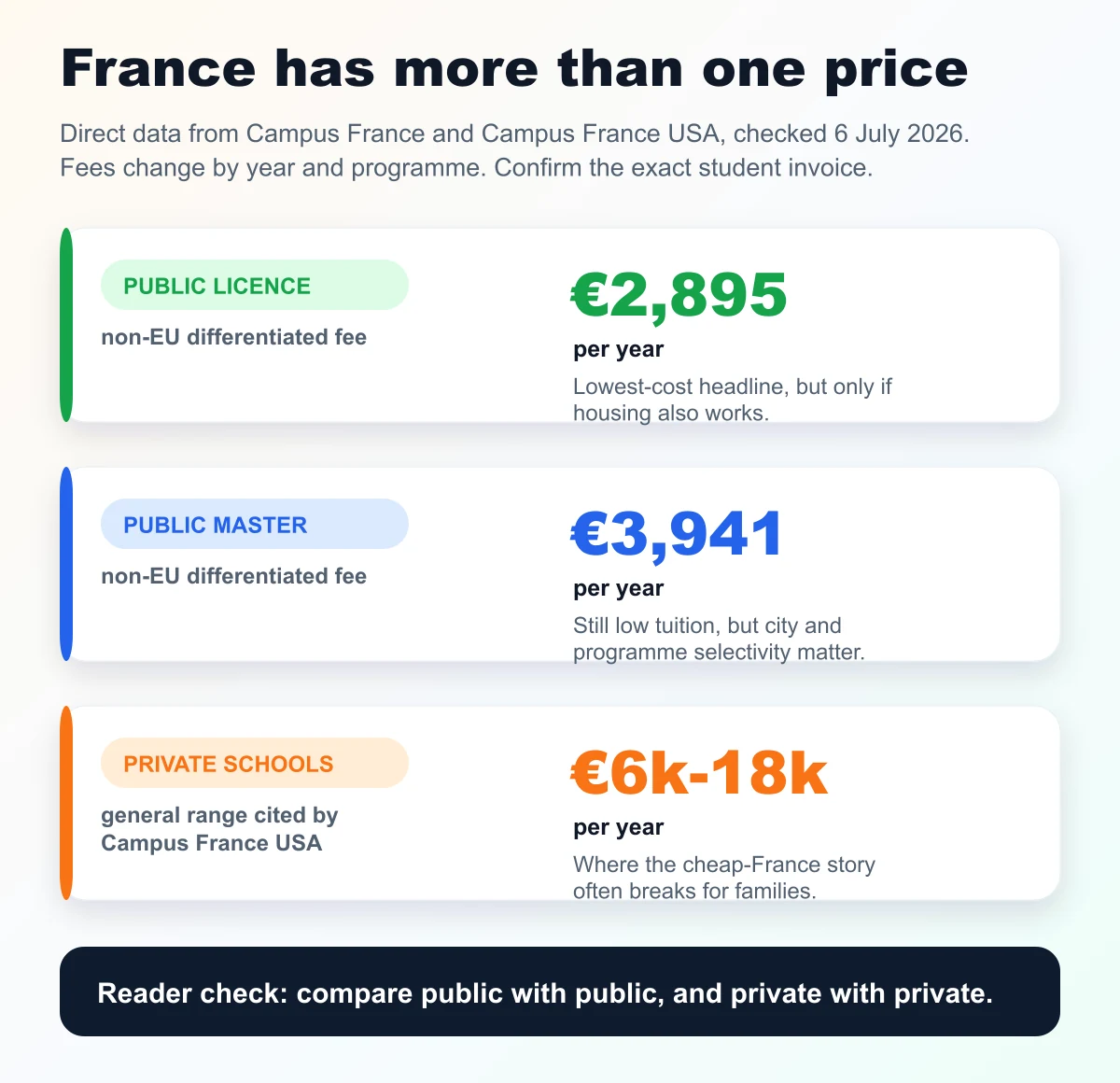
The first France: the public-fee version families hear about
This is the version that gets shared in group chats.
Campus France says tuition is low at public higher-education institutions because the French government subsidizes a large share of the real cost of education. Its public tuition page, updated on 15 September 2025, lists 2025/2026 fees for European students at €178 per year for licence/bachelor level, €254 at master level, €628 for certain engineering schools and €397 for doctoral level. It also lists 2025/2026 differentiated fees for many first-time non-EU students at €2,895 per year for licence/bachelor level and €3,941 at master level, while doctoral tuition is listed at €397 and non-EU doctoral students are not subject to the differentiated tuition in the same way.
For a US family used to American sticker prices, even €2,895 or €3,941 can feel like a rescue boat.
That reaction is understandable. College Board’s 2025 pricing highlights put average published US tuition and fees for 2025/26 at $11,950 for in-state public four-year students, $31,880 for out-of-state public four-year students and $45,000 at private nonprofit four-year colleges.
But that comparison is still only the first page of the spreadsheet. US colleges may offer grants, scholarships, in-state access or campus housing systems. France may offer lower public tuition, but it also asks the family to manage flights, rent, deposits, visa paperwork, exchange rates and a less familiar support structure.
The public-fee version of France is real. It is not the whole country.
The second France: the private-school invoice
This is the tab that ruins the slogan.
Many American students are not looking only at public universities. They are looking at business schools, fashion schools, art schools, culinary schools, international programmes, English-taught private master’s degrees and specialist institutions with glossy websites and strong city branding.
Those can be legitimate choices. They can also sit in a completely different cost category.
Before a family says “France is cheaper,” it needs to answer this plainly:
| The programme you are actually considering | What that means for the budget |
|---|---|
| Public licence/bachelor programme outside Paris | The low-fee story may be realistic, if housing and funding are controlled. |
| Public master’s programme in Paris | Tuition may still be low, but housing can become the main risk. |
| Private business, fashion, arts or international school | The tuition comparison must use the private invoice, not public university figures. |
| English-taught private programme in Paris | This can combine higher tuition with the hardest housing market. |
A private school can still be worth it. The question is not whether private is bad. The question is whether the student is buying better career access, teaching, internships or recognition, or simply paying more for a city and a brochure.
The third France: the actual year of life
The actual year of life is the number parents usually build last. It should be built first.
A student does not live inside the tuition line. They live in a room, take the metro, buy groceries, pay deposits, replace a lost document, and occasionally need a flight home. They may need French phone service, bedding, train tickets, visa validation steps, insurance, winter clothes and a buffer for the month when nothing goes as planned.
Campus France’s budget guidance warns that living costs can be fairly high, especially in Paris and major cities, and its budget examples show how food, transport, housing and setup costs need to be counted separately. Housing is the unstable variable. Campus France describes CROUS residences as attractive because rent is low, but also notes that demand is much higher than supply.
So the Paris trap is not “Paris is impossible.” The trap is assuming that the student will live in the cheapest version of Paris without winning the housing race.
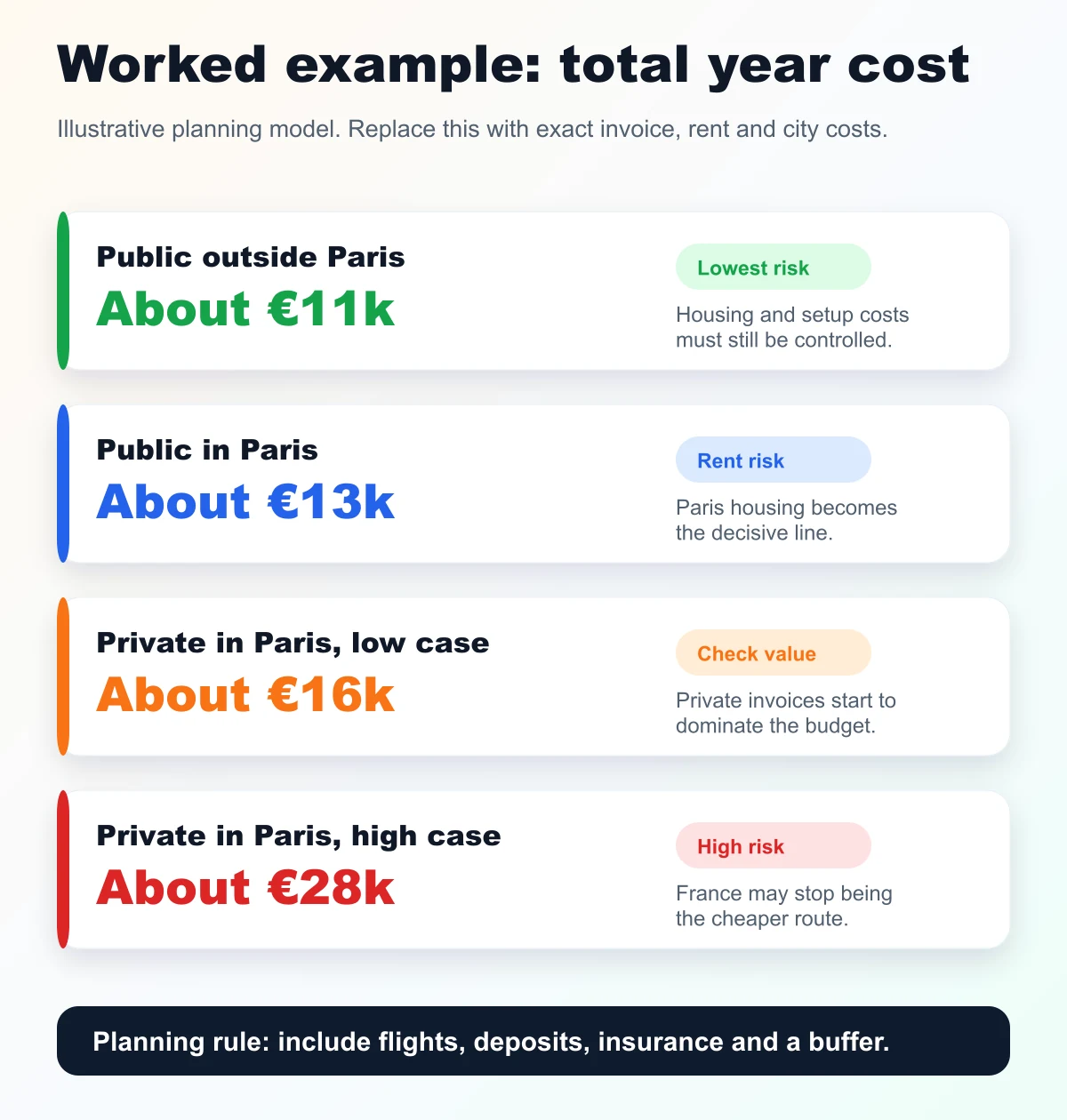
A more honest way to compare France with the US
Do not compare French public tuition with a US private sticker price and stop there. That is emotionally satisfying and financially lazy.
Compare the offers like this:
| Cost line | US college offer | France option |
|---|---|---|
| Tuition and required fees | Use net price after grants, not only sticker price. | Use the exact invoice or written fee confirmation. |
| Housing | Include dorm, meal plan or off-campus estimate. | Use city-specific rent, deposit and guarantor assumptions. |
| Food and daily life | Campus meal plan or local living estimate. | Groceries, university restaurants, transport and setup costs. |
| Travel | Usually lower unless far from home. | International flights and emergency travel. |
| Funding | Grants, loans, work-study, family contribution. | FAFSA eligibility, 529 rules, scholarships, family cash. |
| Risk buffer | Usually familiar systems and family access. | Currency movement, document delays, housing surprises. |
The strongest France plan still works after you add the unglamorous costs.
Fee exemptions: ask for the sentence that applies to your student
Older advice about France can be dangerous because it often says, “Many non-EU students are exempt,” and then leaves the family to fill in the blank.
Do not fill in the blank.
Campus France lists situations where some non-EU students pay the same fees as French and European students. It also lists the differentiated 2025/2026 fees for many first-time non-EU students in relevant public programmes. The only sentence that matters to a US family is the one from the institution saying what this US student will be charged for this programme in this academic year.
Send the boring email:
We are a US family considering [exact programme] for [academic year]. What tuition or registration fee will a US citizen be charged? Is any exemption automatic, already granted, competitive, or unavailable? Please confirm in writing before we pay a deposit.
A confident answer reduces risk. A vague answer is a budget problem.
The part-time work myth
France allows student work within limits, but work permission is not a financial plan.
Campus France guidance describes the student work limit as up to 964 hours per year and frames student work as a bonus rather than the basis of the budget. France-Visas and Campus France pages should still be checked before relying on any work-rights assumption.
That is the line families should write on the spreadsheet.
Not “student job: €400/month.”
Instead: “student job: possible help, not required for rent.”
A student who is learning the academic system, handling French bureaucracy, searching for housing and adjusting socially should not need a job in month one for the plan to survive.
When France is genuinely good value
France is a strong value story when most of these are true:
- the programme is public or reasonably priced;
- the exact fee is confirmed in writing;
- the city is affordable enough without heroic rent assumptions;
- the student has a housing route before arrival;
- FAFSA and 529 questions have been checked separately;
- the student can cover the first year without relying on part-time work;
- the degree makes sense if the student returns to the US;
- French-language needs are understood, not wished away.
In that version, France can give a serious education for less than many American routes.
When “cheap France” falls apart
The low-cost story usually breaks in one of five ways.
First, the student picked a private programme but the family kept quoting public fees. Second, the student picked Paris but budgeted like a regional city. Third, the family assumed a fee exemption without written confirmation. Fourth, they planned to cover rent with work the student had not yet found. Fifth, they ignored US funding rules until after the deposit.
None of those are moral failures. They are normal mistakes. They are also fixable before money moves.
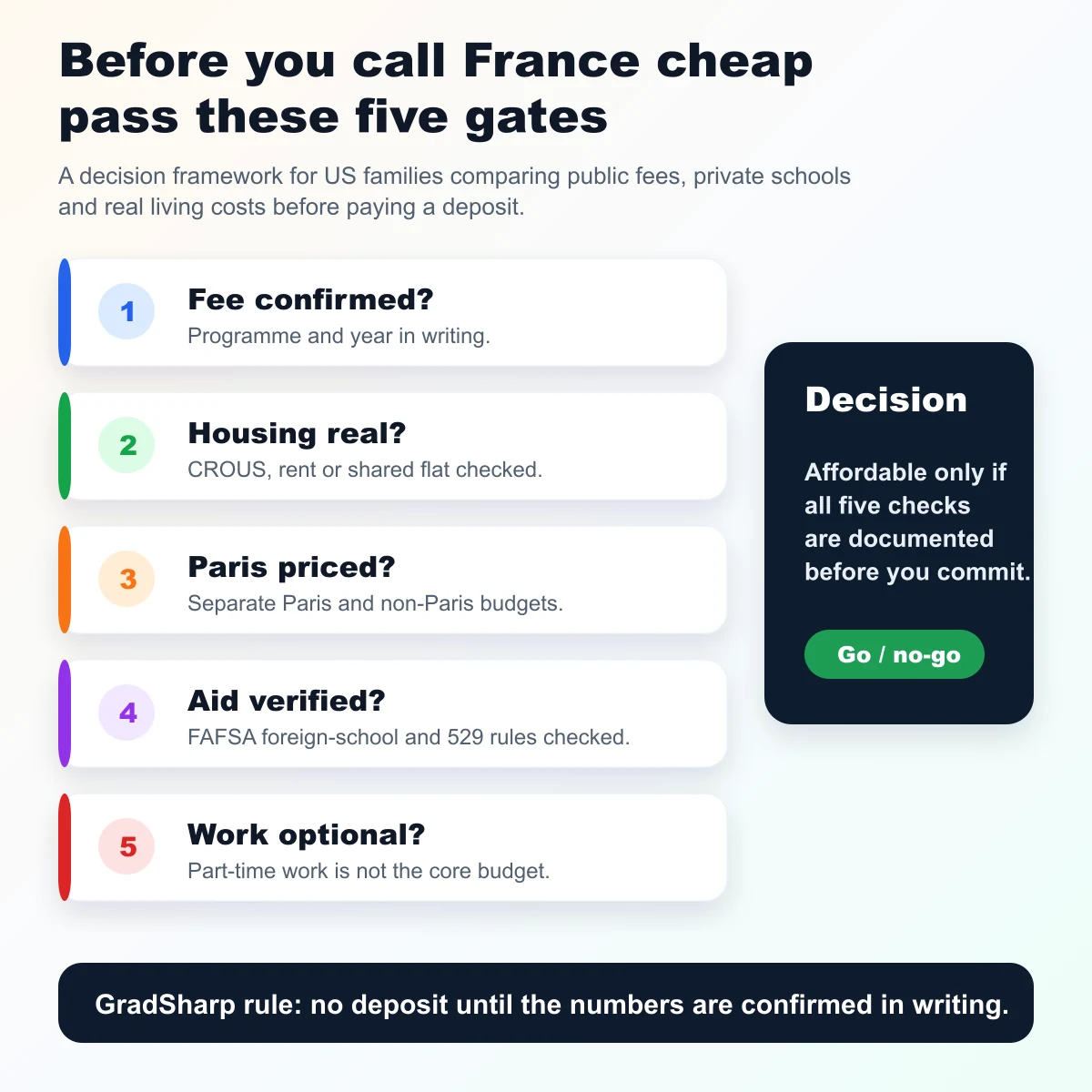
The five-email deposit test
This is the section to copy into a family notes app.
| Ask this before deposit | |
|---|---|
| Admissions | “What exact tuition or registration fee applies to a US citizen in this programme and year?” |
| Finance office | “Is any exemption automatic, already awarded, competitive or unavailable?” |
| Housing office | “What housing is realistically available to first-year international students, and by what date?” |
| International office | “What proof of funds, insurance and visa documents do US students normally prepare?” |
| Programme team | “What French level is needed for internships, placements or part-time work near the programme?” |
Keep the replies in one folder. If the plan depends on a verbal answer, it is not ready.
A 48-hour family audit
In the next two days, do not research “France.” Research one real option.
Choose one programme and build a one-page audit:
- exact institution and programme name;
- public or private status;
- confirmed tuition or the office that must confirm it;
- city and realistic rent range;
- first-year living estimate using Paris and non-Paris assumptions separately;
- flights, visa/admin costs and emergency buffer;
- FAFSA foreign-school status if federal loans matter;
- 529 eligible-institution and qualified-expense questions if 529 funds matter;
- French-language need for housing, internships and work;
- decision: affordable now, affordable only with confirmation, or not affordable.
The goal is not to kill the France idea. It is to protect it from fantasy math.
FAQ
Is France cheaper than US college for American students?
Sometimes. Public university tuition in France can be far lower than many US sticker prices. But the real comparison is total French cost versus the US net price after aid, including housing, travel, insurance, exchange rates and support needs.
Are French public universities free for Americans?
No. Campus France lists low public tuition for some groups and differentiated 2025/2026 fees for many first-time non-EU students in relevant public programmes. US students should ask the institution what fee applies to their exact programme and year.
Are private schools in France cheap?
Not necessarily. Private business, arts, fashion and international schools can move France into a much higher cost category. Always compare the actual invoice, not the public university fee.
Is Paris too expensive for students?
Paris can work, but it needs early housing action and a cautious budget. The danger is assuming the student will get a low-cost room without a backup plan.
Can a student job pay for France?
It should not be the core plan. Student work may help, but official guidance treats part-time work as secondary income rather than enough to cover all expenses.
What is the safest first step?
Get written fee confirmation from the institution. Then build a budget using housing, flights, visa/admin costs and funding checks before paying a deposit.
Related GradSharp reading
- Use American Students Studying in Europe: The Degree, Cost and Career Checks Before You Apply for the wider European-degree decision.
- Use European Bachelor’s vs US College: What American Families Misread Before Applying if the student is deciding between a French bachelor’s and a US undergraduate route.
- Use Can Americans Use FAFSA for a Degree in Europe? The Foreign School Check Families Miss before assuming federal loans can support the plan.
Source-checked notes
Checked on 6 July 2026.
- Campus France tuition fees: public tuition, 2025/2026 differentiated fees for many first-time non-EU students, doctoral fee wording and exemption categories.
- Campus France budget guidance: food, transport, housing and cost-of-living cautions.
- Campus France housing guidance: CROUS and student-housing context.
- Campus France working while studying: student-work limit and warning not to make part-time work the core funding plan.
- France-Visas student guidance: student visa and work-rights context.
- College Board Trends in College Pricing 2025: US tuition and fee comparison context for 2025/2026.
Future students should confirm live tuition, exemption, visa, housing and funding information with official sources and the university before paying application fees or deposits.