US Students in France: Tuition, Visa and Career Checks Before You Apply
A practical France checklist for American students covering tuition, Campus France, student visas, scholarships, housing, language and career risk.

France can look like the elegant answer to US college anxiety: lower advertised tuition, English-taught programmes, respected universities and a lifestyle that feels more independent than a traditional US campus.
That is the appealing version. The useful version is more precise.
For American students, France can be a strong degree choice if the exact programme works for your funding, visa timing, housing plan, language level and career route. It is a weaker choice if you are relying on a vague idea that Europe is cheaper, Paris is worth any cost, or an English-taught degree automatically leads to an English-speaking graduate job.
This guide is for US students and families considering a full degree or long study period in France. It is not a tourism article. Use it before you pay an acceptance deposit, sign a lease, or assume a French degree will work the same way as a US college degree.
Related GradSharp reading: use the broader American students studying in Europe checklist for the full cross-Europe decision, the European bachelor’s versus US college guide if this is an undergraduate family choice, and the FAFSA foreign-school checklist before assuming US federal loans can support the plan.
The France decision in plain English
France is worth considering if you want an international degree, can handle a more independent academic system, and have checked the exact funding and visa steps.
It is not automatically the cheapest European option. It is also not automatically the easiest route to work in Europe after graduation.
| Question | Honest answer |
|---|---|
| Can Americans study in France? | Yes, but degree students usually need to follow the Campus France and student visa process for stays of 90 days or more. |
| Is public university tuition low? | Often lower than many US options, but the latest verified non-EU public fees and living costs still need a full-year budget check. |
| Can you study in English? | Yes, France lists many programmes taught wholly or partly in English, but internships, admin and local jobs may still need French. |
| Can you work during study? | Student work is possible within limits, but it should be treated as a supplement, not the core funding plan. |
| Can you stay after graduation? | Some graduates may use a job seeker/new business creator route, but it is time-limited and not a job guarantee. |
France student visa, tuition and scholarship checks
Broad searches for France international student visa, immigration, tuition and scholarship updates usually need one answer: check the live official pages before you pay anything non-refundable.
This article is not a rolling news update. It is a decision checklist for US students, with several checks that also apply to non-EU international students.
| Check | Where to verify | Why it matters before deposit |
|---|---|---|
| Tuition and fee status | Campus France and the institution’s own fee page | Public non-EU fees, private-school invoices and exemptions can differ. |
| Campus France step | Campus France USA or the relevant country office | Many long-stay students must complete the Campus France process before the visa step. |
| Student visa route | France-Visas and the consulate/appointment route | The visa file depends on admission, funding, housing and timing evidence. |
| Scholarships or fee exemptions | Campus France scholarship tools, the institution and programme page | A scholarship headline is not the same as a confirmed award or fee waiver. |
| Post-study or immigration plan | Campus France and official French immigration pages | Post-study routes are time-limited and conditional, not automatic career guarantees. |
If a search result, agent or old forum post conflicts with the official page, use the official page and ask the university in writing.
The five checks before choosing France
1. Check whether this is study abroad or a French degree
American families often mix up three different routes.
A US-campus study abroad semester keeps you enrolled at your US college. Your home institution usually handles credit transfer, billing and programme support.
A full French degree means you are enrolled directly at a French institution. That changes almost everything: admissions, funding, visa process, housing, transcript format, academic calendar and return-to-US recognition.
An exchange or dual-degree programme sits somewhere in between. It may give you more support than direct enrolment, but you still need to check how the French component appears on your transcript and whether the programme supports your career goal.
The mistake is assuming the enjoyable semester-abroad model scales into a full degree. It does not. A full degree in France is a bigger administrative and financial decision.
2. Check tuition as an invoice, not a headline
The latest Campus France tuition page I could verify on 30 June 2026 still lists tuition charges for the 2025/2026 academic year. For non-EU students who are enrolling for the first time in a public higher education establishment covered by the Ministry in charge of Higher Education and Research, Campus France lists differentiated registration fees of €2,895 per year at licence/bachelor level and €3,941 per year at master level. It also states that non-EU doctoral students are not subject to the new differentiated tuition fees and lists doctoral tuition at €397 for 2025/2026. Campus France tuition fees
Do not treat those as universal France prices. Some non-EU students pay the same fees as French and EU students because of their status or degree, and private institutions or grandes écoles can charge much more. See the current Campus France and institution pages before relying on any figure.
Those public fees are the reason France appears in many “affordable Europe” conversations. But families should not stop there.
A serious budget should include:
| Cost line | What to check |
|---|---|
| Tuition | Public university, grande école, private school, exchange programme or partner billing? |
| Housing | Paris and large cities can change the total cost more than tuition does. |
| Visa and admin | Campus France, visa appointment, validation and document costs. |
| Health and insurance | What is covered, what is not, and whether private cover is needed at arrival. |
| Travel | Flights home, luggage, emergency travel and holiday accommodation. |
| Exchange rate | A dollar budget can shift even when the euro fee stays fixed. |
| Funding | Federal loans, 529 funds, scholarships, family contribution and private loans. |
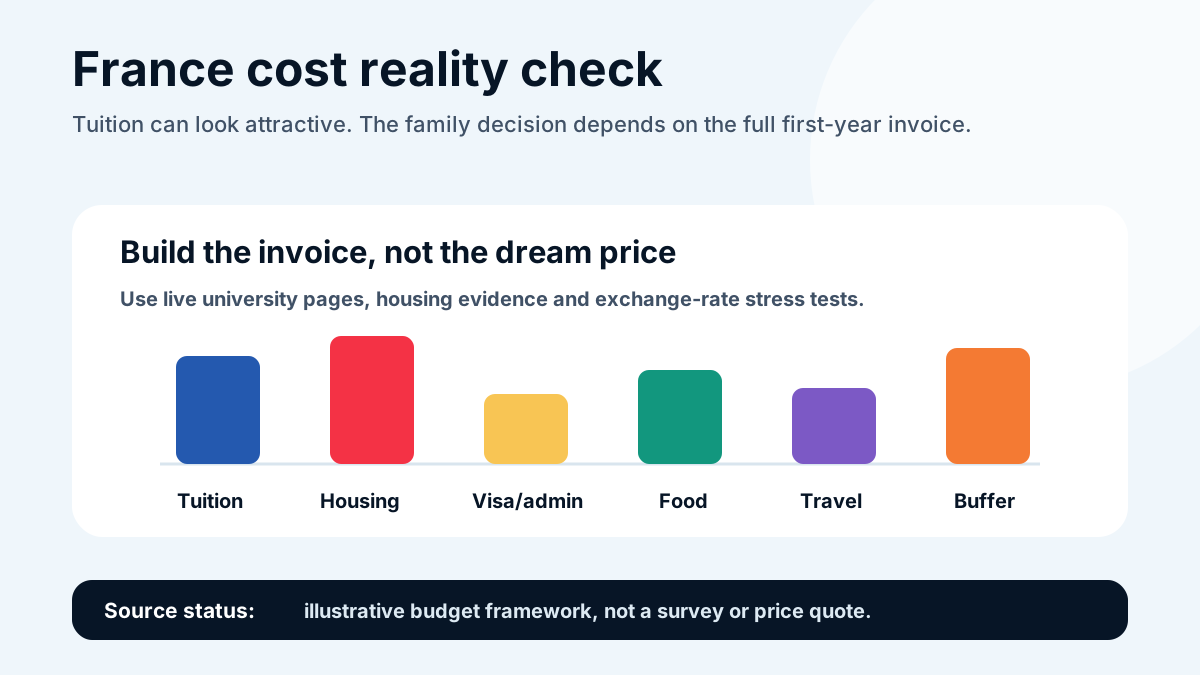
The practical test is not “Is French tuition lower than a private US college?” It is “Can we afford the full first year without relying on optimistic part-time work, an unconfirmed scholarship or a housing plan we have not secured?”
3. Check the Campus France and visa route early
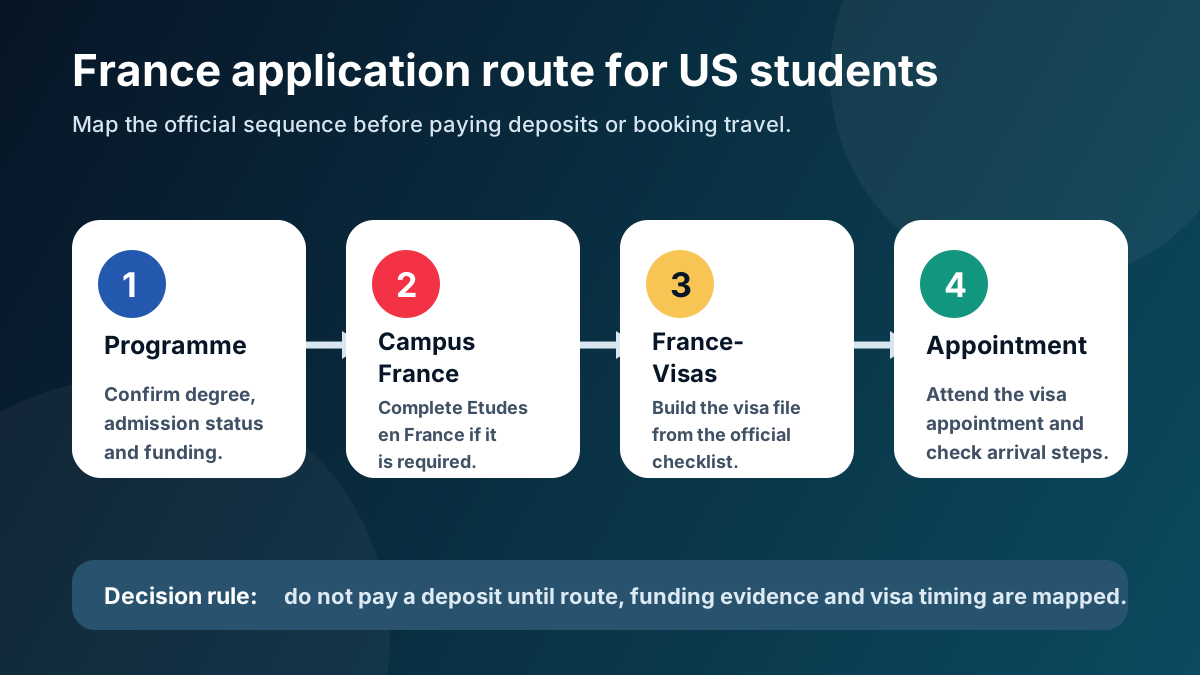
Campus France USA says students who wish to study in France for 90 days or more must follow the Campus France procedure before applying for a student visa. After that step, students move to France-Visas and schedule a visa appointment through the relevant appointment process.
France-Visas says student applicants must already have chosen their course or studies. In practice, this means you cannot treat the visa as a casual final formality. The visa file depends on the programme, admission status, funding evidence, housing information and timing.
For US students, the safer order is:
- Confirm the exact programme and institution.
- Check whether the programme is full degree, exchange, dual degree or study abroad.
- Confirm funding before deposit.
- Complete the Campus France / Études en France step if required.
- Complete France-Visas.
- Book and attend the visa appointment.
- Keep copies of admission, accommodation, funding and insurance documents.
- Check arrival validation or residence steps once in France.
The biggest avoidable mistake is waiting for the US mindset of “I’ll sort paperwork after graduation.” French administrative steps are manageable, but they reward early document discipline.
What matters more than American students think
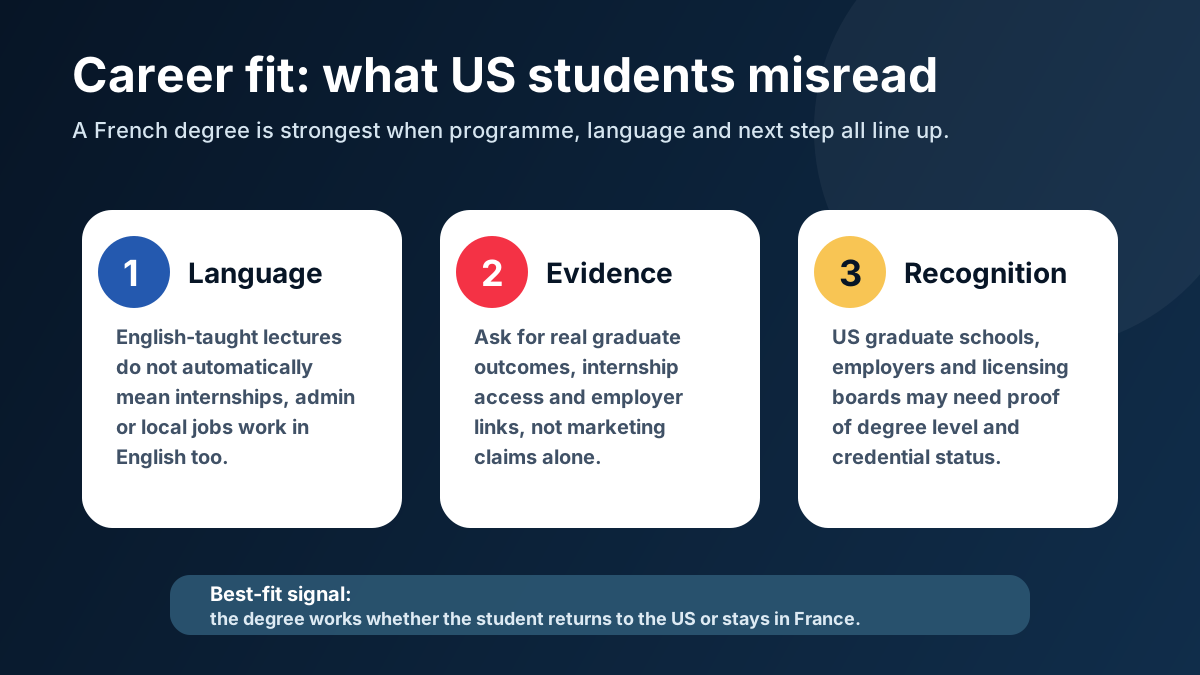
Language matters even when the degree is in English
Campus France lists more than 1,600 programmes that are wholly or partly taught in English. That is good news for US students. It does not remove the French-language question.
You should ask three separate questions:
- Is the classroom language English?
- Are internships and career services realistically accessible in English?
- Can I handle housing, healthcare, banking and day-to-day admin in French?
For some business, policy, international relations and research programmes, English may be enough academically. For internships, part-time work and local graduate jobs, French may become the separator between “I studied in France” and “I built a career in France.”
Housing can be the real bottleneck
Campus France warns that cost of living can be high, especially in Paris and major cities. Its student housing guidance also shows how accommodation type changes the budget, with university residences generally cheaper than many private options.
For American families, the housing check should happen before the deposit, not after the visa. Ask:
- Does the university offer housing support, or only links?
- Is accommodation guaranteed, prioritised, lottery-based or fully independent?
- What is the realistic rent near campus?
- Are deposits, guarantors or French banking requirements likely?
- What happens if housing is not secured before arrival?
France may look affordable on tuition and still become stressful through rent.
Degree recognition is not automatic back in the US
The US Department of Education says it does not evaluate foreign qualifications itself. Recognition in the US depends on the authority that needs the credential: a graduate school, employer, licensing board or immigration authority.
This matters most for regulated careers: medicine, nursing, law, teaching, psychology, architecture, accounting and some engineering routes. It can also matter for US graduate school if the programme expects specific prerequisites or a four-year undergraduate pattern.
A French degree can be strong. That does not mean every US gatekeeper will understand it without explanation.
Before applying, find two realistic US destinations after the French degree: a graduate programme, licensing board, employer or credential evaluator. Ask what they would need to see.
Paris, rankings and headline tuition are incomplete shortcuts
Paris is not the whole decision
Paris is attractive, but France is not only Paris. Lyon, Toulouse, Lille, Grenoble, Strasbourg, Montpellier, Bordeaux, Rennes, Nantes and other cities may offer better fit depending on field and budget.
For students choosing by career outcome, the stronger question is:
Where is the right programme, internship ecosystem and housing plan, not just the most famous city?
A famous French name is not enough
American families often over-focus on whether they recognise the institution name. Recognition matters, but not alone.
A better institution check includes:
| Check | Why it matters |
|---|---|
| Degree type | Licence, bachelor, master, MSc, diplôme d’ingénieur, grande école diploma or university diploma can signal different things. |
| Accreditation/recognition | Check whether the credential is state-recognised and useful for your next step. |
| Teaching language | English-taught does not always mean English-supported career outcomes. |
| Internship structure | Some programmes build in stages or alternance; others leave it to the student. |
| Graduate destinations | Ask for actual outcomes, not marketing adjectives. |
Part-time work should not carry the budget
Campus France says foreign students have the right to work in France and non-EU students with the right residence status may work up to 964 hours per year. It also describes student work income as a bonus.
That framing is important. A student job can help with living costs and French-language immersion. It should not be the main reason the budget balances.
If the cost sheet only works because the student must find work quickly, in French, in a new city, while adapting academically, the plan is too fragile.
Worked examples
Example 1: The Paris business master’s
A US student applies to an English-taught private business school in Paris. The brand sounds international and the programme is one year.
The key checks are tuition, housing, whether the degree is recognised for the student’s target employers, and whether career services have evidence of international students finding relevant jobs in France or elsewhere. Paris may help networking, but it also raises the rent risk.
Example 2: The public university bachelor’s outside Paris
A high-school senior applies for a bachelor’s-level programme at a public university outside Paris.
The sticker tuition may be attractive. The bigger questions are whether the student is ready to specialise earlier than in a US college, whether French is needed for admin and social integration, and whether the degree works if they return to the US for graduate school.
Example 3: The student who wants to stay in France
A student chooses France because they want to build a life there after graduation.
That is possible for some graduates, but it needs realism. Campus France describes the job seeker/new business creator residence permit as a 12-month, non-renewable route for eligible graduates with certain French higher education diplomas. It lets holders look for work, work legally during the permit, or create a company in a field linked to their training or research. It is not a job guarantee.
This student should choose the programme partly by French-language development, internship access, employer links and whether the qualification supports the next immigration step.
The France decision checklist
| Check | Evidence you should have before deposit |
|---|---|
| Exact route | Study abroad, exchange, dual degree or direct French degree. |
| Programme status | Degree name, language, recognition and expected credential. |
| Tuition | Current invoice-level cost from the institution, not a blog estimate. |
| Housing | Realistic rent, deposit, guarantor plan and arrival timeline. |
| Visa route | Campus France and France-Visas steps mapped by date. |
| Funding | Family contribution, federal loans, 529 plan, scholarships and exchange-rate buffer. |
| Language | Classroom language plus internship, work and daily-life language. |
| Career plan | Return-to-US recognition check or France-based job route check. |
Verify the France plan before paying
Pick one French programme, not ten.
Then complete this mini-audit:
- Find the official programme page and save the exact degree title.
- Check the teaching language and whether internships are required.
- Find the current tuition page for that institution.
- Build a first-year budget with tuition, housing, transport, food, insurance, visa/admin, flights and emergency travel.
- Check whether the Campus France USA process is candidate or pre-consular for your situation.
- Read the France-Visas student page and create a document checklist.
- Email admissions or the international office with three questions: housing, US aid/529/federal-loan handling, and recent international graduate outcomes.
- If you may return to the US, ask one graduate school, employer or licensing board how it evaluates French degrees.
Your goal is not to decide immediately. Your goal is to remove the fantasy version of France from the decision.
FAQ
Is France cheaper than college in the US?
Sometimes, especially at some public institutions. But the comparison only works when you include housing, food, travel, insurance, visa/admin costs, exchange rates and lost US aid. Private institutions can be much more expensive.
Do American students need Campus France?
Campus France USA says students who wish to study in France for 90 days or more must follow the Campus France procedure before applying for a visa. The exact pathway depends on whether the student is already accepted or applying through the platform.
Where should I check France student visa, tuition and scholarship updates?
Use Campus France, France-Visas and the institution’s own programme and fee pages. Treat broad “France immigration news” or scholarship summaries as starting points only, because tuition, visa documents, scholarship windows and fee exemptions can change by year, country office and programme.
Can I study in France in English?
Yes, many programmes are wholly or partly taught in English. But students should still check French-language needs for housing, internships, healthcare, admin and graduate jobs.
Can I work while studying in France?
Campus France says foreign students have the right to work in France and non-EU students with the right residence status may work up to 964 hours per year. Treat that income as a supplement, not the foundation of the budget.
Can I stay in France after graduation?
Some graduates may be eligible for the job seeker/new business creator route, which Campus France describes as valid for 12 months and not renewable. Eligibility depends on your situation and degree, and it does not guarantee employment.
Will a French degree be recognised in the US?
There is no single US authority that recognises every foreign degree. The relevant decision-maker may be a graduate school, employer, licensing board or credential evaluator.
Related GradSharp reading
- Use American Students Studying in Europe: The Degree, Cost and Career Checks Before You Apply for the broader Europe-wide degree, cost, recognition and post-study route checklist.
- Use European Bachelor’s vs US College: What American Families Misread Before Applying if the student is comparing a French bachelor’s with a US undergraduate college route.
- Use Can Americans Use FAFSA for a Degree in Europe? The Foreign School Check Families Miss before assuming US federal loans can support the French programme.
- Use 529 Plans and European Universities: What US Families Should Check Before Using the Money before assuming 529 funds can cover French tuition, housing or study-abroad costs.
Source-checked notes
Checked on 30 June 2026.
- Campus France USA application overview: students studying in France for 90 days or more must follow the Campus France procedure before applying for a student visa; after confirmation, they move to France-Visas and the visa appointment process.
- France-Visas student page: checked student visa route types, supporting document guidance and long-stay visa timing.
- Campus France tuition fees: the latest tuition page verified on 30 June 2026 listed 2025/2026 differentiated fees for relevant first-time non-EU public enrolments as €2,895 at licence/bachelor level and €3,941 at master level; doctoral tuition was listed at €397 and non-EU doctoral students were not subject to the new differentiated fees.
- Campus France programme catalogue guidance: France lists more than 1,600 programmes wholly or partly taught in English.
- Campus France working while studying: foreign students may work up to 964 hours per year; part-time income should be treated as a bonus.
- Campus France preparing your budget: cost of living can be high, especially in Paris and major cities.
- Campus France job seeker/new business creator permit: the residence permit is valid for 12 months and is not renewable.
- US Department of Education recognition of foreign qualifications: recognition of foreign qualifications in the US depends on the relevant competent authority, such as education institutions, employers or state licensing boards.