European Bachelor's vs US College: What American Families Misread Before Applying
A practical guide for US families comparing a European bachelor's degree with US college: cost, flexibility, funding, recognition and career risk.
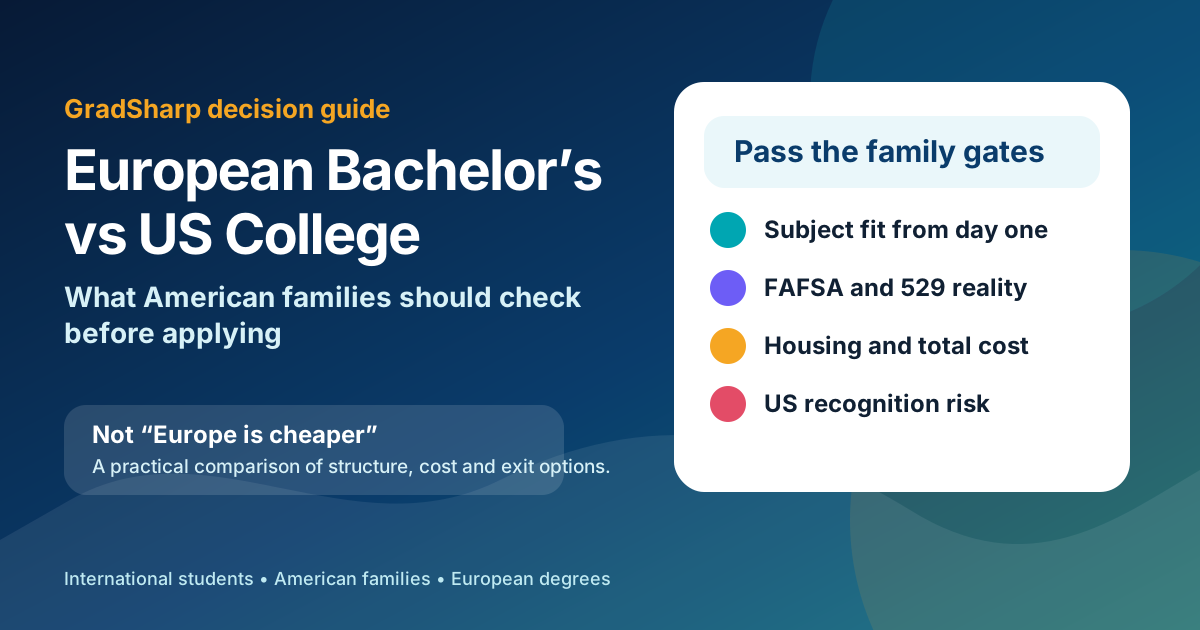
A European bachelor’s degree can look like the cleanest answer to US college anxiety: fewer years, lower advertised tuition and a chance to live abroad.
That is the attractive version. The useful question is harder: will this exact degree work for your student academically, financially and professionally if they return to the United States, stay in Europe, or change direction halfway through?
This is not a “best countries in Europe” list. It is a family decision guide for comparing a full European bachelor’s degree with a US undergraduate college route.
Related GradSharp reading: start with the broader American students studying in Europe checklist if you are comparing multiple degree levels, then check the FAFSA foreign-school guide and 529 plans guide before assuming US funding will travel cleanly.
The decision in plain English
A European bachelor’s can be a strong choice for a student who is clear about their subject, comfortable with more independence and realistic about funding, housing, language and recognition.
It is riskier for a student who wants the classic US college experience, expects to explore majors for two years, needs intensive advising, or may enter a regulated profession in the United States.
The biggest mistake is treating Europe as “US college, but cheaper”. In many European systems, the degree is shorter because it is more specialised from day one. That can be efficient. It can also be unforgiving.
Open Doors 2025 reported that 298,180 US students studied abroad for academic credit in 2023/24, while Project Atlas partners reported more than 95,000 American students enrolled in full-degree programmes abroad. Those are different decisions: a semester abroad is not the same risk as moving the whole undergraduate degree overseas. Open Doors 2025
Europe is not one system
Europe is a useful search label. It is not one higher-education system.
The European Commission’s Study in Europe project covers 33 European countries. Those countries sit within the European Higher Education Area, but each country still governs its own system. European Commission: Higher education in Europe
So the question is not “Is Europe better than the US?”
It is:
Does this exact degree, in this exact country, at this exact institution, support the student’s next step?
| Family question | Why it changes the answer |
|---|---|
| Is the student already committed to a subject? | Many European bachelor’s programmes require earlier specialisation than US colleges. |
| Is the cost plan based on federal aid, 529 funds or private savings? | The school and exact programme may not work the same way as a US institution. |
| Could the student return to the US for graduate school or licensure? | Recognition is decided by the receiving institution, employer or licensing body. |
| Is post-study work in Europe part of the plan? | Work permission is country-specific and separate from admission. |
What does bachelor mean in Europe?
Many American families notice that European bachelor’s degrees are often three years. That can be true, but it needs context.
Under the European Credit Transfer and Accumulation System, 60 ECTS credits usually represent a full academic year, and a first-cycle bachelor’s degree consists of either 180 or 240 ECTS credits. European Commission: ECTS
Study in Europe also notes that most full-time bachelor’s programmes in Europe last three or four years. European Commission: Higher education in Europe
For a US family, “bachelor” usually means the first full undergraduate degree, but the structure may feel different. The student may apply directly into a named subject, accumulate ECTS credits instead of US credits, and have less room to explore unrelated majors after enrolment.
The shorter path is not automatically weaker. It is often built around a different assumption: students enter a named programme earlier and specialise sooner.
That suits a student who can explain why they want economics, engineering, computer science, politics, international relations or business now. It is a weaker fit for a student who says, “I might do psychology, business, data science or law, depending on what I discover.” In many European systems, changing direction may mean applying again, losing time or moving institution.
Family test: ask the student to explain why this subject, not just why Europe. If they cannot, the European route may be premature.
Misread 2: lower tuition does not mean lower total cost
The cost case for Europe is real enough to investigate. It is not strong enough to skip the spreadsheet.
College Board’s 2025 pricing data puts average published US tuition and fees at $11,950 for public four-year in-state students, $31,880 for public four-year out-of-state students and $45,000 for private nonprofit four-year students in 2025/26. Those are tuition-and-fee figures, not every student’s net cost after aid. College Board: Trends in College Pricing
European tuition can be lower in some countries and higher in others. Study in Europe gives a broad non-EU tuition range of approximately EUR1,000 to EUR20,000 per year, but that is a range across countries, not a promise for any programme. European Commission: Higher education in Europe
The hidden cost is usually not tuition alone. Families need to price rent, deposits, flights, health insurance, visa fees, currency movement, emergency travel and the practical cost of setting up life in another country.
| Cost item | US college comparison mistake | European bachelor’s check |
|---|---|---|
| Tuition | Comparing European sticker tuition to US sticker tuition only | Compare likely US net cost against total European cost. |
| Housing | Assuming campus housing works like the US | Check whether students find private rentals, university housing or both. |
| Aid | Assuming FAFSA follows the student automatically | Confirm school and programme eligibility before applying. |
| Travel | Treating flights as vacation spending | Budget flights, storage, emergency travel and family visits. |
| Currency | Ignoring exchange-rate movement | Stress-test the budget if the euro or pound moves against the dollar. |
The right comparison is not European sticker tuition versus US sticker tuition. It is four years of likely US net cost versus three or four years of European tuition, rent, travel and funding risk.
Misread 3: FAFSA and 529 rules are a gate, not an afterthought
American families often ask about FAFSA after they fall in love with a programme. That is backwards.
US Federal Student Aid says students may borrow federal student aid for attendance at an eligible foreign institution only when they meet requirements, including being enrolled as a regular student in an eligible programme at an eligible foreign institution. It also distinguishes “eligible” schools from “deferment only” schools: deferment-only status may allow existing federal loan payments to be deferred, but not new federal loans for that foreign university. Federal Student Aid foreign-school FAQ
The same guidance says students attending foreign schools are not eligible for federal grant programmes such as the Pell Grant or TEACH Grant. Federal Student Aid foreign-school FAQ
For 529 plans, the IRS says qualified higher-education expenses generally relate to attendance at an eligible educational institution, and defines an eligible educational institution as one eligible to participate in a US Department of Education student aid programme. IRS Topic 313 IRS eligible educational institution guidance
Before applying, email the university:
We are a US family considering this exact bachelor’s programme. Is this programme eligible for US federal student loans? If yes, what is the federal school code and who handles US loan certification?
If the answer is vague, pause. Do not assume that because a university is known internationally, every programme works for US aid or 529 planning.
Misread 4: recognition is not automatic when the student returns to the US
A European university can be legitimate, respected and still require explanation in the US.
The US Department of Education says the competent authorities for recognising foreign qualifications in the United States include education institutions, employers, state-level licensing authorities and federal immigration authorities. It also notes that the Department of Education does not evaluate foreign qualifications or degrees. US Department of Education: Recognition of Foreign Qualifications
This matters most for regulated or prerequisite-heavy paths: medicine, nursing, teaching, psychology, accounting, architecture, engineering licensure, law and some public-sector roles.
A three-year European bachelor’s may be accepted by some US graduate schools or employers and questioned by others. The issue is not prestige alone. It is whether the receiving institution, licensing board or employer can map the credits, content and level onto its requirements.
Before applying, find two US graduate programmes, employers or licensing bodies the student might realistically need later. Ask whether a three-year European bachelor’s in that subject is acceptable, whether a credential evaluation is required and whether specific prerequisites must be completed.
Misread 5: English-taught does not mean US-style college life
A programme taught in English solves one problem: classroom language. It does not solve everything around the degree.
Study in Europe notes differences between European and US higher education systems, including institutional types, grading systems and teaching approaches. It also notes that some European countries distinguish between universities of applied sciences and research universities, a distinction that does not exist in the same way in the US. European Commission: Higher education in Europe
For American students, the lived difference can show up in ordinary places: fewer campus-style residence halls, more private-market housing, less hand-holding around course choices, fewer continuous-assessment points in some courses, and internships that quietly favour local-language speakers.
None of that is bad. For the right student, it is the appeal. But families should not sell a European bachelor’s as the same as a US residential college with older buildings and cheaper tuition.
Who this path fits best
A European bachelor’s is worth serious consideration when the student:
- has a clear subject direction;
- wants international experience as part of the degree;
- can handle distance from family;
- has checked funding before applying;
- is not relying on a regulated US career path without verification;
- understands that staying in Europe after graduation is a separate immigration and job-market question.
It is less suitable when the student wants broad major exploration, needs a highly structured campus environment, may need US licensure quickly after graduation, has no housing plan, or needs Pell Grant funding to make the degree affordable.
A practical comparison worksheet
| Question | US college option | European bachelor’s option |
|---|---|---|
| Exact degree title | ||
| Length of degree | ||
| Can the student change subject easily? | ||
| Estimated first-year total cost | ||
| Aid, loans or 529 eligibility confirmed? | ||
| Housing plan realistic? | ||
| Language needed outside class? | ||
| US graduate-school/licensure risk checked? | ||
| Backup plan if the student wants to return? |
The European option should not move forward until the funding, housing and recognition rows have real answers.
Three quick examples
The focused engineering student: Germany, the Netherlands or Ireland may be worth exploring, but the family should check whether the programme is academic or applied, whether internships require local language and how the degree is viewed by US graduate schools or employers.
The undecided liberal-arts student: a US college may fit better because the student can explore before committing. A European bachelor’s can still work, but only if the student is happy with the subject from day one.
The pre-med student: this is high risk. A European undergraduate degree may be strong, but US medical-school prerequisites, advising, clinical exposure and grade translation need careful checking. Do not rely on reputation alone.
Compare two real offers, not two stereotypes
Pick one US option and two European programmes. Do not compare 20 countries.
For each European programme:
- Confirm the degree length, ECTS credits and teaching language.
- Email the university about US federal loan eligibility for that exact programme.
- Check whether the institution is eligible for US aid or only deferment.
- Ask your 529 plan administrator how withdrawals would be treated.
- Find the country’s official student visa page and read work-rights limits.
- Search two US graduate programmes or licensing bodies the student might need later.
- Build a first-year budget using tuition, rent, deposit, flights, insurance, visa fees and emergency travel.
- Ask the student to explain why this subject, not just why Europe.
FAQ
Is a European bachelor’s degree recognised in the United States?
Sometimes, but recognition depends on the receiving employer, graduate school or licensing board. The US Department of Education does not evaluate foreign degrees itself.
Is a three-year European bachelor’s equal to a four-year US degree?
Not always in practice. Many European bachelor’s degrees are legitimate first-cycle qualifications, often 180 or 240 ECTS credits, but US institutions decide how they evaluate foreign credentials for their own purposes.
What are ECTS credits?
ECTS means European Credit Transfer and Accumulation System. It is a European credit framework used to describe workload and transferability. A full-time academic year is usually 60 ECTS credits, and many first-cycle bachelor’s degrees are 180 or 240 ECTS credits.
Is college in Europe for American students like US college?
Not usually. A European bachelor’s often asks students to choose a subject earlier, may have less general-education breadth, and can rely more on independent student organisation. That can be efficient for a focused student and risky for an undecided one.
Can American students use FAFSA for a European university?
Possibly, but only for eligible programmes at eligible foreign institutions and subject to federal rules. Deferment-only status is not the same as eligibility for new federal loans.
Can 529 funds be used for a European degree?
Potentially, if the expenses are for attendance at an eligible educational institution under IRS rules. Families should check the school, the plan administrator and a tax professional before making withdrawals.
Is studying in Europe cheaper than US college?
It can be, especially where tuition is low and the degree is shorter. It is not guaranteed. Housing, flights, health insurance, visa costs, exchange rates and lost grant aid can change the comparison.
Related GradSharp reading
- Use American Students Studying in Europe: The Degree, Cost and Career Checks Before You Apply for the broader country, visa and degree-level checklist.
- Use Can Americans Use FAFSA for a Degree in Europe? The Foreign School Check Families Miss before assuming federal loans can support the plan.
- Use 529 Plans and European Universities: What US Families Should Check Before Using the Money before using tax-advantaged savings for tuition, housing or study-abroad costs.
- Use Germany EU Blue Card for International Graduates in 2026 if the student is considering Germany and wants to understand longer-term work-permission checks after graduation.
- Use Netherlands Orientation Year Visa: What International Graduates Need to Know Before Relying on Zoekjaar if a Dutch bachelor’s is on the shortlist and the family is assuming a post-study job-search year.
Source-checked notes
Checked on 2026-06-25 against Open Doors 2025, European Commission Study in Europe and ECTS pages, US Federal Student Aid, IRS, US Department of Education and College Board Trends in College Pricing 2025.
Funding, tax, visa and degree-recognition rules can change. Readers should confirm live details with the university, the relevant government source, the 529 plan administrator, and any US graduate school or licensing board that may matter later.